Tri-Fold Blind Rivet Technical Datasheet
Product Overview
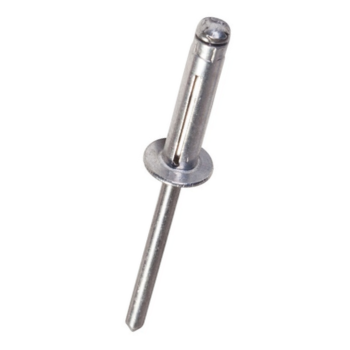
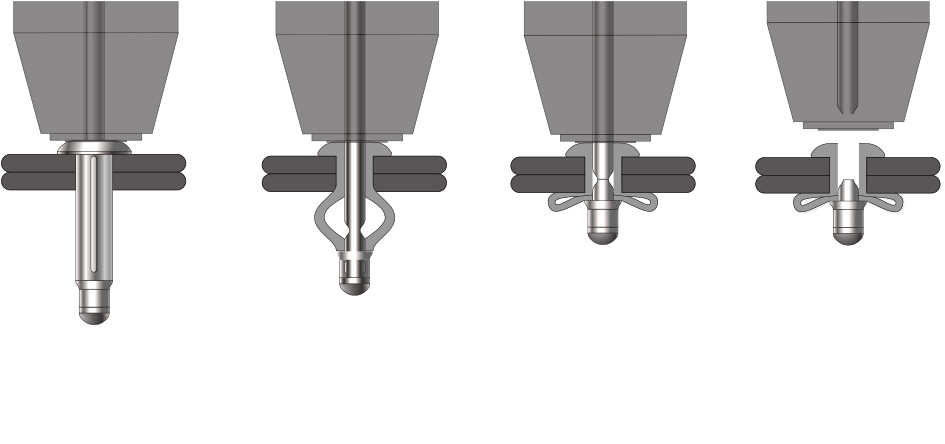
Tri-Fold Rivet is a specialized structural blind fastening solution designed for applications involving soft, brittle, or thin materials where conventional blind rivets may cause pull-through or surface damage. During installation, the rivet body splits into three folded legs on the blind side, creating a large bearing surface that distributes the clamping load over a wider area.
Tri-fold blind rivets are particularly suitable for fastening plastics, composites, fiberglass, insulation panels, automotive trim components, and other low-strength materials. Their unique expansion characteristics provide excellent pull-out resistance while minimizing material deformation.
Table of Contents
ITEM CODE: 4019
Standards
As per manufacturer’s standard.
Installation
Dimensions
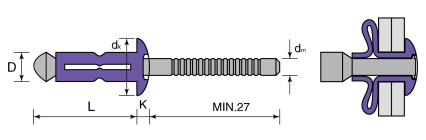
| d (nom) | 4 | 4.8 | 5.0 |
| dk (max) | 8.4 | 10.1 | 11 |
| dk (min) | 6.9 | 8.3 | 8.5 |
| k (max) | 1.7 | 2 | 2.3 |
| dm (max) | 2.45 | 2.95 | 3 |
| p (min) | 27 | 27 | 27 |
| Hole diameter | 4.2-4.4 | 5.1-5.3 | 5.3-5.5 |
all dimensions in mm
Mechanical Properties
Aluminium Body / Aluminium Mandrel
| d | 3.2 | 4 | 4.8 |
| Tensile Strength | 700 N | 1100 N | 1300 N |
| Shear Strength | 600 N | 800 N | 1000 N |
Material Characteristics and Recommended Applications
| Material Combination | Characteristics | Recommended Applications |
|---|---|---|
| Aluminium Body / Aluminium Mandrel | Corrosion resistant, lightweight | Plastic panels, composites, automotive trims |
Technical Specifications
| Property | Specification |
|---|---|
| Product Type | Trifold Blind Rivet |
| Head Style | Dome Head |
| Installation Method | Blind Installation |
| Expansion Type | Three-leg expanding body |
| Hole Preparation | Standard drilled hole |
| Grip Capability | Wide grip range |
| Blind Side Formation | Three folded legs |
| Vibration Resistance | Good |
| Pull-Out Resistance | Excellent |
| Suitable Materials | Soft and brittle materials |
| Watertight Capability | Limited (not a sealed rivet) |
| Installation Tool | Standard blind rivet tool |
| Removal Method | Drill out |
Applications
- Automotive interior trim panels
- Truck and bus body manufacturing
- Fiberglass component assembly
- Plastic panel fastening
- Composite panel installations
- HVAC ducting and insulation panels
- Caravan and recreational vehicle manufacturing
- Marine panel assembly
- Electrical enclosures
- Signage and display systems
- Furniture manufacturing
- Appliance assembly
Advantages
- Large blind-side bearing area reduces pull-through.
- Ideal for soft, brittle, and low-strength materials.
- Distributes clamping force evenly.
- Minimizes cracking and deformation of substrates.
- Provides excellent retention in oversized holes.
- Suitable for joining dissimilar materials.
- Fast and easy one-side installation.
- Wide grip capability.
- Good vibration resistance.
- Eliminates the need for access to both sides of the assembly.
Frequently Asked Questions
What is a trifold blind rivet?
A trifold blind rivet is a specialized blind rivet that forms three folded legs on the blind side during installation, creating a large bearing area for fastening soft or brittle materials.
When should trifold rivets be used?
Trifold rivets should be used when fastening plastics, composites, fiberglass, insulation materials, or thin sheets where conventional blind rivets may pull through or damage the material.
Are trifold rivets structural rivets?
No. Trifold rivets provide superior pull-out resistance in soft materials but are generally not classified as structural blind rivets.
Are trifold rivets waterproof?
Standard trifold rivets are not fully watertight. For sealed applications, closed-end blind rivets or additional sealing methods are recommended.
Can trifold rivets be installed using standard rivet tools?
Yes. Most trifold blind rivets can be installed using standard hand, pneumatic, or battery-operated blind rivet tools.
What materials can be joined using trifold rivets?
Trifold rivets are commonly used to join plastics, fiberglass, composites, aluminum sheets, insulation panels, and other low-strength materials.
What is the main advantage of a trifold rivet compared to a standard blind rivet?
The primary advantage is the large blind-side bearing area, which significantly reduces the risk of pull-through and material damage.
Need Technical Assistance or a Quote?
Looking for pricing, samples, CAD drawings, or help selecting the right fastener? Our team can help you choose the correct product for your application.
📧 sales@horizonincindia.com | 📞 +91 80 4117 9152 | 💬 +91 99167 77262
Related Products
- Open End Blind Rivets
- Closed End Blind Rivets
- Multi-Grip Blind Rivets
- Monobolt Rivets
- Interlock Rivets
- High Strength Rivets
Technical Disclaimer
The technical information, specifications, dimensions, mechanical properties, drawings, and performance data provided on this website are intended for general reference and engineering guidance only. Values shown are representative of products manufactured under normal production conditions and may vary depending on material grade, manufacturing tolerances, installation method, application, and operating environment.
While Horizon Inc. makes every reasonable effort to ensure the accuracy of the information provided, we make no warranties, express or implied, regarding its completeness, accuracy, or suitability for any particular purpose. Customers are responsible for verifying that the selected product is appropriate for their specific application and operating conditions. Where safety, structural integrity, or regulatory compliance is critical, independent engineering evaluation and product testing should be performed.
Horizon Inc. reserves the right to modify product specifications, dimensions, materials, and technical data without prior notice.
To the fullest extent permitted by applicable law, Horizon Inc. shall not be liable for any direct, indirect, incidental, consequential, or special damages arising from the use of, or reliance upon, the information contained on this website.
Copyright
© 2026 Horizon Inc. All Rights Reserved.
All content, product data, specifications, technical drawings, images, and documents published on this website are the property of Horizon Inc. and may not be reproduced, distributed, modified, or transmitted without prior written permission.