ISO Metric Thread System
The ISO Metric Thread System is the world’s most widely used screw thread standard for bolts, screws, nuts, studs, and threaded fasteners. Developed by the International Organization for Standardization, the ISO metric thread system provides a standardized method of defining thread dimensions, tolerances, and fit classes, ensuring interchangeability between fasteners manufactured worldwide.
This guide explains the nomenclature, dimensions, thread pitch series, tolerance classes, and practical applications of ISO metric threads used in engineering, manufacturing, construction, automotive, aerospace, and industrial fastening systems.
Table of Contents
1. What is the ISO Metric Thread System?
The ISO metric thread system uses the metric unit system (millimeters) to define the dimensions of screw threads. The thread profile is based on a symmetrical 60° V-thread form, standardized under:
- ISO 68-1 — Basic thread profile
- ISO 261 — General plan for metric screw threads
- ISO 262 — Selected thread sizes and pitches
- ISO 965 — Tolerance system for metric threads
The designation begins with the letter “M”, followed by the nominal diameter and pitch.
Examples:
| Thread Designation | Meaning |
|---|---|
| M6 | 6 mm diameter, standard coarse pitch |
| M8 × 1.25 | 8 mm diameter, 1.25 mm pitch |
| M10 × 1.0 | 10 mm diameter, fine pitch |
| M20 × 2.5 | 20 mm diameter, coarse pitch |
2. Basic ISO Metric Thread Profile
The ISO metric thread profile consists of:
| Parameter | Symbol | Description |
|---|---|---|
| Major Diameter | D / d | Outside diameter of thread |
| Pitch Diameter | D2 / d2 | Effective diameter |
| Minor Diameter | D1 / d1 | Root diameter |
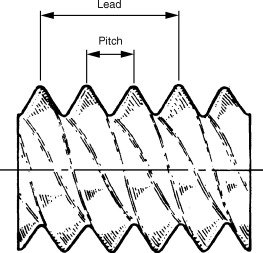
| Pitch | P | Distance between adjacent threads |
| Flank Angle | α | 60° included angle |
| Lead | L | Distance advanced in one revolution |
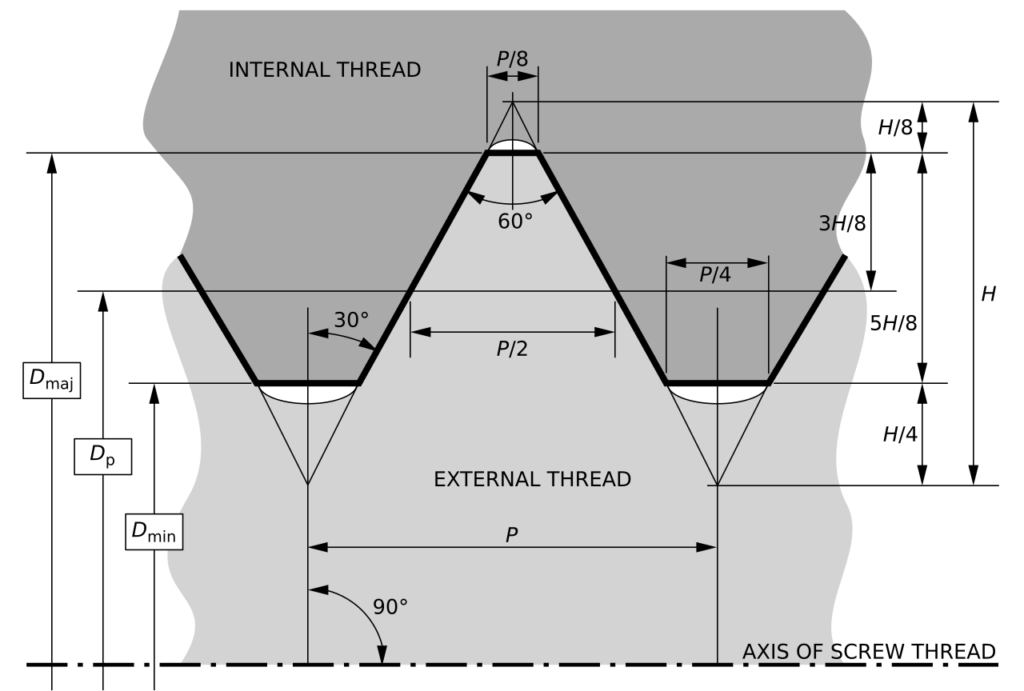
The basic profile angle for all ISO metric threads is 60°.
3. Understanding Metric Thread Designation
Example: M12 × 1.75 – 6g
| Element | Meaning |
|---|---|
| M | Metric thread |
| 12 | Nominal diameter (mm) |
| 1.75 | Thread pitch (mm) |
| 6g | External thread tolerance class |
For internal threads:
M12 × 1.75 – 6H
where:
- 6 = tolerance grade
- H = internal thread tolerance position
4. Coarse and Fine Thread Series
ISO metric threads are divided into two main categories:
Coarse Threads
These are the standard threads used in general engineering.
| Thread | Pitch |
|---|---|
| M3 | 0.5 mm |
| M4 | 0.7 mm |
| M5 | 0.8 mm |
| M6 | 1.0 mm |
| M8 | 1.25 mm |
| M10 | 1.5 mm |
| M12 | 1.75 mm |
| M16 | 2.0 mm |
| M20 | 2.5 mm |
Fine Threads
Used for superior strength in tension and shear, resist loosening from high vibrations
| Thread | Fine Pitch Options |
|---|---|
| M3 | 0.35 mm |
| M4 | 0.5 mm |
| M5 | 0.5 mm |
| M6 | 0.75 mm |
| M8 | 1.0 mm |
| M10 | 1.25, 1.0 mm |
| M12 | 1.5, 1.25 mm |
| M16 | 1.5 mm |
| M20 | 2.0, 1.5 mm |
5. ISO Thread Tolerance Classes
Thread tolerances ensure proper assembly between mating parts.
| External Thread | Internal Thread | Typical Fit |
|---|---|---|
| 6g | 6H | General engineering |
| 4h | 5H | Precision fit |
| 8g | 7H | Loose fit |
| 6e | 6H | Corrosion-resistant coatings |
The most common industrial combination worldwide is:
6g / 6H
This fit provides good interchangeability and ease of assembly.
6. ISO Metric Thread Series Table
| Diameter | Coarse Pitch | Fine Pitch |
|---|---|---|
| M3 | 0.5 | 0.35 |
| M4 | 0.7 | 0.5 |
| M5 | 0.8 | 0.5 |
| M6 | 1.0 | 0.75 |
| M8 | 1.25 | 1.0 |
| M10 | 1.5 | 1.25, 1.0 |
| M12 | 1.75 | 1.5, 1.25 |
| M16 | 2.0 | 1.5 |
| M20 | 2.5 | 2.0, 1.5 |
| M24 | 3.0 | 2.0 |
7. Advantages of ISO Metric Threads
- Global standardization and interchangeability
- Simplified manufacturing and inspection
- Wide availability of fasteners and tooling
- Compatible with automated assembly systems
- Standardized tolerances and fit classes
- Suitable for nearly all engineering industries
- Supports both coarse and fine thread applications
8. Applications of ISO Metric Threads
ISO metric threads are extensively used in:
- Industrial machinery
- Sheet metal fabrication
- Electrical panels and enclosures
- Automotive manufacturing
- Aerospace components
- Railway equipment
- Construction fasteners
- Renewable energy systems
- Medical equipment
- Telecommunications equipment
- Data centers and IT infrastructure
9. Comparison: Metric vs Imperial Threads
| Parameter | ISO Metric | UNC/UNF |
|---|---|---|
| Unit | Millimeters | Inches |
| Thread Angle | 60° | 60° |
| Designation | M10 × 1.5 | 3/8″-16 UNC |
| Pitch Measurement | mm/thread | Threads per inch |
| Standard | ISO | ASME/ANSI |
| Global Usage | Worldwide | Primarily USA |
10. Frequently Asked Questions
What does M10 × 1.5 mean?
It indicates a metric thread with a nominal diameter of 10 mm and a thread pitch of 1.5 mm.
What is the difference between coarse and fine metric threads?
Coarse threads are used for general applications, while fine threads provide greater tensile area, better adjustment capability, and improved vibration resistance.
What is the most common metric thread tolerance?
The most widely used tolerance combination is 6g for external threads and 6H for internal threads.
Are ISO metric threads interchangeable worldwide?
Yes. ISO metric threads are internationally standardized and are used throughout most countries.
What is the thread angle of ISO metric threads?
ISO metric threads use a symmetrical 60-degree thread profile.