Weld Stud ISO 13918 PT Technical Datasheet
ISO 13918 PT Weld Studs for Permanent Threaded Fastening
ISO 13918 PT Capacitor Discharge (CD) Weld Studs are externally threaded studs designed for permanent attachment to metallic substrates using the capacitor discharge stud welding process. Unlike drawn arc welding, CD welding delivers a short-duration, high-current electrical discharge, producing a clean, low-heat weld with minimal reverse-side marking and distortion.
These weld studs are ideal for fastening components to thin sheet metal where appearance, dimensional accuracy, and production speed are critical. They are extensively used in electrical enclosures, HVAC equipment, commercial appliances, sheet metal fabrication, medical equipment, food processing machinery, and automotive assemblies.
Manufactured in accordance with ISO 13918, PT weld studs provide a reliable external threaded fixing point while maintaining the integrity of the parent material.
Table of Contents
ITEM CODE: 1042
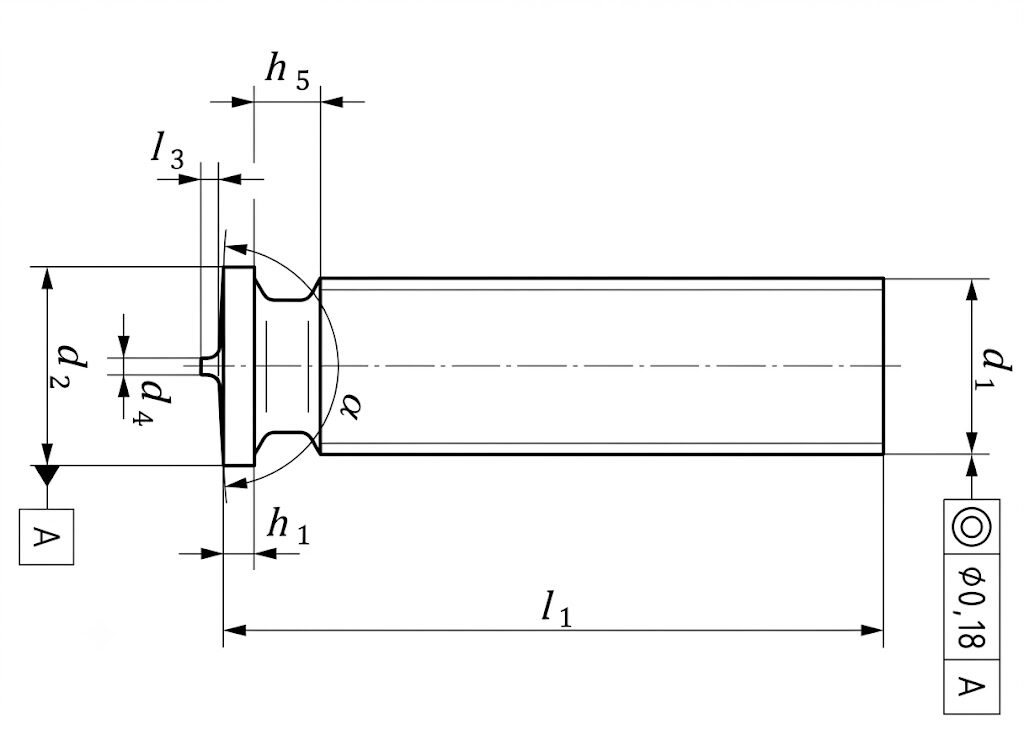
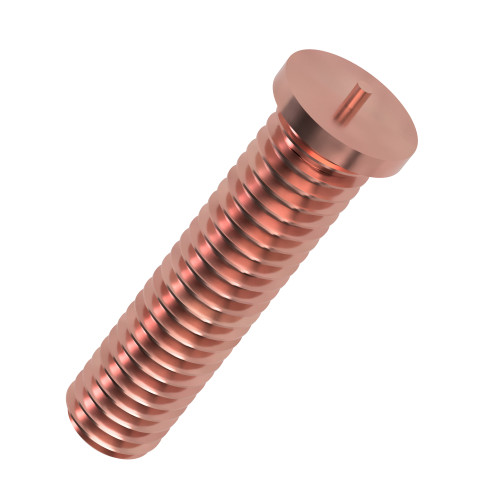
Standard
ISO 13918 PT
Dimensions
| d1 | d2 (±0.2) | d4 (±0.08) | l3 (±0.05) | max. h5 | h1 | α (±2°) |
| M3 | 4.5 | 0.6 | 0.55 | 0.6 | 0.7 to 1.4 | 174° |
| M4 | 5.5 | 0.65 | 0.55 | 0.6 | 0.7 to 1.4 | 174° |
| M5 | 6.5 | 0.75 | 0.8 | 1 | 0.7 to 1.4 | 174° |
| M6 | 7.5 | 0.75 | 0.8 | 1 | 0.7 to 1.4 | 174° |
| M8 | 9 | 0.75 | 0.85 | 1.5 | 0.8 to 1.4 | 174° |
all dimensions in mm
Dimensions Tolerances:
General dimensional tolerances for standard metric fasteners—including thread diameter, overall length, head diameter, head height/thickness, across flats, and washer dimensions—are available in our Standard Dimensional Tolerances for Common Metric Fasteners guide.
Certain product-specific features, such as drive recess dimensions, socket depth, countersink geometry, under-head radii, and other special characteristics, are governed by the applicable DIN or ISO product standard and may not included in this datasheet.
Download Technical Datasheets
| Material | Download |
|---|---|
| Steel with Copper Coating | ⬇️ Download Datasheet |
| Stainless Steel – A2-70 | ⬇️ Download Datasheet |
Material Characteristics and Recommended Applications
| Material | Characteristics | Typical Applications |
|---|---|---|
| Low Carbon Steel | Economical, high strength | Electrical cabinets, sheet metal fabrication |
| Stainless Steel A2 (304) | Excellent corrosion resistance | Food processing, commercial kitchens, architectural applications |
| Stainless Steel A4 (316) | Superior corrosion resistance | Marine, offshore, chemical processing |
Technical Specifications
| Property | Specification |
|---|---|
| Product Type | Capacitor Discharge Weld Stud |
| Standard | ISO 13918 PT |
| Welding Process | Capacitor Discharge (CD) Stud Welding |
| Thread Type | Metric External Thread |
| Thread Direction | Right-Hand |
| Installation | One-sided welding |
| Base Material | Steel, Stainless Steel |
| Surface Finish | Zinc or Copper plated for steel, self for stainless steel |
| Typical Thread Sizes | M3 to M10 |
| Stud Form | External Thread |
| Weld End | Capacitor Discharge Tip |
| Corrosion Resistance | Depends on material selection |
Applications
ISO 13918 PT CD Weld Studs are widely used in:
- Electrical Control Panels
- Switchgear
- Telecom Cabinets
- Data Centre Enclosures
- HVAC Equipment
- Medical Equipment
- Food Processing Machinery
- Commercial Refrigeration
- Sheet Metal Enclosures
- Commercial Kitchen Equipment
- Industrial Machinery
- Railway Interiors
- Automotive Components
- Battery Enclosures
- Electronics Manufacturing
Advantages
- Designed for capacitor discharge stud welding
- Minimal heat input
- Very low reverse-side marking
- Suitable for thin sheet metal
- Fast welding cycle
- No drilled holes required
- Permanent attachment
- Excellent dimensional consistency
- High production efficiency
- Suitable for automated manufacturing
- Reduced distortion compared to conventional welding
- Clean cosmetic finish
- High vibration resistance
- One-sided installation
Installation Best Practices
Do
- Ensure the workpiece surface is clean and free from oil, rust, paint, and coatings.
- Select the correct capacitor discharge welding settings for the stud diameter and material.
- Maintain proper grounding throughout the welding process.
- Verify stud alignment before welding.
- Perform regular weld quality inspections.
Don’t
- Weld through painted or contaminated surfaces.
- Use damaged studs.
- Exceed the recommended sheet thickness limits for CD welding.
- Reuse contaminated chuck components.
- Operate with incorrect capacitor charge settings.
Common Installation Problems & Solutions
| Problem | Possible Cause | Recommended Solution |
|---|---|---|
| Weak weld | Insufficient discharge energy | Increase capacitor charge |
| Stud leaning | Poor gun alignment | Hold welding gun perpendicular |
| Incomplete fusion | Dirty work surface | Clean the base material thoroughly |
| Excessive indentation | Excessive welding energy | Reduce capacitor charge |
| Stud detachment | Poor grounding | Improve grounding connection |
Why Choose Capacitor Discharge Weld Studs?
Compared with conventional arc weld studs, capacitor discharge weld studs offer:
- Lower heat input
- Faster welding cycle
- Better cosmetic finish
- Minimal discoloration
- Reduced distortion
- Excellent for thin gauge sheet metal
- Suitable for visible architectural applications
- Minimal reverse-side witness marks
Frequently Asked Questions
What is an ISO 13918 PT weld stud?
It is an externally threaded weld stud manufactured in accordance with ISO 13918 and designed for permanent attachment using the capacitor discharge stud welding process.
What is the difference between CD welding and arc stud welding?
Capacitor discharge (CD) welding uses a very short, high-current electrical discharge with low heat input, making it ideal for thin sheet metal and cosmetic applications. Drawn arc stud welding uses a longer welding cycle and is generally preferred for larger diameter studs and thicker base materials.
Can PT weld studs be used on stainless steel?
Yes. Stainless steel PT weld studs are available in A2 (304) and A4 (316) grades, provided compatible welding equipment and procedures are used.
What materials can be welded using CD studs?
Depending on the welding equipment and stud material, CD weld studs can be installed on carbon steel, stainless steel, and certain aluminium alloys.
Are custom thread sizes available?
Yes. Special thread diameters, lengths, and materials can be manufactured subject to minimum order quantities.
What is the typical size range?
Standard metric sizes generally range from M3 to M10, with larger diameters available for specific applications and welding systems.
Need Technical Assistance or a Quote?
Looking for pricing, samples, CAD drawings, or help selecting the right fastener? Our team can help you choose the correct product for your application.
📧 sales@horizonincindia.com | 📞 +91 80 4117 9152 | 💬 +91 99167 77262
Related Products
- ISO 13918 IT Internal Thread CD Weld Stud
- ISO 13918 RD Capacitor Discharge Weld Stud
- ISO 13918 UD Capacitor Discharge Weld Stud
- Shear Connector Studs
Technical Disclaimer
The technical information, specifications, dimensions, mechanical properties, drawings, and performance data provided on this website are intended for general reference and engineering guidance only. Values shown are representative of products manufactured under normal production conditions and may vary depending on material grade, manufacturing tolerances, installation method, application, and operating environment.
While Horizon Inc. makes every reasonable effort to ensure the accuracy of the information provided, we make no warranties, express or implied, regarding its completeness, accuracy, or suitability for any particular purpose. Customers are responsible for verifying that the selected product is appropriate for their specific application and operating conditions. Where safety, structural integrity, or regulatory compliance is critical, independent engineering evaluation and product testing should be performed.
Horizon Inc. reserves the right to modify product specifications, dimensions, materials, and technical data without prior notice.
To the fullest extent permitted by applicable law, Horizon Inc. shall not be liable for any direct, indirect, incidental, consequential, or special damages arising from the use of, or reliance upon, the information contained on this website.
Copyright
© 2026 Horizon Inc. All Rights Reserved.
All content, product data, specifications, technical drawings, images, and documents published on this website are the property of Horizon Inc. and may not be reproduced, distributed, modified, or transmitted without prior written permission.