
Blind Rivet – Closed End Countersunk Head (CSK) Technical Datasheet
Product Overview
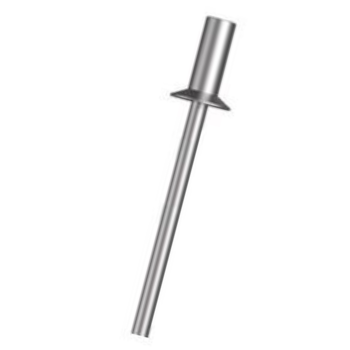
Closed End Countersunk Head Blind Rivets, also known as sealed CSK blind rivets, are one-sided installation permanent fasteners designed to provide a flush surface finish while creating a moisture and dust-resistant joint. The closed-end body design prevents the passage of liquids and gases through the rivet, making them suitable for applications requiring sealing and corrosion resistance. These rivets are widely used in electrical enclosures, control panels, HVAC equipment, automotive components, telecommunications cabinets, and sheet metal fabrication industries.
ITEM CODE: 4014
Standards
| Aluminium / Steel | ISO 15974 |
| Steel / Steel | Conforming to ISO 15976 |
| St Steel / St Steel | Conforming to ISO 16585 |
| Aluminium / Aluminium | Conforming to ISO 15975 |
Dimensions
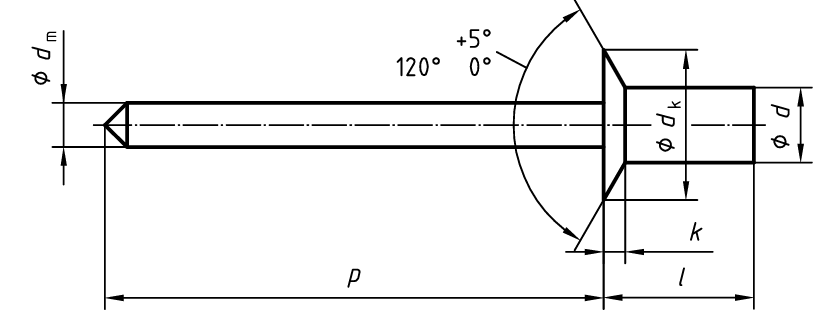
| d (nom) | 3.2 | 4 | 4.8 |
| d (max) | 3.28 | 4.08 | 4.88 |
| d (min) | 3.05 | 3.85 | 4.65 |
| dk (max) | 6.7 | 8.4 | 10.1 |
| dk (min) | 5.8 | 6.9 | 8.3 |
| k | 1.3 | 1.7 | 2 |
| dm (max) | 2 | 2.45 | 2.95 |
| p (min) | 25 | 27 | 27 |
| b | lmax + 4 | lmax + 4 | lmax + 4.5 |
| Hole diameter | 3.3-3.4 | 4.1-4.2 | 4.9-5 |
all dimensions in mm
Mechanical Properties
Aluminium Body / Steel Mandrel – ISO 15974
| d | 3.2 | 4 | 4.8 |
| Tensile Strength (N) | 1450 | 2200 | 3100 |
| Shear Strength (N) | 1100 | 1600 | 2200 |
| Mandel Break Load (N) | 3500 | 5000 | 7000 |
Steel Body / Steel Mandrel – Conforming to ISO 15976
| d | 3.2 | 4 | 4.8 |
| Tensile Strength (N) | 1300 | 1550 | 2800 |
| Shear Strength (N) | 1150 | 1700 | 2400 |
| Mandel Break Load (N) | 4000 | 5700 | 7500 |
Stainless Steel Body / Stainless Steel Mandrel
Conforming to ISO 16585
| d | 3.2 | 4 | 4.8 |
| Tensile Strength (N) | 2200 | 3500 | 4400 |
| Shear Strength (N) | 2000 | 3000 | 4000 |
| Mandel Break Load (N) | 4500 | 6500 | 8500 |
Aluminium Body / Aluminium Mandrel
Conforming to ISO 15975
| d | 3.2 | 4 | 4.8 |
| Tensile Strength (N) | 540 | 760 | 1400 |
| Shear Strength (N) | 460 | 720 | 1000 |
| Mandel Break Load (N) | 1780 | 2670 | 3560 |
Material Characteristics and Recommended Applications
Closed End CSK Head Blind Rivets are available in several material combinations to meet different strength, corrosion resistance, and application requirements.
| Material Combination | Characteristics | Recommended Applications |
|---|---|---|
| Aluminium Body / Steel Mandrel | Lightweight, economical, general-purpose | Sheet metal fabrication, electrical panels, HVAC equipment |
| Steel Body / Steel Mandrel | High strength and durability | Heavy-duty fabrication, machinery, industrial equipment |
| Stainless Steel Body / Stainless Steel Mandrel | Excellent corrosion resistance | Marine, food processing, pharmaceutical, outdoor applications |
| Aluminium Body / Aluminium Mandrel | Lightweight with good corrosion resistance | Aluminium fabrications, signage, lightweight assemblies |
Technical Specifications
| Parameter | Specification |
|---|---|
| Product Type | Closed End Blind Rivet |
| Head Style | Countersunk Head (CSK) |
| Installation | One-side access |
| Body Construction | Closed/Sealed End |
| Surface Finish | Plain / Zinc / Passivated |
| Installation Tool | Blind Rivet Tool |
| Joint Type | Permanent Mechanical Fastening |
| Hole Type | Through Hole |
| Sealing Capability | Excellent |
| Vibration Resistance | Good |
| Corrosion Resistance | Material Dependent |
| Head Angle | Typically 120° |
Applications
Closed End CSK Head Blind Rivets are commonly used in:
- Electrical control panels
- Sheet metal enclosures
- Telecommunication cabinets
- HVAC systems
- Automotive components
- Railway equipment
- Medical equipment
- Solar mounting systems
- Outdoor signage
- Industrial machinery
- Electronic housings
- Appliance manufacturing
Advantages
- Provides a flush surface finish after installation.
- Closed-end design offers excellent sealing performance.
- Prevents ingress of water, dust, oil, and contaminants.
- Suitable for blind-side installation.
- High vibration resistance.
- Permanent and tamper-resistant fastening.
- Available in multiple material combinations.
- Suitable for thin sheet assemblies.
- Excellent aesthetic appearance.
- Reduced risk of galvanic corrosion when properly matched.
- Applications
Related Products
Frequently Asked Questions
What is a Closed End Blind Rivet?
A Closed End Blind Rivet is a sealed blind rivet with a fully enclosed body that prevents the passage of liquids, dust and air through the rivet after installation.
What is the difference between Open End and Closed End Blind Rivets?
Open End Blind Rivets have an open body allowing the mandrel to pass through, whereas Closed End Blind Rivets have a sealed body that provides leak-resistant fastening.
Are Closed End Blind Rivets waterproof?
Yes. When installed correctly, they provide an excellent seal against water and moisture, making them suitable for outdoor and weather-exposed applications.
Can they be used outdoors?
Yes. Stainless steel and aluminium variants offer excellent corrosion resistance for outdoor applications.
Which industries commonly use Closed End Blind Rivets?
They are widely used in electrical enclosures, HVAC systems, automotive manufacturing, transportation, marine equipment, appliances, telecommunications, and general sheet metal fabrication.
Can Closed End Blind Rivets be removed?
Yes. Like most blind rivets, they are removed by drilling through the rivet body using an appropriately sized drill bit.
What tools are required for installation?
Closed End Blind Rivets can be installed using manual hand riveters, pneumatic rivet guns, battery-operated rivet tools, or hydraulic rivet installation equipment.
Why use a countersunk head blind rivet?
Countersunk head blind rivets provide a flush finish, making them suitable where protruding heads are undesirable.
Technical Disclaimer
The technical information, specifications, dimensions, mechanical properties, drawings, and performance data provided on this website are intended for general reference and engineering guidance only. Values shown are representative of products manufactured under normal production conditions and may vary depending on material grade, manufacturing tolerances, installation method, application, and operating environment.
While Horizon Inc. makes every reasonable effort to ensure the accuracy of the information provided, we make no warranties, express or implied, regarding its completeness, accuracy, or suitability for any particular purpose. Customers are responsible for verifying that the selected product is appropriate for their specific application and operating conditions. Where safety, structural integrity, or regulatory compliance is critical, independent engineering evaluation and product testing should be performed.
Horizon Inc. reserves the right to modify product specifications, dimensions, materials, and technical data without prior notice.
To the fullest extent permitted by applicable law, Horizon Inc. shall not be liable for any direct, indirect, incidental, consequential, or special damages arising from the use of, or reliance upon, the information contained on this website.
Copyright
© 2026 Horizon Inc. All Rights Reserved.
All content, product data, specifications, technical drawings, images, and documents published on this website are the property of Horizon Inc. and may not be reproduced, distributed, modified, or transmitted without prior written permission.