Self Clinching Nut Technical Datasheet
Product Overview
Self clinching nuts are permanently installed threaded fasteners designed to provide strong, reusable internal threads in thin sheet metal. Installed by applying a squeezing force, the knurled clinching ring displaces the surrounding sheet material, creating a high-strength mechanical interlock without welding or secondary fastening operations.
Self clinching nuts are widely used in electrical panels, telecommunications equipment, server racks, automotive components, industrial enclosures, appliances, and sheet metal fabrications where reliable threads are required in thin materials. They are manufactured in accordance with internationally recognized standards and are available in steel, stainless steel, and aluminum materials with metric and imperial thread sizes.
Table of Contents
ITEM CODE: 5011

Standards
Primary Standard: PEM® Type S, CLS equivalent
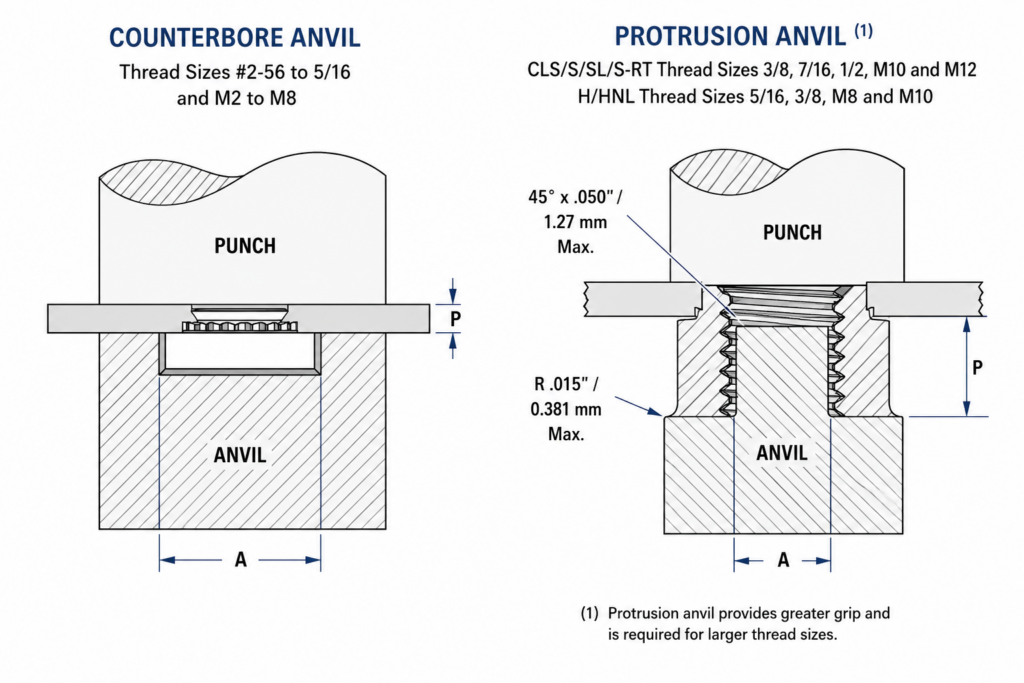
Installation
- Prepare properly sized mounting hole in sheet.
- Do not perform any secondary operations such as deburring.
- Place the fastener into the anvil hole and place the mounting hole (preferably punch side) over the shank of the fastener.
- With the installation punch and anvil surfaces parallel, apply squeezing force until the head of the nut comes into contact with the sheet material.
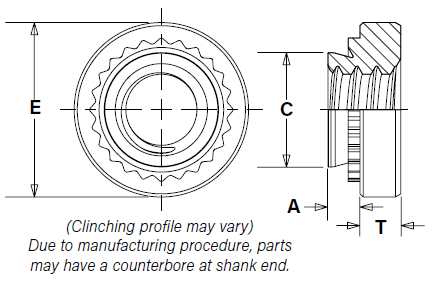
Dimensions
| Size | Shank Code | A (Shank) Max. | Min Sheet Thickness | Hole Size In Sheet +0.08 | C Max. | E ±0.25 | T ±0.25 | Min. Dist. HoleTo Edge |
|---|---|---|---|---|---|---|---|---|
| M2x 0.4 | 0 | 0.77 | 0.8 | 4.22 | 4.2 | 6.35 | 1.5 | 4.8 |
| 1 | 0.97 | 1 | ||||||
| 2 | 1.38 | 1.4 | ||||||
| 3 | 2.21 | 2.29 | ||||||
| M2.5 x 0.45 | 0 | 0.77 | 0.8 | 4.22 | 4.2 | 6.35 | 1.5 | 4.8 |
| 1 | 0.97 | 1 | ||||||
| 2 | 1.38 | 1.4 | ||||||
| 3 | 2.21 | 2.29 | ||||||
| M3 x 0.5 | 0 | 0.77 | 0.8 | 4.22 | 4.2 | 6.35 | 1.5 | 4.8 |
| 1 | 0.97 | 1 | ||||||
| 2 | 1.38 | 1.4 | ||||||
| 3 | 2.21 | 2.29 | ||||||
| M3.5 x 0.6 | 0 | 0.77 | 0.8 | 4.75 | 4.73 | 7.11 | 1.5 | 5.6 |
| 1 | 0.97 | 1 | ||||||
| 2 | 1.38 | 1.4 | ||||||
| 3 | 2.21 | 2.29 | ||||||
| M4x0.7 | 0 | 0.77 | 0.8 | 5.41 | 5.38 | 7.87 | 2 | 6.9 |
| 1 | 0.97 | 1 | ||||||
| 2 | 1.38 | 1.4 | ||||||
| 3 | 2.21 | 2.29 | ||||||
| M5 x 0.8 | 0 | 0.77 | 0.8 | 6.35 | 6.33 | 8.64 | 2 | 7.1 |
| 1 | 0.97 | 1 | ||||||
| 2 | 1.38 | 1.4 | ||||||
| 3 | 2.21 | 2.29 | ||||||
| M6x1 | 0 | 1.15 | 1.2 | 8.75 | 8.73 | 11.18 | 4.08 | 8.6 |
| 1 | 1.38 | 1.4 | ||||||
| 2 | 2.21 | 2.29 | ||||||
| 3 | 3.05 | 3.18 | ||||||
| M8 x 1.25 | 1 | 1.38 | 1.4 | 10.5 | 10.47 | 12.7 | 5.47 | 9.7 |
| 2 | 2.21 | 2.29 | ||||||
| 3 | 3.05 | 3.2 | ||||||
| M10 x 1.5 | 1 | 2.21 | 2.29 | 14 | 13.97 | 17.35 | 7.48 | 13.5 |
| 2 | 3.05 | 3.18 | ||||||
| 3 | 6 | 6.4 | ||||||
| M12x1.75 | 1 | 3.05 | 3.18 | 17 | 16.95 | 20.57 | 8.5 | 16 |
| 2 | 6 | 6.4 |
all dimensions in mm
Download Datasheets
Self Clinching Nut – S – Steel Zn
Self Clinching Nut – CLS – Stainless Steel
Material Characteristics and Recommended Applications
Self clinching nuts are available in several material combinations to meet different strength, corrosion resistance, and application requirements.
| Material | Characteristics | Typical Applications |
|---|---|---|
| Carbon Steel, Zinc Plated | High strength, economical, corrosion protected | Electrical panels, industrial equipment |
| Stainless Steel 304 | Excellent corrosion resistance | Outdoor enclosures, food processing equipment |
| Stainless Steel 316 | Superior corrosion resistance | Marine and chemical industries |
| Aluminum Alloy | Lightweight and corrosion resistant | Electronics, aerospace, lightweight assemblies |
Technical Specifications
| Parameter | Specification |
|---|---|
| Product Type | Self Clinching Nut |
| Installation Method | Press-in / Clinching |
| Thread Standards | Metric (M), UNC, UNF |
| Thread Sizes | M2 to M12 (typical) |
| Material Options | Carbon Steel, Stainless Steel, Aluminum |
| Surface Finish | Zinc plated, Passivated, Plain |
| Sheet Material | Steel, Stainless Steel, Aluminum |
| Minimum Sheet Thickness | From 0.5 mm (depending on size) |
| Installation Equipment | Arbor Press, Pneumatic Press, Hydraulic Press |
| Operating Principle | Cold flow displacement of sheet material |
| Reusability | Permanent installation with reusable thread |
| Compliance | Manufacturer standards |
Self-Clinching Nut Installation – Best Practices
✅ Installation DOs
| Recommendation | Reason |
|---|---|
| Select the correct fastener material for the application and corrosion environment. | Prevents galvanic corrosion and ensures long service life. |
| Install only into sheet material in the recommended hardness condition. | The sheet must be softer than the fastener for proper clinching. |
| Use a sharp punch when producing mounting holes. | Minimizes work hardening around the hole. |
| Maintain the specified mounting hole diameter and tolerance. | Ensures correct clinching and maximum torque-out performance. |
| Install the fastener from the punched side of the sheet. | Provides proper material flow into the clinching ring. |
| Ensure the pilot (shank) is fully located in the hole before pressing. | Prevents misalignment and uneven installation. |
| Avoid installing adjacent to bends or heavily cold-worked areas. | Ensures sufficient material flow during clinching. |
| Apply installation force between parallel flat surfaces using a press. | Produces uniform seating without distortion. |
| Use recommended installation tooling such as arbor, pneumatic, or hydraulic presses. | Ensures consistent installation quality. |
| Apply sufficient force until the shoulder seats flush against the sheet. | Fully embeds the clinching ring for maximum holding strength. |
❌ Installation DON’Ts
| Avoid | Reason |
|---|---|
| Do not install standard steel or stainless steel clinching nuts into harder sheet materials than recommended. | The sheet material must deform—not the fastener. |
| Do not install steel or stainless steel fasteners into aluminum before anodizing or finishing. | Surface finishing may affect installation quality and corrosion performance. |
| Do not deburr mounting holes excessively. | Removing material reduces the clinching engagement. |
| Do not install too close to the sheet edge. | May cause sheet bulging or edge cracking. |
| Do not over-squeeze the fastener. | Excessive force can distort threads and buckle the sheet. |
| Do not install using hammer blows or impact methods. | Clinching requires controlled squeezing force, not impact. |
| Do not tighten screws from the non-load side during installation. | Load should always be directed toward the sheet after installation. |
| Do not install on painted or coated surfaces. | Coatings prevent proper metal flow and mechanical interlock. |
Applications
- Electrical control panels
- Sheet metal enclosures
- Server racks and cabinets
- Telecommunications equipment
- Data center infrastructure
- Medical equipment
- Automotive components
- Aerospace assemblies
- Industrial machinery
- Consumer appliances
- EV charging stations
- Railway and transportation equipment
Advantages
- Provides strong threads in thin sheet materials
- Eliminates welding operations
- Permanent installation
- High torque-out and push-out resistance
- Allows repeated assembly and disassembly
- Suitable for automated production
- Minimal backside protrusion
- Available in metric and imperial threads
- Compatible with steel, stainless steel, and aluminum sheets
- Reduces manufacturing cost and assembly time
Frequently Asked Questions
What is a self clinching nut?
A Closed End Blind Rivet is a sealed blind rivet with a fully enclosed body that prevents the passage of liquids, dust and air through the rivet after installation.
How does a self clinching nut work?
During installation, the surrounding sheet metal cold-flows into the clinching groove of the fastener, creating a permanent mechanical interlock.
What materials are self clinching nuts available in?
They are commonly available in carbon steel, stainless steel (304/316), and aluminum.
Can self clinching nuts be installed in stainless steel sheets?
Yes. However, the hardness of the self clinching nut must be greater than the hardness of the sheet material.
What is the minimum sheet thickness required?
Minimum sheet thickness varies by thread size and manufacturer, typically starting from 0.5 mm.
Are self clinching nuts stronger than rivet nuts?
For thin sheet metal applications, self clinching nuts generally provide higher torque resistance and require access to only one side during installation.
Can self clinching nuts be removed?
They are designed as permanent fasteners and are generally not intended for removal without damaging the host sheet.
What industries use self clinching nuts?
They are widely used in electrical enclosures, telecommunications, automotive, aerospace, industrial machinery, electronics, and sheet metal fabrication industries.
Need Technical Assistance or a Quote?
Looking for pricing, samples, CAD drawings, or help selecting the right fastener? Our team can help you choose the correct product for your application.
📧 sales@horizonincindia.com | 📞 +91 80 4117 9152 | 💬 +91 99167 77262
Related Products
- Self Clinching Studs
- Self Clinching Standoffs
- Self Clinching Nuts
- Self Clinching Blind Fasteners
- Captive Panel Screws
- Nut Inserts
- Weld Studs
Technical Disclaimer
The technical information, specifications, dimensions, mechanical properties, drawings, and performance data provided on this website are intended for general reference and engineering guidance only. Values shown are representative of products manufactured under normal production conditions and may vary depending on material grade, manufacturing tolerances, installation method, application, and operating environment.
While Horizon Inc. makes every reasonable effort to ensure the accuracy of the information provided, we make no warranties, express or implied, regarding its completeness, accuracy, or suitability for any particular purpose. Customers are responsible for verifying that the selected product is appropriate for their specific application and operating conditions. Where safety, structural integrity, or regulatory compliance is critical, independent engineering evaluation and product testing should be performed.
Horizon Inc. reserves the right to modify product specifications, dimensions, materials, and technical data without prior notice.
To the fullest extent permitted by applicable law, Horizon Inc. shall not be liable for any direct, indirect, incidental, consequential, or special damages arising from the use of, or reliance upon, the information contained on this website.
Copyright
© 2026 Horizon Inc. All Rights Reserved.
All content, product data, specifications, technical drawings, images, and documents published on this website are the property of Horizon Inc. and may not be reproduced, distributed, modified, or transmitted without prior written permission.