Shear Connector Stud ISO 13918 SD Technical Datasheet
Headed Shear Connectors for Composite Steel-Concrete Construction
ISO 13918 SD Shear Connector Studs are headed weld studs specifically designed to transfer longitudinal shear forces between structural steel members and reinforced concrete slabs. Installed using the drawn arc stud welding process, these studs create a permanent, high-strength mechanical connection that enables steel beams and concrete slabs to act as a single composite structural element.
Manufactured in accordance with ISO 13918, SD shear connector studs are widely used in composite floor systems, steel bridges, industrial buildings, power plants, metro rail projects, parking structures, and heavy infrastructure. Their robust design improves structural performance, enhances load distribution, and increases the overall stiffness and load-carrying capacity of composite structures.
Unlike conventional threaded weld studs, ISO 13918 SD studs feature a forged head that provides mechanical anchorage within the concrete, preventing pull-out and ensuring effective shear transfer throughout the service life of the structure.
Table of Contents
ITEM CODE: 1043
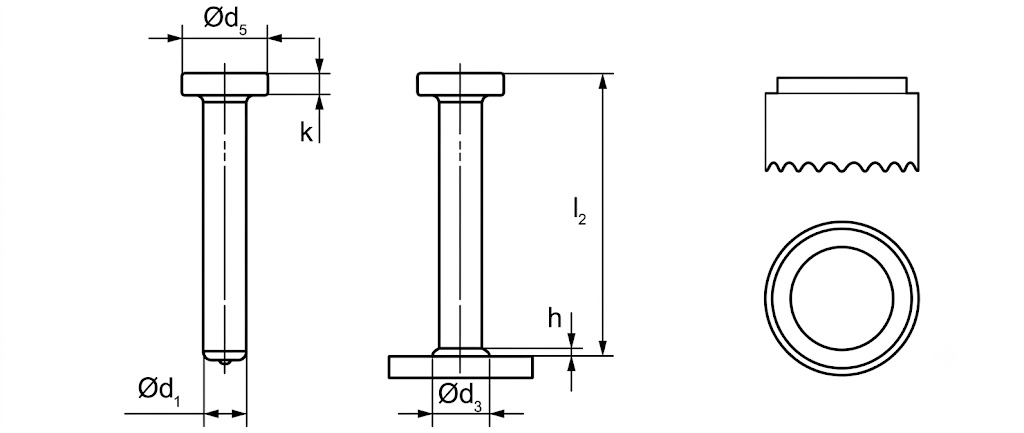

Standard
ISO 13918 SD
Dimensions
| d1 ± 0.4 | 9.5 / 10 | 12.7 / 13 | 16 | 19 | 22 | 25 / 25.4 |
| d5 ± 0.3 | 19 | 25 | 32 | 32 | 35 | 41 |
| k (+1, -0.5) | 7.1 | 8 | 8 | 10 | 10 | 12 |
| d3 | 13 | 17 | 21 | 29 | 29 | 31 |
| h | 2.5 | 3 | 4.5 | 6 | 6 | 7 |
| l1 ± 1.5 | l2 + 3 | l2 + 3 | l2 + 4 | l2 + 4.5 | l2 + 5 | l2 + 5.5 |
all dimensions in mm
Mechanical Properties
| Tensile Strength (Rm): | 450 N/mm² |
| Yield Strength (Re): | 350 N/mm² |
| Elongation (A5): | 15% |
Download Technical Datasheets
| Material | Download |
|---|---|
| Steel | ⬇️ Download Datasheet |
Material Characteristics and Recommended Applications
| Material | Characteristics | Typical Applications |
|---|---|---|
| Low Carbon Steel | High ductility and weldability | Composite floor systems, bridges |
| Structural Stud Welding Steel | Designed for stud welding | Buildings, industrial structures |
| Special Steel Grades | Higher strength or project-specific requirements | Infrastructure and heavy engineering |
Technical Specifications
| Property | Specification |
|---|---|
| Product Type | Headed Shear Connector Stud |
| Standard | ISO 13918 SD |
| Welding Process | Drawn Arc Stud Welding |
| Stud Configuration | Headed Shear Connector |
| Thread | None |
| Installation | One-sided Stud Welding |
| Base Material | Structural Steel |
| Surface Finish | Plain |
| Standard Diameters | Ø10–Ø25 mm |
| Standard Lengths | 60–200 mm |
| Weld End | Arc Welding Tip |
| Associated Standard | EN ISO 14555 |
Applications
ISO 13918 SD Shear Connector Studs are extensively used in:
Composite Steel Construction
- Composite Steel Beams
- Composite Floor Decking
- Steel-Framed Buildings
- High-Rise Buildings
- Industrial Buildings
Infrastructure
- Steel Bridges
- Railway Bridges
- Metro Rail Projects
- Flyovers
- Parking Structures
Industrial Projects
- Power Plants
- Petrochemical Plants
- Offshore Platforms
- Heavy Industrial Structures
- Warehouses
- Distribution Centres
Advantages
- Manufactured in accordance with ISO 13918
- Permanent structural connection
- Excellent shear load transfer
- Improves composite beam performance
- Eliminates mechanical drilling and bolting
- Fast installation using automated stud welding
- Excellent fatigue resistance
- High ductility
- Reliable weld quality
- Suitable for large-scale construction projects
- Reduces construction time
- Compatible with profiled steel decking
How Shear Connector Studs Work
Headed shear connector studs are welded directly onto structural steel beams before concrete is poured.
Once the concrete cures, the stud head becomes embedded within the slab, preventing relative movement between the concrete and the steel beam.
This composite action:
- Transfers longitudinal shear forces
- Prevents horizontal slip
- Increases structural stiffness
- Improves bending resistance
- Allows more efficient use of steel sections
- Enhances fatigue performance
Installation Best Practices
Do
- Ensure steel surfaces are clean and free from paint, rust, oil, and mill scale.
- Use approved stud welding equipment.
- Select the correct ceramic ferrule for the stud diameter.
- Verify welding current and welding time before production.
- Perform bend tests and visual inspections as specified by project requirements.
Don’t
- Weld on contaminated surfaces.
- Reuse ceramic ferrules.
- Use damaged studs.
- Ignore welding qualification procedures.
- Weld using incorrect grounding.
Common Installation Problems & Solutions
| Problem | Possible Cause | Recommended Solution |
|---|---|---|
| Weak weld | Low welding current | Increase current |
| Lack of fusion | Dirty steel surface | Clean base material |
| Excessive spatter | Incorrect welding parameters | Recalibrate equipment |
| Stud leaning | Improper gun positioning | Maintain perpendicular alignment |
| Weld cracks | Incorrect welding procedure | Verify welding settings and materials |
Why Use ISO 13918 SD Shear Connector Studs?
At first glance, a standard bolt, plain steel rod, or deformed reinforcing bar (TMT/Tor steel) may appear capable of performing the same function as a shear connector stud. However, ISO 13918 SD shear studs are specifically engineered for composite steel-concrete construction and cannot be directly substituted with conventional fasteners or reinforcement bars.
The primary function of a shear connector is to transfer longitudinal shear forces between a structural steel member and the concrete slab, enabling both materials to behave as a single composite structural element. This requires a combination of controlled weldability, mechanical anchorage, fatigue resistance, and predictable structural performance.
Comparison of Common Alternatives
| Feature | ISO 13918 SD Shear Stud | Hex Bolt | Plain Steel Rod | TMT / Deformed Rebar |
|---|---|---|---|---|
| Designed for stud welding | ✓ | ✗ | ✗ | ✗ |
| Headed mechanical anchorage | ✓ | Limited | ✗ | ✗ |
| Optimised for composite action | ✓ | ✗ | ✗ | ✗ |
| Recognised by structural design codes | ✓ | ✗ | ✗ | ✗ |
| Predictable load-slip performance | ✓ | ✗ | ✗ | ✗ |
| Excellent fatigue resistance | ✓ | Limited | Poor | Not intended for this application |
Why Not Use a Standard Bolt?
Conventional bolts are designed to clamp components together using preload. They are not manufactured for stud welding or for transferring repeated shear forces between steel and concrete.
Compared with ISO 13918 SD studs, standard bolts have:
- Threads that reduce the effective cross-sectional area.
- Stress concentration at the thread roots.
- Higher carbon content in many property classes, reducing weldability.
- No engineered weld tip for consistent stud welding.
- A head geometry that is not optimised for anchorage in concrete.
Why Not Use a Plain Steel Rod?
Although a plain steel rod can be welded to a steel beam, it lacks the forged head that provides positive mechanical anchorage within the concrete.
Without this anchorage, the connection relies mainly on bond and friction, which are insufficient for the repeated loading conditions encountered in composite structures.
Why Not Use TMT or Deformed Reinforcing Bars?
Deformed reinforcing bars (TMT/Tor steel) are designed to reinforce concrete, not to function as shear connectors.
While the ribs improve bond with concrete, they do not replace the mechanical anchorage provided by the forged head of an ISO 13918 SD stud.
In addition:
- TMT bars are not specifically manufactured for stud welding.
- Their metallurgical properties differ from stud welding steel.
- Welding may alter the heat-treated outer layer and reduce weld quality.
- They are not covered by composite construction design provisions as direct replacements for headed shear studs.
The Importance of the Forged Head
The forged head of an ISO 13918 SD stud is one of its most important design features. Once embedded in concrete, it provides a positive mechanical interlock that resists pull-out and efficiently transfers shear forces between the steel beam and the concrete slab.
This allows:
- Reliable shear force transfer.
- Reduced relative movement between steel and concrete.
- Improved structural stiffness.
- Higher load-carrying capacity.
- Long-term fatigue performance under cyclic loading.
Designed for Composite Construction
ISO 13918 SD shear connector studs are manufactured from low-carbon stud welding steel with controlled chemical composition and dimensional tolerances. Combined with the precision weld tip, this ensures consistent weld quality and dependable structural performance when installed in accordance with EN ISO 14555.
For this reason, headed shear connector studs manufactured to ISO 13918 remain the preferred and internationally recognised solution for composite steel-concrete construction, offering predictable performance that cannot be achieved by simply welding conventional bolts, steel rods, or reinforcing bars to a structural beam.
Frequently Asked Questions
What is an ISO 13918 SD shear connector stud?
It is a headed weld stud designed to transfer shear forces between structural steel beams and reinforced concrete slabs, enabling composite construction.
How are shear connector studs installed?
They are installed using the drawn arc stud welding process in accordance with EN ISO 14555, typically before the concrete slab is poured.
Why do shear studs have a head?
The forged head anchors the stud within the concrete, preventing pull-out and ensuring effective shear force transfer between the steel and concrete.
What are the common diameters?
The most common sizes are Ø13, Ø16, Ø19, Ø22, and Ø25 mm, with other sizes available depending on project requirements.
Can shear studs be welded through profiled decking?
Yes. They are commonly welded through profiled steel decking directly onto structural steel beams using suitable stud welding equipment and ceramic ferrules.
Are ISO 13918 SD studs reusable?
No. Once welded into place and embedded in concrete, shear connector studs become a permanent part of the structure.
Need Technical Assistance or a Quote?
Looking for pricing, samples, CAD drawings, or help selecting the right fastener? Our team can help you choose the correct product for your application.
📧 sales@horizonincindia.com | 📞 +91 80 4117 9152 | 💬 +91 99167 77262
Related Products
- ISO 13918 PT Internal Thread CD Weld Stud
- ISO 13918 IT Internal Thread Weld Stud
- ISO 13918 UD Capacitor Discharge Weld Stud
- ISO 13918 RD Capacitor Discharge Weld Stud
Technical Disclaimer
The technical information, specifications, dimensions, mechanical properties, drawings, and performance data provided on this website are intended for general reference and engineering guidance only. Values shown are representative of products manufactured under normal production conditions and may vary depending on material grade, manufacturing tolerances, installation method, application, and operating environment.
While Horizon Inc. makes every reasonable effort to ensure the accuracy of the information provided, we make no warranties, express or implied, regarding its completeness, accuracy, or suitability for any particular purpose. Customers are responsible for verifying that the selected product is appropriate for their specific application and operating conditions. Where safety, structural integrity, or regulatory compliance is critical, independent engineering evaluation and product testing should be performed.
Horizon Inc. reserves the right to modify product specifications, dimensions, materials, and technical data without prior notice.
To the fullest extent permitted by applicable law, Horizon Inc. shall not be liable for any direct, indirect, incidental, consequential, or special damages arising from the use of, or reliance upon, the information contained on this website.
Copyright
© 2026 Horizon Inc. All Rights Reserved.
All content, product data, specifications, technical drawings, images, and documents published on this website are the property of Horizon Inc. and may not be reproduced, distributed, modified, or transmitted without prior written permission.