Fastener Surface Finishes Explained – Types, Corrosion Resistance, Standards & Applications
Introduction
Fasteners are rarely supplied without a protective surface finish. Surface treatments improve corrosion resistance, wear resistance, appearance, lubrication, and service life while helping fasteners meet the environmental requirements of different industries.
Selecting the correct coating depends on factors such as the operating environment, required corrosion resistance, installation torque, electrical conductivity, temperature, and compliance requirements like RoHS or REACH.
From economical zinc electroplating used in indoor applications to high-performance zinc flake coatings for automotive and offshore industries, every finish has its own advantages and limitations.
This guide explains the most common fastener surface finishes, how they are applied, their corrosion performance, relevant international standards, and the applications where each finish is most suitable.
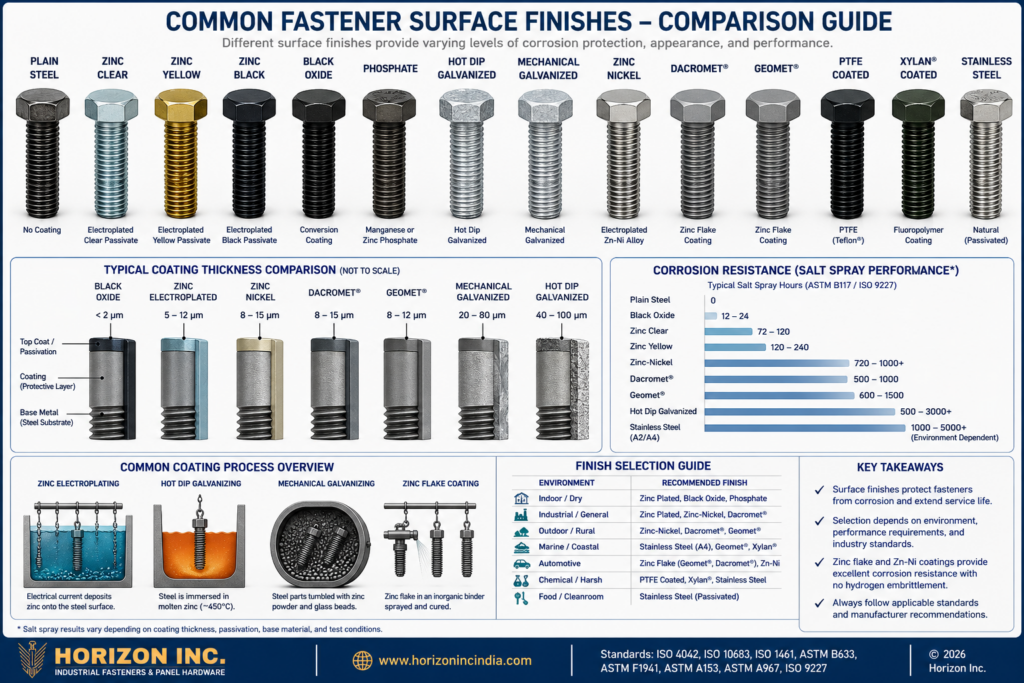
Surface Finish Comparison Table
| Finish | Appearance | Corrosion Resistance | Thickness | RoHS | Typical Industries |
|---|---|---|---|---|---|
| Plain Steel | Grey | Very Low | None | Yes | Indoor machinery |
| Zinc Plated Clear | Silver | Medium | 5–12 μm | Yes | General engineering |
| Zinc Yellow | Yellow/Gold | Medium | 5–12 μm | Modern versions Yes | Industrial equipment |
| Zinc Black | Black | Medium | 5–12 μm | Yes | Electronics |
| Black Oxide | Matte Black | Low | <2 μm | Yes | Tooling |
| Phosphate | Dark Grey | Low | 2–15 μm | Yes | Automotive |
| Hot Dip Galvanized | Dull Grey | Excellent | 40–100 μm | Yes | Structures |
| Mechanical Galvanized | Grey | High | 20–80 μm | Yes | High-strength bolts |
| Zinc-Nickel | Silver | Very High | 8–15 μm | Yes | Automotive |
| Dacromet | Silver Grey | Excellent | 8–15 μm | Yes | Wind & Automotive |
| Geomet | Grey | Excellent | 8–12 μm | Yes | Automotive |
| PTFE | Various | Excellent | Variable | Yes | Chemical industry |
| Xylan | Black/Green | Excellent | Variable | Yes | Offshore |
| Stainless Steel | Metallic | Excellent | None | Yes | Marine |
Corrosion Resistance Comparison
| Finish | Typical Salt Spray (Hours)* |
|---|---|
| Plain Steel | 0 |
| Black Oxide | 12–24 |
| Zinc Clear | 72–120 |
| Zinc Yellow | 120–240 |
| Zinc-Nickel | 720–1000+ |
| Dacromet | 500–1000 |
| Geomet | 600–1500 |
| Hot Dip Galvanized | 500–3000+ |
| Stainless Steel | Environment dependent |
*Values vary by coating thickness, passivation system, and test method (e.g., ASTM B117 or ISO 9227).
Surface Finish Selection Guide
| Environment | Recommended Finish |
|---|---|
| Indoor Office | Zinc Plated |
| Industrial Factory | Zinc-Nickel |
| Outdoor Equipment | Hot Dip Galvanized |
| Marine | A4 Stainless / Geomet |
| Automotive | Zinc Flake |
| Chemical Plant | PTFE |
| Food Industry | Stainless Steel |
| Electrical Panels | Zinc Plated |
| Solar Structures | Hot Dip Galvanized |
| Wind Turbines | Geomet |
Relevant International Standards
| Standard | Description |
|---|---|
| ISO 4042 | Electroplated coatings on threaded fasteners |
| ISO 10683 | Zinc flake coatings |
| ISO 1461 | Hot dip galvanized coatings |
| ASTM B633 | Zinc electroplating |
| ASTM F1941 | Electroplated coatings for fasteners |
| ASTM A153 | Hot dip galvanized fasteners |
| ASTM A967 | Passivation of stainless steel |
| ISO 9227 | Salt spray corrosion testing |
| ASTM B117 | Salt spray testing |
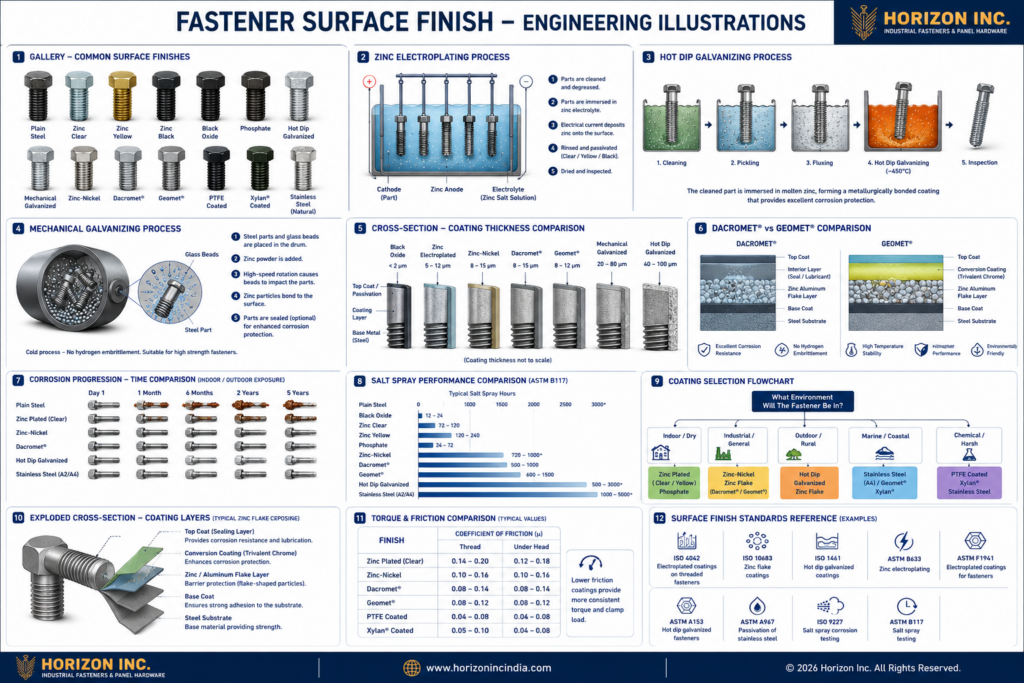
Engineering Illustration of Common Plating Process
Frequently Asked Questions
1. Why are fasteners given a surface finish?
Surface finishes protect fasteners from corrosion, improve durability, enhance appearance, reduce friction during installation, and, in some cases, increase wear resistance or chemical resistance. The right finish extends the service life of both the fastener and the assembled joint.
2. What is the difference between zinc plating and hot-dip galvanizing?
Zinc plating is an electroplated coating that is thin, smooth, and suitable for indoor or moderately corrosive environments. Hot-dip galvanizing produces a much thicker zinc coating by immersing the fastener in molten zinc, providing significantly better corrosion resistance for outdoor and structural applications.
3. Which fastener coating provides the best corrosion resistance?
The best coating depends on the application. Hot-dip galvanizing, zinc flake coatings (such as Dacromet® and Geomet®), zinc-nickel plating, and stainless steel all provide excellent corrosion resistance. Marine and offshore environments often require A4 stainless steel or advanced zinc flake coatings.
4. What is the difference between Dacromet® and Geomet® coatings?
Both are zinc flake coating systems that provide excellent corrosion resistance without the risk of hydrogen embrittlement. Geomet® is a newer, chromium-free technology that generally offers improved environmental compliance, better friction control, and enhanced corrosion performance compared to traditional Dacromet® coatings.
5. What is hydrogen embrittlement, and which coatings can cause it?
Hydrogen embrittlement is a condition where hydrogen atoms become trapped in high-strength steel during certain manufacturing or electroplating processes, making the fastener brittle and prone to sudden failure. Electroplated coatings on high-strength fasteners require proper baking after plating. Non-electrolytic coatings such as Geomet®, Dacromet®, and mechanical galvanizing largely eliminate this risk.
6. Which surface finish is recommended for Grade 10.9 and Grade 12.9 fasteners?
High-strength fasteners are commonly supplied with black oxide, phosphate, zinc flake coatings, or mechanical galvanizing. Electroplated coatings can also be used when proper hydrogen embrittlement relief procedures are followed. The choice depends on the application and applicable standards.
7. Does the coating thickness affect fastener threads?
Yes. Thick coatings such as hot-dip galvanizing increase thread dimensions and usually require oversized or specially tapped mating threads. Thin coatings like zinc plating or zinc flake coatings have minimal impact on thread fit.
8. What is salt spray testing, and does it indicate real-world service life?
Salt spray testing, performed according to standards such as ASTM B117 or ISO 9227, measures the corrosion resistance of a coating under accelerated laboratory conditions. While useful for comparing different coatings, salt spray hours should not be directly interpreted as the expected service life in actual operating environments.
9. Which surface finish is best for outdoor applications?
For long-term outdoor exposure, hot-dip galvanized fasteners, zinc flake coatings, zinc-nickel coatings, or stainless steel fasteners are typically recommended. The best choice depends on the level of moisture, pollution, and exposure to chemicals or salt.
10. Are all fastener coatings RoHS and REACH compliant?
Most modern fastener coatings are available in RoHS- and REACH-compliant versions. However, some older chromate conversion coatings containing hexavalent chromium are no longer permitted in many industries. Always verify compliance with the fastener manufacturer or supplier.
11. Can stainless steel fasteners rust?
Although stainless steel offers excellent corrosion resistance, it is not completely rust-proof. Under certain conditions—such as exposure to chlorides, marine environments, or contamination from carbon steel—stainless steel can experience staining, pitting, or crevice corrosion. Choosing the correct stainless steel grade, such as A4 for marine applications, helps improve corrosion resistance.
12. How do I choose the right surface finish for my fasteners?
The selection depends on several factors, including:
Indoor or outdoor environment
Exposure to moisture or chemicals
Required corrosion resistance
Fastener strength class
Operating temperature
Electrical conductivity requirements
Industry standards and regulatory compliance
Selecting the correct finish ensures optimum performance, durability, and cost-effectiveness.
What international standards govern fastener surface finishes?
Several international standards specify coating requirements, testing methods, and corrosion performance for fastener finishes. Common standards include:
ISO 4042 – Electroplated coatings on threaded fasteners
ISO 10683 – Zinc flake coatings
ISO 1461 – Hot-dip galvanized coatings
ASTM B633 – Zinc electroplating
ASTM F1941/F1941M – Electrodeposited coatings on threaded fasteners
ASTM A153/A153M – Hot-dip galvanized coatings for iron and steel hardware
ASTM A967 – Passivation of stainless steel
ISO 9227 and ASTM B117 – Salt spray corrosion testing
These standards help ensure consistent coating quality, corrosion protection, and performance across different industries and applications.