Hydrogen Embrittlement in Fasteners Explained
Causes, Prevention, Standards & Best Practices
Table of Contents
Introduction
Hydrogen embrittlement (HE) is one of the most critical and misunderstood failure mechanisms affecting high-strength steel fasteners. Although invisible to the naked eye, hydrogen embrittlement can cause bolts, screws, studs, and other threaded fasteners to fracture suddenly without warning—even when they have been correctly installed and loaded below their design capacity.
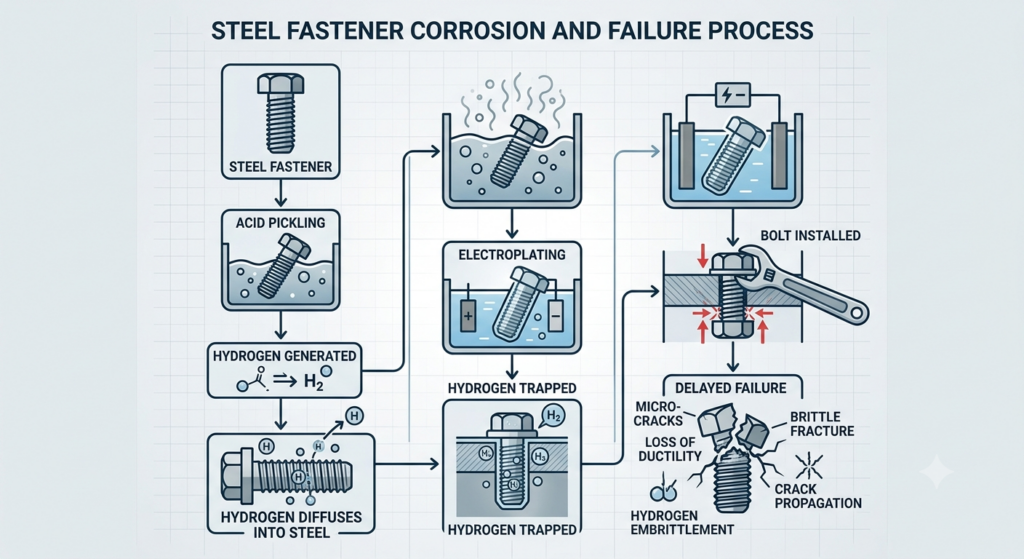
Hydrogen atoms introduced during manufacturing processes such as acid pickling or electroplating can diffuse into the steel’s crystal structure. Under tensile stress, these atoms weaken the material, leading to microscopic cracks that grow over time until catastrophic failure occurs. This phenomenon is particularly common in high-strength fasteners of property classes 10.9, 12.9, and above.
Understanding hydrogen embrittlement is essential for design engineers, quality professionals, procurement teams, and maintenance personnel involved in critical bolted joints. This guide explains the causes, affected fasteners, prevention methods, international standards, and recommended surface finishes to help engineers minimize the risk of delayed brittle fracture.
What is Hydrogen Embrittlement?
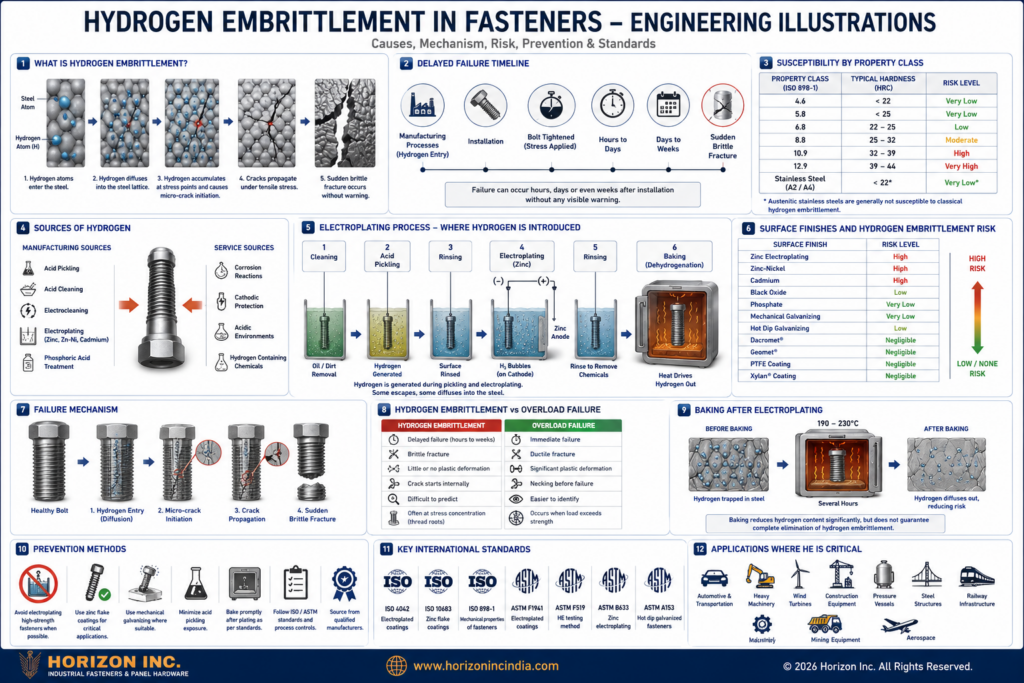
Hydrogen embrittlement is the loss of ductility and toughness in high-strength steel caused by hydrogen atoms entering the metal.
Because hydrogen atoms are extremely small, they diffuse into the steel lattice where they accumulate around microscopic imperfections and areas of high stress.
When the fastener is tightened, tensile stresses concentrate at these locations, allowing cracks to initiate and propagate until the component fractures.
Unlike overload failures, hydrogen embrittlement typically occurs without noticeable deformation or warning signs.
Why is Hydrogen Embrittlement Dangerous?
The most dangerous characteristic of hydrogen embrittlement is that failure is delayed.
A fastener may:
- Pass inspection
- Be installed correctly
- Reach the specified tightening torque
- Operate normally
…and still fail hours, days, or weeks later.
This delayed brittle fracture often occurs without any visible warning, making hydrogen embrittlement one of the leading causes of unexpected fastener failures.
Timeline
Manufacturing
↓
Electroplating
↓
Installation
↓
Bolt Tightened
↓
24 Hours
↓
Several Days
↓
Sudden Brittle Fracture
Which Fasteners Are Most Susceptible?
Hydrogen embrittlement primarily affects high-strength hardened steel fasteners.
| Property Class | Risk Level | Typical Applications |
|---|---|---|
| 4.6 | Very Low | General fabrication |
| 5.8 | Very Low | Light engineering |
| 6.8 | Low | Machinery |
| 8.8 | Moderate | Industrial equipment |
| 10.9 | High | Heavy machinery |
| 12.9 | Very High | Socket head cap screws |
| Stainless Steel A2/A4 | Very Low* | Corrosion-resistant applications |
*Standard austenitic stainless steels are generally not susceptible to classical hydrogen embrittlement in the same way as hardened carbon steels, though other hydrogen-related degradation mechanisms can occur in specific environments.
What Causes Hydrogen Embrittlement?
Hydrogen can enter steel during several manufacturing and service processes.
Manufacturing Sources
- Acid pickling
- Acid cleaning
- Electrocleaning
- Zinc electroplating
- Zinc-nickel plating
- Cadmium plating
- Phosphoric acid treatment
Service Sources
- Corrosion reactions
- Cathodic protection
- Acidic environments
- Hydrogen-containing chemicals
How Does Electroplating Cause Hydrogen Embrittlement?
Electroplating is one of the most common sources of hydrogen embrittlement.
During:
- Acid cleaning
- Pickling
- Electroplating
Hydrogen is produced at the surface of the steel.
Some hydrogen escapes immediately.
Some diffuses into the steel where it becomes trapped.
If the fastener is sufficiently hard, these trapped hydrogen atoms may eventually initiate cracks under tensile loading.
How Does Failure Occur?
The failure mechanism usually follows these stages:
- Hydrogen enters the steel.
- Hydrogen diffuses through the crystal lattice.
- Tensile stress concentrates around thread roots.
- Micro-cracks initiate.
- Cracks propagate slowly.
- Sudden brittle fracture occurs.
Unlike overload failure, the fastener generally shows little or no plastic deformation.
Hydrogen Embrittlement vs Normal Overload Failure
| Hydrogen Embrittlement | Overload Failure |
|---|---|
| Delayed failure | Immediate failure |
| Brittle fracture | Ductile fracture |
| Little deformation | Significant stretching |
| Crack starts internally | Necking before failure |
| Difficult to predict | Easier to identify |
Surface Finishes and Hydrogen Embrittlement Risk
| Surface Finish | Risk |
|---|---|
| Zinc Electroplating | High |
| Zinc-Nickel | High |
| Cadmium | High |
| Black Oxide | Low |
| Phosphate | Very Low |
| Mechanical Galvanizing | Very Low |
| Hot Dip Galvanizing | Low* |
| Dacromet | Negligible |
| Geomet | Negligible |
| PTFE | Negligible |
| Xylan | Negligible |
*Hot dip galvanizing generally presents a much lower hydrogen embrittlement risk than electroplating because it is not an electrolytic process, but process control and application suitability should still be considered.
Baking After Electroplating
To reduce hydrogen embrittlement risk, plated fasteners are often baked immediately after electroplating.
Typical baking parameters include:
- Temperature: 190–230°C
- Duration: Several hours, depending on fastener size, hardness, and applicable specifications.
The purpose of baking is to allow hydrogen to diffuse out of the steel before it becomes trapped.
Important: Baking significantly reduces the risk but does not guarantee complete elimination of hydrogen embrittlement.
Prevention Methods
Hydrogen embrittlement can often be minimized through proper process selection and quality control.
Recommended Practices
- Avoid electroplating high-strength fasteners where suitable alternatives exist.
- Use zinc flake coatings for critical applications.
- Use mechanical galvanizing when appropriate.
- Minimize acid pickling exposure.
- Bake electroplated fasteners promptly after plating when required by applicable standards.
- Purchase fasteners from qualified manufacturers with controlled plating processes.
- Specify the correct coating for the operating environment.
Common Applications Where Hydrogen Embrittlement is Critical
- Automotive suspension systems
- Heavy machinery
- Wind turbines
- Construction equipment
- Mining equipment
- Pressure vessels
- Structural steel connections
- Aerospace components
- Railway infrastructure
- Industrial machinery
International Standards
| Standard | Description |
|---|---|
| ISO 4042 | Electroplated coatings on threaded fasteners |
| ISO 10683 | Zinc flake coatings |
| ISO 898-1 | Mechanical properties of steel fasteners |
| ASTM F1941 | Electroplated coatings on threaded fasteners |
| ASTM F519 | Mechanical hydrogen embrittlement testing |
| ASTM B633 | Zinc electroplating |
| ASTM A153 | Hot dip galvanized fasteners |
Key Takeaways
- Hydrogen embrittlement mainly affects hardened, high-strength steel fasteners.
- Electroplating and acid pickling are common sources of hydrogen ingress.
- Failure is often delayed and occurs without visible warning.
- High-strength property classes such as 10.9 and 12.9 require particular attention.
- Baking after electroplating can substantially reduce risk but is not a complete solution.
- Zinc flake coatings, mechanical galvanizing, and carefully selected non-electrolytic finishes are often preferred for critical high-strength applications.
- Proper coating selection and adherence to international standards help improve fastener reliability.
Related Knowledge Centre Articles
- Fastener Surface Finishes Explained
- Bolt Grades & Strength Classes Explained
- DIN & ISO Standards for Fasteners
- General Technical Delivery Standards for Fasteners
- ISO Metric Thread System Explained
- Fastener Terminology & Nomenclature
- Stainless Steel Fastener Grades Explained
Frequently Asked Questions
What is hydrogen embrittlement in fasteners?
Hydrogen embrittlement is a failure mechanism in which hydrogen atoms enter high-strength steel, reducing ductility and causing delayed brittle fracture under tensile stress.
Which bolt grades are most susceptible to hydrogen embrittlement?
High-strength steel fasteners, particularly property classes 10.9 and 12.9, are significantly more susceptible than lower-strength grades because of their higher hardness and reduced ductility.
Does electroplating always cause hydrogen embrittlement?
Not always, but electroplating processes can introduce hydrogen into steel. The risk depends on factors such as fastener hardness, process controls, post-plating baking, and the specific plating method used.
Does baking eliminate hydrogen embrittlement?
No. Baking performed promptly after electroplating can substantially reduce the amount of absorbed hydrogen, but it does not guarantee complete elimination of the risk.
Which coatings help avoid hydrogen embrittlement?
Non-electrolytic coatings such as zinc flake systems (e.g., Geomet and Dacromet), mechanical galvanizing, PTFE, and Xylan generally present a much lower risk of hydrogen embrittlement than conventional electroplated coatings.
Can stainless steel fasteners suffer from hydrogen embrittlement?
Standard austenitic stainless steel fasteners (such as A2 and A4) are generally resistant to classical hydrogen embrittlement. However, hydrogen-related degradation can occur in certain high-strength stainless steels or under specific service conditions.
How can hydrogen embrittlement failures be identified?
Typical signs include a sudden brittle fracture with little or no plastic deformation, often occurring after a period of service rather than immediately during installation.
Which international standards address hydrogen embrittlement?
Important standards include ISO 4042, ISO 898-1, ISO 10683, ASTM F1941, ASTM F519, and ASTM B633, which cover electroplated coatings, mechanical properties, hydrogen embrittlement testing, and related processes.