
Rivet Bushings Technical Datasheets
Browse technical datasheets, engineering drawings, dimensions, material specifications and PDF downloads for industrial rivet bushings. This technical library includes mini rivet bushings, mini rivet bush standoffs and rivet bushings, used across sheet metal fabrication, electrical enclosures, construction and industrial manufacturing applications.
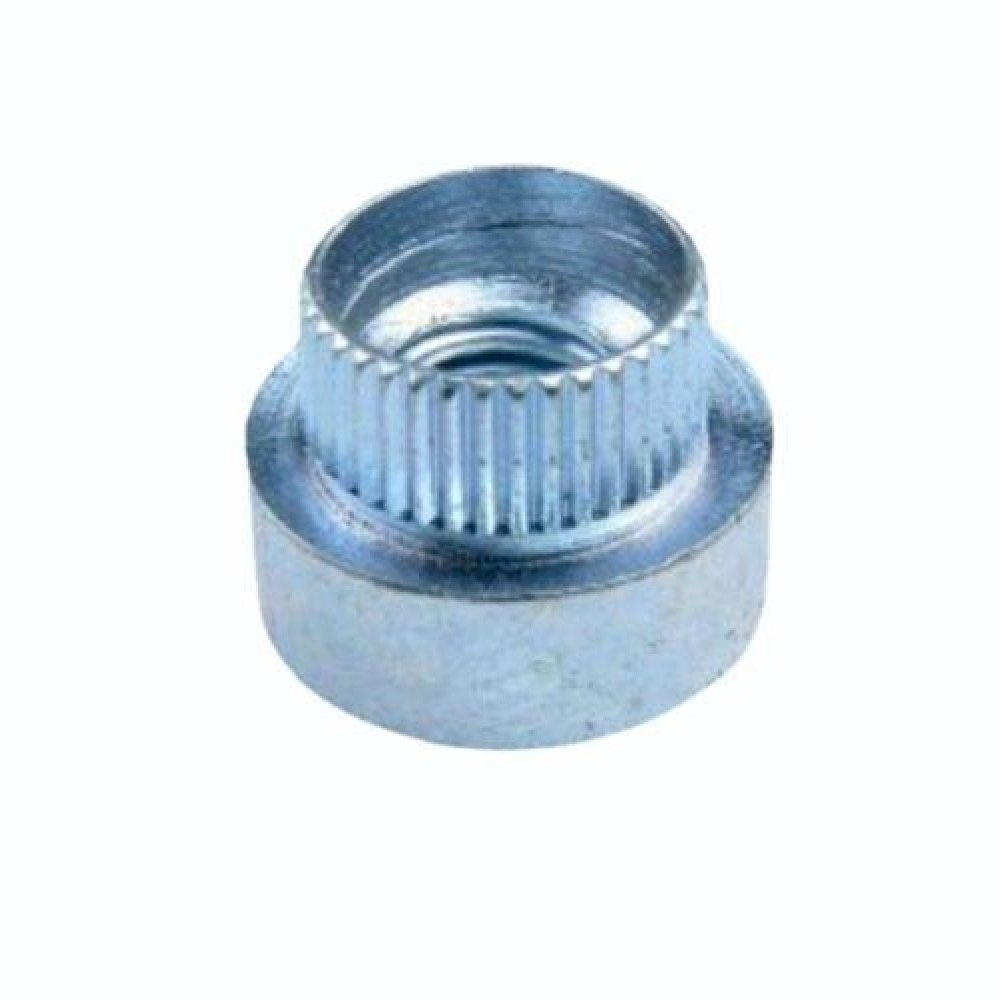
Mini Rivet Bushing
Mini Rivet Bushing Standoff
Rivet Bushing
Rivet Bushing Standoff
About Rivet Bushings
A rivet bushing is a permanently installed threaded insert that provides durable internal threads in thin sheet metal. During installation, the bushing is inserted into a prepared hole and the projecting shank is mechanically peened over using a profiled punch. This forms a permanent mechanical joint while the serrations beneath the flange embed into the sheet material, preventing rotation during service. Rivet Bushings are also known in industry as Anchor Nuts, Rozen Nuts or Rosan Nuts.
The result is a strong, reusable threaded connection capable of withstanding repeated assembly and disassembly without damaging the parent material.
Rivet Bushing Installation Best Practices
Proper selection and installation are essential to achieve the full performance of a rivet bushing. Following these recommendations helps ensure maximum thread strength, resistance to rotation, and long service life.
✅ Do’s
- Select the correct bushing length for the sheet thickness to ensure proper peening and secure retention.
- Use the recommended hole diameter specified in the dimensional table. An accurate hole size is critical for proper installation.
- Ensure the flange sits flush against the sheet before peening.
- Keep the bushing perpendicular to the sheet during installation to maintain thread alignment.
- Use a profiled installation punch designed for the rivet bushing size to achieve consistent results.
- Apply only the required installation force to form the shank securely without damaging the component.
- Support the workpiece adequately during installation to prevent distortion of thin sheet metal.
- Inspect the peened end after installation to confirm a complete and uniform mechanical lock.
- Choose the appropriate material (zinc-plated steel or stainless steel) based on the service environment and corrosion requirements.
- Use the correct mating fastener with the specified thread size and strength class.
❌ Don’ts
- Do not install into oversized or irregular holes, as this can reduce pull-out and torque resistance.
- Do not use a bushing that is too short or too long for the sheet thickness, as improper peening may result.
- Do not install the bushing at an angle, as misalignment can affect thread engagement and assembly.
- Do not over-peen the shank, as excessive force may deform the thread or damage the flange.
- Do not strike the bushing directly with a hammer, unless the installation tooling is specifically designed for that purpose.
- Do not reuse a rivet bushing after it has been removed from an assembly.
- Do not install into damaged, cracked, or distorted sheet material, as the joint strength will be compromised.
- Do not exceed the recommended tightening torque of the mating screw, as this may damage the internal threads.
- Do not substitute a rivet bushing for a blind rivet nut where installation access is available from only one side.
- Do not mix incompatible materials in corrosive environments without considering the risk of galvanic corrosion.
Common Installation Issues & Troubleshooting
Why does a rivet bushing rotate when tightening the screw?
A properly installed rivet bushing should remain securely locked in the sheet metal during screw installation and removal. If the bushing rotates, it is usually the result of an installation or application issue rather than a defect in the component.
Possible Causes
| Issue | Explanation | Recommended Solution |
|---|---|---|
| Oversized installation hole | An oversized hole prevents the serrated flange and riveted shank from developing sufficient grip. | Always use the recommended hole diameter and maintain specified tolerances. |
| Incorrect bushing length | A shank that is too short may not form an adequate mechanical lock, while an excessively long shank may not peen correctly. | Select the correct rivet bushing length for the sheet thickness. |
| Insufficient peening force | If the shank is not fully formed, the bushing may not clamp the sheet securely. | Use the correct installation tooling and apply sufficient force to achieve a complete peened profile. |
| Improper installation tooling | Flat punches or incorrect tooling may fail to form the riveted end correctly. | Use a profiled punch designed for the specific rivet bushing size. |
| Incorrect sheet thickness | Using the bushing outside its recommended grip range reduces installation strength. | Select a rivet bushing suitable for the material thickness. |
| Damaged or distorted sheet material | Bent or uneven sheets can prevent the flange from seating correctly. | Ensure the installation surface is flat and free from damage. |
| Excessive tightening torque | Applying torque beyond the recommended limit can overcome the mechanical lock. | Tighten the mating screw according to the recommended torque for the thread size and fastener grade. |
| Poor-quality or worn rivet bushings | Inconsistent dimensions, shallow serrations, or manufacturing defects can reduce resistance to rotation. | Source rivet bushings from reputable manufacturers with consistent quality and dimensional control. |
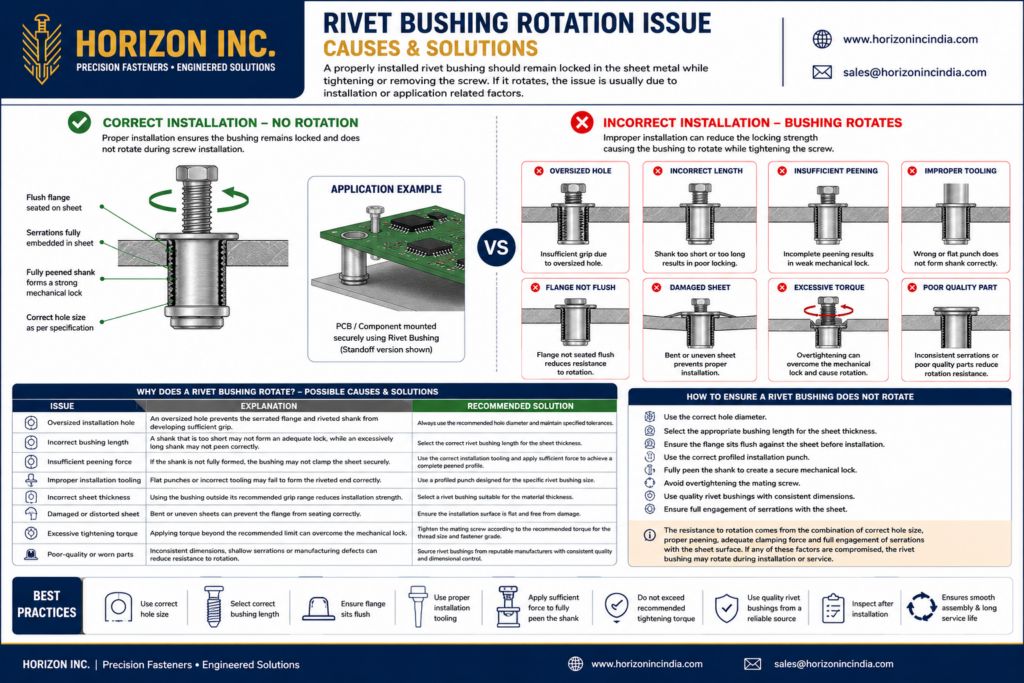
How to Ensure a Rivet Bushing Does Not Rotate
For reliable performance:
- Use the correct hole diameter.
- Select the appropriate rivet bushing length for the sheet thickness.
- Ensure the flange sits flush against the sheet before installation.
- Use the correct profiled installation punch.
- Fully peen the shank to create a secure mechanical lock.
- Avoid overtightening the mating screw.
- Use quality rivet bushings manufactured to consistent dimensional tolerances.
Important Note
While rivet bushings are designed with serrated flanges to resist rotation, the serrations alone do not prevent spinning. The resistance to rotation comes from the combination of:
- the correct hole size,
- proper peening of the shank,
- adequate clamping force on the sheet, and
- full engagement of the serrations with the sheet surface.
If any of these factors are compromised, the rivet bushing may rotate during installation or service.
Frequently Asked Questions
What is a rivet bushing used for?
Rivet bushings create permanent, reusable threaded holes in thin sheet metal where conventional tapping is not possible or practical.
What is the difference between a rivet bushing and a rivet nut?
A rivet bushing is installed by mechanically peening the projecting shank and typically requires access to both sides of the sheet. A blind rivet nut is installed using a rivet nut setting tool and requires access from only one side.
What materials are available?
Rivet bushings are commonly manufactured in zinc-plated steel and stainless steel. Some variants are also available in brass or aluminium for specialised applications.
Can rivet bushings be used in stainless steel sheets?
Yes. They can be installed in stainless steel, mild steel, and aluminium sheets using the correct hole size and installation tooling.
Are the threads reusable?
Yes. Rivet bushings provide durable internal threads designed for repeated assembly and disassembly.
Which rivet bushing should I choose?
Mini Rivet Bushing: For compact assemblies and limited installation space.
Standard Rivet Bushing: For general-purpose threaded connections in sheet metal.
Rivet Bushing Standoff: When an integral spacer is required to create clearance between components.