
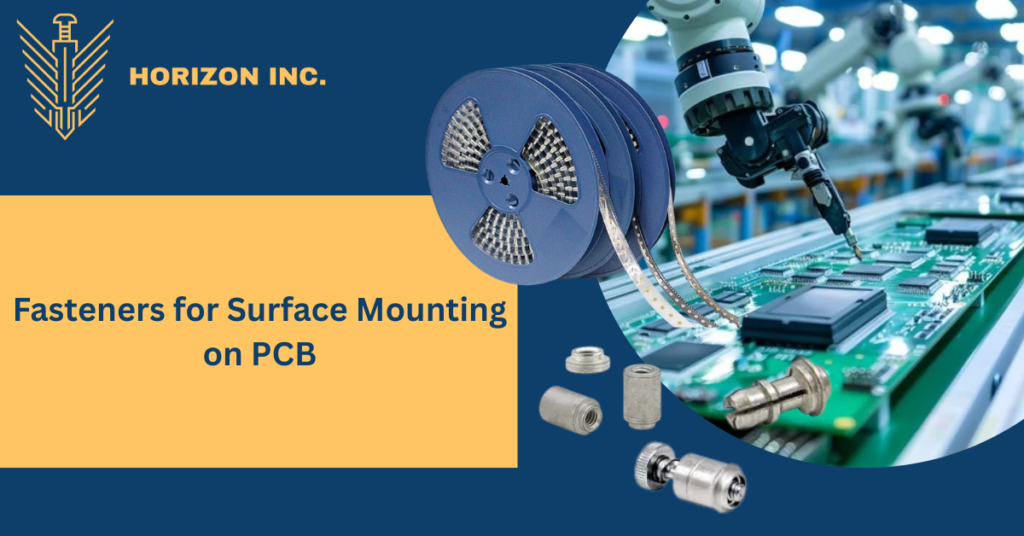
What Are SMT Fasteners?
SMT (Surface Mount Technology) fasteners are mechanical fastening components designed to be soldered directly onto the surface of a printed circuit board (PCB) during the standard SMT assembly process. Unlike traditional through-hole fasteners that require drilled holes, SMT fasteners are mounted onto solder pads and installed using automated pick-and-place equipment and reflow soldering processes.
Common SMT fasteners include surface-mount nuts, standoffs, spacers, pins and captive fastening systems. They provide mechanical attachment points for covers, daughter boards, shields, connectors and enclosures while preserving valuable PCB space.
As electronic products become smaller and more densely populated, SMT fasteners help designers reduce assembly operations, eliminate secondary hardware installation and support automated manufacturing. They are widely used in telecom equipment, industrial electronics, medical devices, automotive electronics, IoT products and data centre infrastructure.
Key Takeaways
- SMT fasteners are mounted directly onto PCB surfaces.
- No drilled holes are required.
- Compatible with automated pick-and-place assembly.
- Help reduce PCB real estate consumption.
- Improve assembly efficiency in high-volume manufacturing.
- Available as nuts, standoffs, pins and captive hardware.
- Commonly manufactured in stainless steel, brass and plated steel.
- Widely used in telecom, industrial controls, automotive electronics and data centres.
Introduction
Modern electronic devices demand higher component density, reduced product size and faster manufacturing cycles. Surface Mount Technology (SMT) has become the dominant assembly method because it allows electronic components to be mounted directly onto PCB surfaces without requiring drilled holes.
However, electronic assemblies require more than electrical connections. Engineers must also provide secure mechanical mounting points for enclosures, shields, connectors, cooling systems and secondary boards.
This is where SMT fasteners become critical.
By integrating fastening features into the SMT process, manufacturers can reduce assembly costs, improve reliability and simplify product design.
Why Are SMT Fasteners Used in PCB Assemblies?
SMT fasteners solve several design and manufacturing challenges:
Space Optimisation
Traditional through-hole hardware consumes valuable PCB area and routing space. SMT fasteners allow higher component density.
Automated Assembly
SMT fasteners can be placed using standard pick-and-place machines, eliminating manual installation.
Reduced Manufacturing Cost
Fewer secondary operations mean lower labour costs and shorter production cycles.
Improved Product Miniaturisation
Compact electronics require compact fastening solutions.
Better Design Flexibility
Designers can add threaded attachment points without redesigning PCB layers around drilled holes.
What Types of SMT Fasteners Are Available?
SMT Nuts
Surface-mount nuts provide reusable threaded attachment points directly on PCBs.
Typical applications:
- Equipment covers
- Shielding plates
- Connectors
- Sensor modules
SMT Standoffs
Standoffs create spacing between PCBs or between PCBs and enclosures.
Typical applications:
- Board stacking
- Display modules
- Telecom equipment
- Industrial controllers
SMT Pins
SMT pins provide:
- Mechanical location
- Electrical grounding
- Connector alignment
- Module positioning
SMT Captive Fasteners
Captive systems prevent screw loss during maintenance.
Common applications:
- Telecom equipment
- Data centre hardware
- Industrial control systems
- Medical equipment
SMT Fasteners vs Through-Hole Fasteners
| Parameter | SMT Fasteners | Through-Hole Fasteners |
|---|---|---|
| PCB Drilling Required | No | Yes |
| Assembly Method | Automated SMT Process | Secondary Operation |
| PCB Space Usage | Lower | Higher |
| Manufacturing Speed | Faster | Slower |
| Component Density | Higher | Lower |
| Mechanical Strength | Moderate | Higher |
| Ideal For | Compact Electronics | High Load Applications |
| Production Volume | High Volume | Low to Medium Volume |
While SMT fasteners improve manufacturing efficiency, through-hole solutions may still be preferred where very high pull-out or vibration resistance is required.
How Do Engineers Select the Right SMT Fastener?
Selection Guide
| Design Requirement | Recommended SMT Fastener |
| Threaded attachment point | SMT Nut |
| PCB spacing | SMT Standoff |
| Board alignment | SMT Pin |
| Serviceable access panel | SMT Captive Fastener |
| EMI Shield Retention | SMT Nut or Standoff |
| Daughter Board Mounting | SMT Standoff |
What Materials Are Used for SMT Fasteners?
Stainless Steel
Advantages:
- Corrosion resistance
- Good mechanical strength
- Long service life
Brass
Advantages:
- Excellent conductivity
- Good solderability
- Suitable for grounding applications
Carbon Steel
Advantages:
- Cost-effective
- High strength
- Available with protective plating
What Surface Finishes Are Commonly Used?
Typical SMT fastener finishes include:
- Tin Plating
- Nickel Plating
- Gold Plating
- Zinc-Nickel Coatings
These finishes improve:
- Solderability
- Corrosion resistance
- Electrical performance
- Shelf life
Where Are SMT Fasteners Used?
Telecom Equipment
Applications include:
- 5G infrastructure
- RF modules
- Base station electronics
Data Centre Electronics
Applications include:
- Server management boards
- Power distribution electronics
- Monitoring systems
Industrial Automation
Applications include:
- PLC systems
- Industrial controllers
- HMI devices
Automotive Electronics
Applications include:
- Infotainment systems
- ECU modules
- Battery management systems
Medical Equipment
Applications include:
- Diagnostic equipment
- Portable monitoring devices
- Imaging systems
What Are Common SMT Fastener Design Mistakes?
Insufficient Pad Design
Poor solder pad geometry can reduce joint strength.
Ignoring Mechanical Loads
SMT fasteners are not intended for heavy structural loading.
Improper Reflow Profiles
Incorrect temperature profiles may affect solder joint integrity.
Lack of Clearance
Designers often overlook screwdriver access and assembly clearances.
Selecting the Wrong Thread Size
Oversized screws can overstress solder joints.
Practical Observations from Electronics Manufacturing
From experience supplying fastening solutions to electronics manufacturers, several recurring challenges are observed:
- Designers frequently underestimate mechanical loading on PCB-mounted hardware.
- Shielding covers often require repeated servicing, making captive fasteners valuable.
- PCB stacking applications benefit significantly from SMT standoffs instead of improvised spacer solutions.
- Automated assembly environments achieve greater consistency when SMT-compatible hardware is specified during initial design.
Early fastener selection often prevents costly redesigns later in product development.
Frequently Asked Questions (FAQs)
What are SMT fasteners?
SMT fasteners are hardware components designed to be soldered directly onto PCB surfaces during the SMT assembly process.
Are SMT fasteners stronger than through-hole fasteners?
Generally, through-hole fasteners provide greater mechanical strength. SMT fasteners prioritise assembly efficiency and space savings.
Can SMT fasteners be installed using pick-and-place machines?
Yes. Most SMT fasteners are specifically designed for automated assembly.
What materials are commonly used for SMT fasteners?
Stainless steel, brass and plated steel are the most common materials.
Are SMT fasteners suitable for high-vibration applications?
They can be used in moderate vibration environments, but high-vibration applications may require specialised designs or through-hole alternatives.
Can SMT fasteners be used for grounding?
Yes. SMT pins and certain nut designs are frequently used for grounding and shielding applications.
Conclusion
SMT fasteners have become an essential part of modern electronics manufacturing. By providing mechanical attachment points directly within the SMT process, they help engineers reduce assembly costs, increase automation and support increasingly compact product designs.
Whether the application involves telecom equipment, industrial automation systems, medical devices or data centre electronics, selecting the correct SMT fastener improves both manufacturability and long-term reliability.
For PCB assemblies where space, efficiency and automated production are critical, SMT fasteners are often the preferred solution.
Contact us today:
📞 +91-9916777262
📧 sales@horizonincindia.com
🌐 www.horizonincindia.com

Yusuf T. Unjhawala is Co-founder of Horizon Inc., a supplier of industrial fasteners serving electrical control panel manufacturers, sheet metal fabricators, telecom equipment manufacturers, solar industry, HVAC, and industrial OEMs across South India.
Public Policy and Research:
Yusuf is an Adjunct Scholar at the Takshashila Institution, Bengaluru, where his work focuses on defence, strategic affairs.