
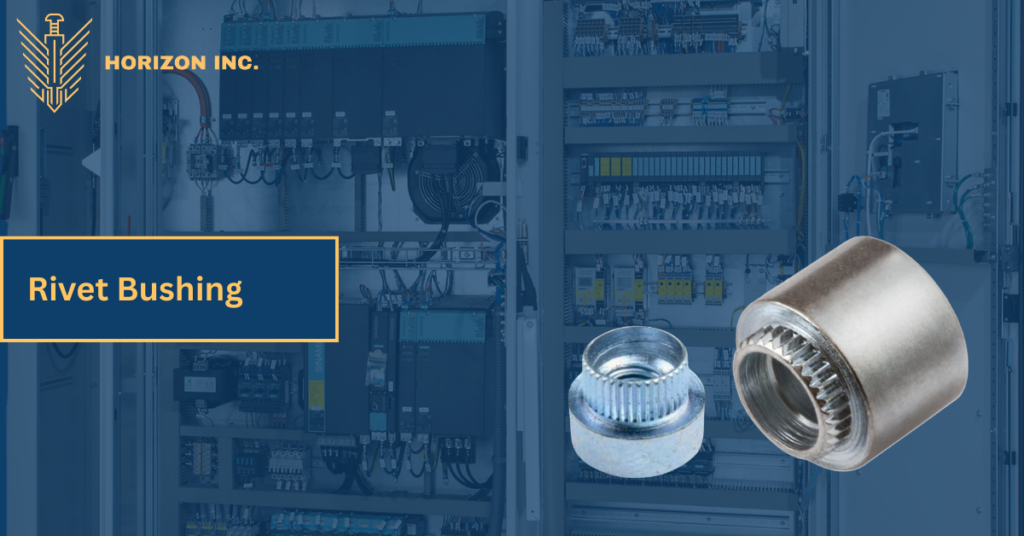
A rivet bushing is a threaded insert designed to create strong reusable threads in thin sheet metal where conventional tapping is impractical. Also known in India as Rosan Nut, Rozen Nut, Rosen Nut, or Anchor Nut, rivet bushings are widely used in electrical panels, telecom cabinets, data centre equipment, industrial enclosures, HVAC equipment, and electronic assemblies.
Unlike tapping directly into thin sheet metal, a rivet bushing provides significantly higher pull-out resistance and torque resistance while allowing repeated assembly and disassembly. Mini rivet bushings are designed for compact installations where space is limited, while rivet bushing standoffs combine threaded fastening and spacing functions in a single component.
For design engineers and OEMs working with sheet metal assemblies, selecting the correct rivet bushing type improves assembly reliability, reduces field failures, and simplifies manufacturing processes.
Key Takeaways
- Rivet bushings create durable threads in thin sheet metal.
- Mini rivet bushings are designed for space-constrained applications.
- Rivet bushing standoffs combine a threaded insert and spacer in one component.
- Common thread sizes range from M3 to M8.
- Suitable for steel, stainless steel, aluminium, and some plastic assemblies.
- Commonly used in electrical enclosures, telecom cabinets, HVAC equipment, and PCB mounting.
- Proper hole size and installation technique are critical for performance.
- Often known in India as Rosan Nut, Rozen Nut, or Rosen Nut.
Introduction
Thin sheet metal presents a common fastening challenge. When sheet thickness falls below approximately 2 mm, there is often insufficient material available to create reliable tapped threads. Traditional nuts can increase assembly complexity, while welding nuts may introduce distortion and additional manufacturing steps.
Rivet bushings solve this challenge by creating permanent threaded fixing points directly within the sheet metal. Available in standard, mini, and standoff configurations, they provide engineers with versatile fastening solutions suitable for both structural and electronic assemblies.
What Is a Rivet Bushing?
A rivet bushing is a cylindrical threaded insert featuring:
- Internal metric thread
- Serrated or knurled body
- Head or shoulder flange
- Riveting section for permanent installation
During installation, the shank is mechanically flared or riveted into a punched hole, creating a secure captive thread within the sheet metal.
Typical Applications
- Electrical control panels
- Industrial enclosures
- Telecom cabinets
- HVAC equipment
- Machinery covers
- Data centre infrastructure
Common Materials
| Material | Typical Use |
|---|---|
| Zinc-plated steel | General industrial applications |
| Stainless steel | Corrosive environments |
| Brass | Electrical applications |
| Aluminium | Lightweight assemblies |
What Is a Mini Rivet Bushing?
A mini rivet bushing performs the same function as a standard rivet bushing but occupies significantly less space.
Mini rivet bushings are commonly used when:
- Hole spacing is limited
- Components are located near bends
- Internal clearance is restricted
- Compact electronics are involved
Mini rivet bushings are frequently used in:
- Instrumentation panels
- Electronic enclosures
- Medical devices
- EV charging equipment
- Telecom electronics
Their smaller outside diameter allows installation in locations where standard rivet bushings cannot be accommodated.
What Is a Rivet Bushing Standoff?
A rivet bushing standoff combines two functions:
- Threaded attachment point
- Fixed spacing element
This design eliminates the need for separate spacers and nuts.
Common Uses
- PCB mounting
- Electronic assemblies
- Control panel internals
- Display mounting
- Airflow gap creation
- Cable routing clearances
By reducing component count, rivet bushing standoffs simplify assembly while improving consistency.
How Do Rivet Bushings Compare With Other Thin Sheet Fasteners?
| Feature | Rivet Bushing | Mini Rivet Bushing | Self-Clinching Nut | Blind Rivet Nut |
| Installation Access | Both sides | Both sides | Both sides | One side |
| Space Requirement | Medium | Very Low | Medium | Medium |
| Torque Resistance | High | Moderate-High | Very High | Moderate |
| Best Application | General enclosures | Compact assemblies | High-load panels | Closed sections |
| Standoff Option | Yes | Yes | Yes | Limited |
How Do You Select the Correct Rivet Bushing?
| Selection Factor | Recommendation |
| Sheet Thickness | Match grip range to material thickness |
| Thread Size | M3–M8 commonly used |
| Material | Match environmental conditions |
| Available Space | Standard or Mini version |
| Need for Spacing | Use Standoff version |
| Corrosion Resistance | Stainless steel option |
What Installation Mistakes Cause Rivet Bushing Failures?
Incorrect Hole Diameter
Oversized holes reduce torque resistance and pull-out strength.
Improper Riveting
Insufficient flaring can result in loosening during service.
Material Mismatch
Using carbon steel bushings in corrosive environments may lead to premature failure.
Installation Near Bends
Insufficient edge distance may distort the sheet during installation.
Over-Torquing Fasteners
Excessive tightening torque can damage threads or deform surrounding sheet metal.
Where Are Rivet Bushings Used in Industry?
Electrical Panels and Enclosures
Providing reusable threads for doors, mounting plates, and accessories.
Data Centres
Supporting cable management systems, equipment brackets, and electronic modules.
Telecom Infrastructure
Used extensively in outdoor cabinets and communication equipment.
HVAC Systems
Securing access panels and internal components.
EV Charging Equipment
Mounting electronic modules and internal hardware.
Industrial Automation
Supporting controllers, sensors, and operator interfaces.
Based on Horizon Inc.’s experience supplying fastening solutions to panel manufacturers, rivet bushings are particularly useful where repeated maintenance access is required without damaging sheet metal threads.
Frequently Asked Questions
What is another name for a rivet bushing?
In India, rivet bushings are commonly called Rosan Nuts, Rozen Nuts, Rosen Nuts, or Anchor Nuts.
What is the difference between a rivet bushing and a rivet nut?
A rivet bushing typically requires access to both sides during installation, whereas a blind rivet nut can be installed from one side only.
Can rivet bushings be installed in stainless steel sheets?
Yes. Proper hole preparation and installation tooling are required.
What thread sizes are commonly available?
M3, M4, M5, M6, and M8 are the most commonly used sizes.
When should I use a rivet bushing standoff?
Whenever a fixed spacing distance between components is required in addition to a threaded attachment point.
Are mini rivet bushings as strong as standard rivet bushings?
Mini rivet bushings are designed for lighter-duty applications and compact assemblies. Standard versions generally provide higher load capacity.
Conclusion
Rivet bushings, mini rivet bushings, and rivet bushing standoffs provide practical solutions for creating strong reusable threads in thin sheet metal assemblies. By selecting the correct variant based on space constraints, load requirements, and assembly design, engineers can improve product reliability while simplifying manufacturing and maintenance.
For electrical panels, telecom cabinets, data centre equipment, HVAC systems, and industrial enclosures, these small components often eliminate the need for loose hardware, reduce assembly time, and create more robust fastening systems.
Need reliable fastening solutions for thin sheet metal assemblies?
Horizon Inc. supplies rivet bushings, mini rivet bushings, rivet bushing standoffs, self-clinching fasteners, rivet nuts, blind rivets, and weld studs for electrical panels, telecom infrastructure, data centres, HVAC equipment, EV charging systems, and industrial manufacturing.
Contact our team to discuss thread sizes, materials, grip ranges, and application-specific fastening requirements.
📞 Call: 080-41179152
📱 WhatsApp: +91 9916777262
✉️ Email: sales@horizonincindia.com
🌐 Visit: www.horizonincindia.com

Yusuf T. Unjhawala is Co-founder of Horizon Inc., a supplier of industrial fasteners serving electrical control panel manufacturers, sheet metal fabricators, telecom equipment manufacturers, solar industry, HVAC, and industrial OEMs across South India.
Public Policy and Research:
Yusuf is an Adjunct Scholar at the Takshashila Institution, Bengaluru, where his work focuses on defence, strategic affairs.