
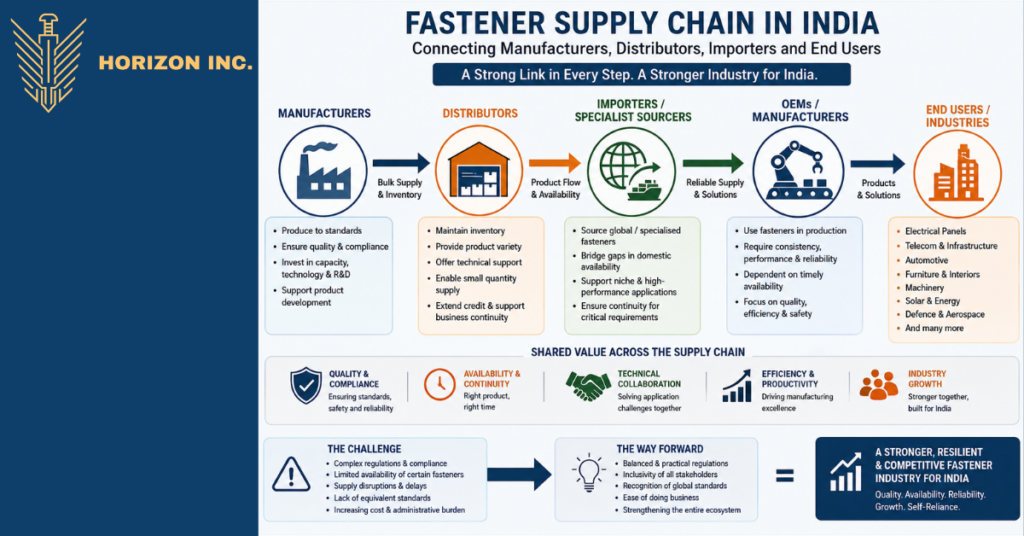
Restricting BIS certification to manufacturers may improve oversight of manufacturing facilities, but it can also create unintended challenges for industries that depend on specialised fasteners. Many fasteners used in electrical panels, telecom infrastructure, data centres, electronics manufacturing, renewable energy systems, and industrial machinery are either not manufactured in India or are only available in production quantities far larger than customer requirements. Industrial traders, importers, distributors, and stockists bridge this gap by aggregating demand, holding inventory, sourcing products globally, and supplying customers in practical quantities. Because modern fastener supply chains depend heavily on trader-to-trader transactions, a compliance framework that excludes traders from obtaining certification may reduce supply chain flexibility without necessarily improving product quality.
Key Takeaways
- Not all fasteners used in India are manufactured domestically.
- Manufacturing capability does not automatically mean market availability.
- Trader-to-trader transactions are a normal and necessary part of industrial supply chains.
- Traders perform inventory aggregation, demand consolidation, and MOQ reduction.
- Many MSMEs depend on distributors for access to specialised products.
- Compliance systems should focus on product conformity and traceability.
- Quality assurance and supply chain resilience should be complementary objectives.
Introduction
India’s Quality Control Orders (QCOs) and BIS certification framework are intended to improve product quality, consistency, and reliability.
These objectives are important.
However, industrial supply chains are often more complex than they appear.
A common assumption is that products move directly from manufacturers to end users. In reality, most industrial products pass through multiple stages involving importers, traders, stockists, distributors, and logistics providers before reaching the factory floor.
This is especially true in the fastener industry.
Fasteners are among the most widely used industrial components, yet they are also among the most fragmented. A single manufacturing facility may use hundreds of different fastener types sourced from multiple countries and supplied through multiple channels.
Understanding how these supply chains operate is essential when evaluating the impact of quality regulations.
Are All Fasteners Used in India Manufactured in India?
No.
While India has a strong fastener manufacturing sector, many specialised fastening products used by Indian industry are not manufactured domestically.
Examples include:
- Self-clinching fasteners
- Many rivet nut variants
- Structural blind rivets
- Electronics hardware fasteners
- Speciality captive fasteners
- Certain SEMS screws
- Trilobular thread-forming screws
- Application-specific fastening systems
These products are commonly used in:
- Electrical panels and enclosures
- Telecom equipment
- Data centres
- Electronics manufacturing
- Renewable energy systems
- Industrial machinery
- EV charging equipment
For many manufacturers, importing these products is not a preference.
It is often the only available option.
How Do Fasteners Actually Reach Indian Manufacturers?
A common misconception is that manufacturers sell directly to end users.
In reality, industrial supply chains are often built around multiple layers of inventory holders.
A typical supply chain may look like this:
Manufacturer → International Distributor → Export Trader → Indian Importer → Regional Distributor → Customer
In other cases:
Manufacturer → Stockist → Stockist → Distributor → Customer
Or:
Manufacturer → Importer → Trader → OEM
Every participant performs a specific economic function.
Inventory is accumulated, broken into smaller quantities, moved closer to demand, and made available to customers who require immediate supply.
Without these intermediary layers, many products would be difficult or impossible to obtain.
Why Are Trader-to-Trader Transactions Important?
Trader-to-trader purchases are not an exception within industrial supply chains.
They are an intrinsic part of how industrial products move around the world.
Inventory Pooling
A distributor in Europe may stock thousands of fastener SKUs from multiple manufacturers.
An Indian importer may only require a fraction of those products.
Purchasing from the distributor is often more efficient than purchasing directly from each manufacturer.
Global Availability
Many specialised products are sourced through established distribution networks rather than directly from factories.
This allows customers to access products that may otherwise be unavailable in their region.
MOQ Reduction
Large manufacturing quantities are broken into commercially viable quantities for smaller customers.
Supply Chain Flexibility
When one source faces disruption, traders often obtain inventory from alternative stockists and distributors.
This flexibility helps maintain continuity of supply.
Working Capital Efficiency
Inventory is spread across multiple participants rather than concentrated at the manufacturer or customer level.
Does Manufacturing Capability Automatically Mean Product Availability?
No.
One of the most important distinctions in industrial procurement is the difference between production capability and actual availability.
Consider the following examples.
| Product | Typical Customer Requirement | Typical Manufacturer MOQ |
|---|---|---|
| Rivet Nuts | 2,000 Pieces | 100,000 Pieces |
| Blind Rivets | 5,000 Pieces | 200,000 Pieces |
| Self-Clinching Studs | 1,500 Pieces | 50,000 Pieces |
| Speciality Screws | 3,000 Pieces | 100,000 Pieces |
The manufacturer cannot economically produce small quantities.
The customer cannot economically purchase large quantities.
The trader bridges this gap.
By holding inventory and supplying multiple customers, traders make these products commercially accessible.
A product is not truly available if a customer must purchase fifty times more than they actually require.
Why Do MSMEs Depend on Traders?
Large corporations may be able to:
- Place direct factory orders
- Carry large inventories
- Commit to annual volume contracts
Most MSMEs cannot.
Many smaller manufacturers require:
- Small order quantities
- Immediate availability
- Mixed-product purchases
- Technical assistance
Distributors and stockists make these procurement models possible.
Without them, many smaller manufacturers would face higher inventory costs and longer procurement cycles.
Should Compliance Be Linked to the Product or the Manufacturer?
This is the central policy question.
The objective of quality regulation should be ensuring that products placed on the market meet the required standards.
A manufacturer-only framework focuses on who produced the product.
An alternative approach focuses on whether the product itself complies with the applicable requirements and whether the party placing it on the market can demonstrate conformity.
| Supply Chain Participant | Function |
| Manufacturer | Produces product |
| Importer | Places product into domestic market |
| Trader | Aggregates supply and demand |
| Distributor | Maintains inventory |
| Brand Owner | Markets product |
| End User | Consumes product |
A compliance framework can assign responsibility to any economic operator that places products on the market.
The focus shifts from restricting participation to ensuring accountability.
Why Is Market Surveillance Important?
No quality framework can inspect every product before it enters the market.
For this reason, many regulatory systems rely on:
- Product testing
- Technical documentation
- Traceability requirements
- Market inspections
- Enforcement actions
This allows regulators to identify non-compliant products while maintaining supply chain flexibility.
Rather than restricting legitimate supply chain participants, the emphasis is placed on ensuring accountability and conformity.
Real-World Example
Consider an electrical enclosure manufacturer requiring:
- Self-clinching studs
- Rivet nuts
- Blind rivets
- Speciality machine screws
The total value of these fasteners may represent only a small percentage of the finished product cost.
However, if one item becomes unavailable, production may stop completely.
The required products may have been:
- Manufactured in Taiwan
- Stocked in Europe
- Purchased by an Indian importer
- Supplied through a regional distributor
At each stage, inventory has been moved closer to the customer and made available in practical quantities.
This is how industrial supply chains function today.
Conclusion
The discussion surrounding fastener quality should not be limited to manufacturing alone.
Quality matters.
Traceability matters.
Compliance matters.
But availability matters too.
Many specialised fasteners used by Indian manufacturers are sourced through global networks involving manufacturers, importers, traders, distributors, and stockists. These participants do not merely add commercial margins. They perform essential supply chain functions that make products available in the quantities and timeframes that industry requires.
The purpose of quality regulation should be to ensure that compliant products reach manufacturers efficiently and reliably.
A compliance framework that focuses solely on manufacturers may improve oversight of production facilities, but it risks overlooking how industrial supply chains actually operate.
For industries such as fasteners, supply chain flexibility is not a weakness. It is one of the foundations of industrial competitiveness.
Horizon Inc. supplies self-drilling screws, blind rivets, rivet nuts, self-clinching fasteners, weld studs, machine screws, and industrial fastening solutions to manufacturers across India. With stocking locations in Bangalore and Chennai, we help procurement teams access specialised fastening products through established domestic and international supply networks, supported by technical guidance, inventory availability, and responsive service.

Yusuf T. Unjhawala is Co-founder of Horizon Inc., a supplier of industrial fasteners serving electrical control panel manufacturers, sheet metal fabricators, telecom equipment manufacturers, solar industry, HVAC, and industrial OEMs across South India.
Public Policy and Research:
Yusuf is an Adjunct Scholar at the Takshashila Institution, Bengaluru, where his work focuses on defence, strategic affairs.