
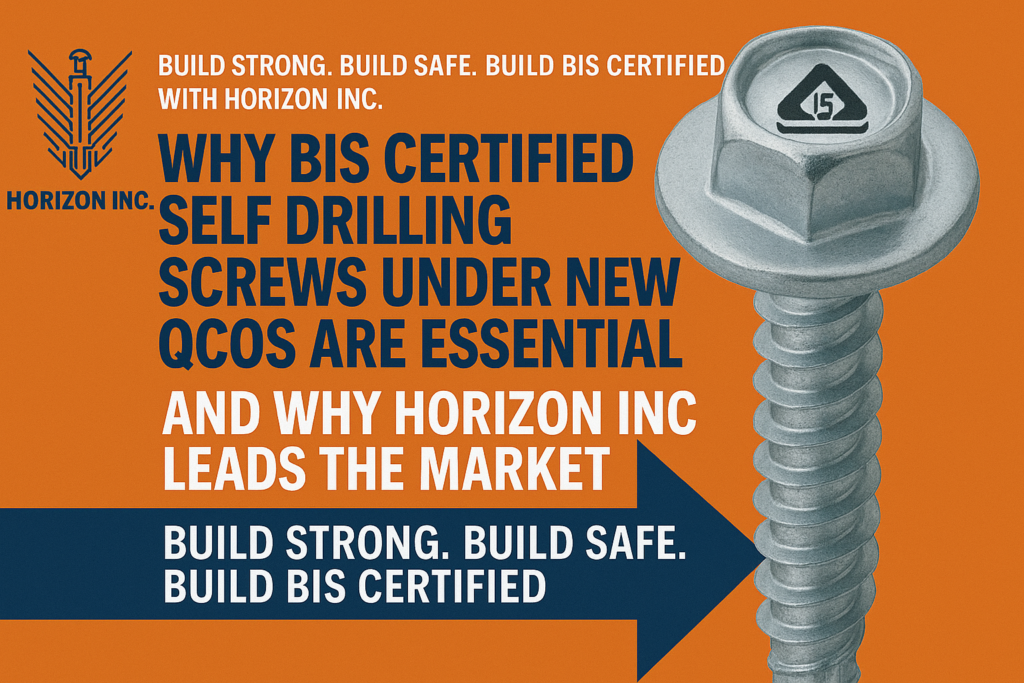
BIS certified self drilling screws are self drilling screws that comply with the applicable Indian Standard and are supplied in accordance with BIS requirements where required under India’s Quality Control Order (QCO) framework. These screws are widely used in roofing, cladding, steel construction, PEB structures, HVAC installations, solar mounting systems and sheet metal fabrication.
When sourcing self drilling screws, buyers should verify the applicable standard, screw dimensions, drilling capacity, corrosion protection, washer quality and suitability for the intended application. Compliance requirements are important, but performance factors such as drilling efficiency, coating durability and long-term weather resistance remain critical considerations.
Key Takeaways
- Self drilling screws are widely used in roofing and sheet metal applications.
- Certain categories are covered by BIS requirements.
- Buyers should verify both compliance and technical suitability.
- Washer quality and corrosion resistance are critical.
- Not all self drilling screws perform equally in the field.
- Procurement teams should evaluate supplier reliability and product consistency.
Introduction
Self drilling screws are among the most widely used fasteners in modern construction and industrial assembly.
Unlike self tapping screws, self drilling screws incorporate a drill point that eliminates the need for pre-drilling in many applications. This significantly reduces installation time and labour costs.
With the introduction of fastener Quality Control Orders (QCOs), many buyers now specifically request BIS certified self drilling screws as part of their procurement specifications.
Understanding what this means and what factors should be considered during supplier selection can help prevent installation failures, leakage issues and supply chain disruptions.
What Are Self Drilling Screws?
Self drilling screws combine drilling and fastening functions into a single operation.
The drill point creates the hole while the threads form the connection.
They are commonly used in:
- Roofing sheets
- PEB structures
- Sandwich panels
- PUF panels
- HVAC ducting
- Solar structures
- Sheet metal fabrication
- Industrial enclosures
Which Standard Applies To Self Drilling Screws?
Many self drilling screws are covered under IS 18509.
The standard specifies requirements relating to:
| Parameter | Description |
|---|---|
| Dimensions | Diameter, length and tolerances |
| Drill Point Geometry | Drilling performance requirements |
| Mechanical Properties | Strength and performance |
| Surface Finish | Corrosion protection |
| Inspection Requirements | Quality verification |
Procurement teams should verify the applicable standard and supplier documentation before purchase.
Why Are Buyers Asking For BIS Certified Self Drilling Screws?
Many organisations have updated procurement policies following implementation of fastener QCOs.
Typical drivers include:
- Internal compliance requirements
- Infrastructure project specifications
- EPC contractor requirements
- Customer approval processes
- Corporate procurement standards
As a result, suppliers increasingly need to provide compliant products and supporting documentation.
What Should Buyers Verify Before Purchasing?
Selecting a self drilling screw involves more than confirming compliance.
Buyers should evaluate:
| Requirement | Importance |
| Applicable Standard | Compliance verification |
| Drill Point Quality | Installation performance |
| Washer Quality | Leak prevention |
| Coating Type | Corrosion resistance |
| Material Grade | Mechanical performance |
| Thread Design | Pull-out performance |
| Supplier Traceability | Quality assurance |
| Availability | Supply continuity |
Why Does Washer Quality Matter?
One of the most common causes of roofing fastener failure is poor washer performance.
In roofing and cladding applications, the EPDM washer provides the weather seal.
Low-quality washers may:
- Crack during installation
- Deteriorate prematurely
- Lose elasticity
- Allow water ingress
At Horizon Inc., one of the most common problems reported by customers switching from low-cost fasteners is washer failure leading to roof leakage after exposure to weather conditions.
This is often a greater concern than the screw itself.
How Are Self Drilling Screws Used In PEB And Roofing Applications?
Self drilling screws are widely used for:
| Application | Typical Screw Type |
| Roof Sheet Fixing | Hex Head With EPDM Washer |
| Wall Cladding | Hex Head Self Drilling Screws |
| PUF Panels | Long Length Self Drilling Screws |
| Solar Structures | Corrosion Resistant Variants |
| HVAC Installations | Sheet Metal Fastening |
Correct selection depends on material thickness, environmental exposure and load requirements.
Common Procurement Challenges
Following implementation of QCO requirements, some buyers and suppliers have reported:
| Challenge | Impact |
| Limited supplier options | Reduced sourcing flexibility |
| Longer lead times | Inventory planning challenges |
| Documentation requirements | Additional procurement effort |
| Product availability constraints | Potential project delays |
| Specification confusion | Incorrect sourcing decisions |
Procurement teams should plan sourcing activities accordingly.
How To Select The Right Self Drilling Screw
| Application | Recommended Consideration |
| Roofing | Washer quality and weather resistance |
| Coastal Areas | Enhanced corrosion protection |
| PEB Structures | Drill capacity and strength |
| Solar Installations | Long-term corrosion resistance |
| HVAC Ducting | Ease of installation |
| Sheet Metal Fabrication | Consistent drill point performance |
BIS Certified vs Standard Procurement Considerations
| Factor | Why It Matters |
| Compliance Status | Procurement requirements |
| Drill Performance | Installation productivity |
| Washer Quality | Weather sealing |
| Corrosion Resistance | Service life |
| Product Consistency | Assembly efficiency |
| Supplier Support | Technical guidance |
Successful fastener selection requires evaluating all these factors together.
Frequently Asked Questions
What are BIS certified self drilling screws?
They are self drilling screws that comply with the applicable Indian Standard and are supplied in accordance with BIS requirements where applicable.
Which standard applies to self drilling screws?
Many self drilling screws are covered under IS 18509.
What is the difference between self drilling and self tapping screws?
A self drilling screw includes a drill point capable of creating its own hole, while a self tapping screw generally requires a pre-formed hole.
Why are EPDM washers important?
They create the weather seal that helps prevent water ingress in roofing and cladding applications.
Are self drilling screws used in PEB buildings?
Yes. They are widely used for roofing, wall cladding and panel installation.
What causes roof leakage around fasteners?
Common causes include poor washer quality, incorrect installation torque and corrosion-related deterioration.
Conclusion
BIS certified self drilling screws have become an important procurement consideration for many construction, infrastructure and industrial projects operating under India’s evolving fastener regulations.
However, compliance alone does not determine field performance.
Factors such as drill point quality, washer reliability, corrosion resistance, dimensional consistency and supplier support remain critical when selecting self drilling screws for roofing, PEB, solar, HVAC and industrial applications.
Need self drilling screws for roofing, cladding, PEB structures, solar installations or industrial fabrication?
Horizon Inc. supplies self drilling screws from Bangalore and Chennai, supporting contractors, fabricators, EPC companies and manufacturers across South India with technical assistance and application guidance.

Yusuf T. Unjhawala is Co-founder of Horizon Inc., a supplier of industrial fasteners serving electrical control panel manufacturers, sheet metal fabricators, telecom equipment manufacturers, solar industry, HVAC, and industrial OEMs across South India.
Public Policy and Research:
Yusuf is an Adjunct Scholar at the Takshashila Institution, Bengaluru, where his work focuses on defence, strategic affairs.