
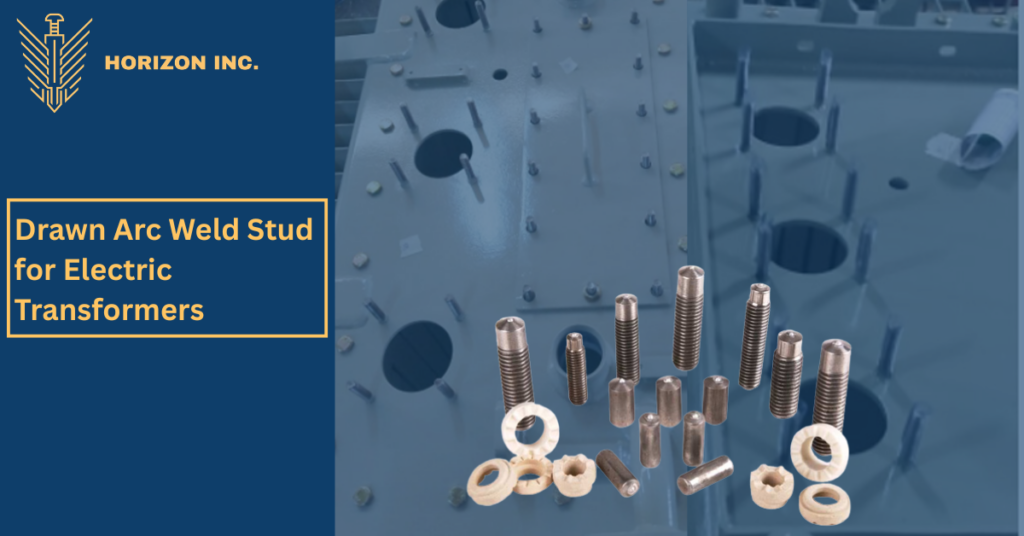
Drawn arc weld studs are threaded or unthreaded fasteners permanently attached to steel surfaces using an electric arc welding process. In electrical transformer manufacturing, they provide secure mounting points for internal components, cable supports, brackets, busbar supports, insulation assemblies, covers, and auxiliary equipment.
Unlike conventional bolts, drawn arc weld studs can be installed from one side of the material without drilling through the transformer tank. This reduces fabrication time, improves structural integrity, eliminates leak paths, and creates a clean internal assembly.
The process produces a full cross-sectional weld that is often stronger than the stud itself when correctly installed. Drawn arc weld studs are widely used in transformer tanks, switchgear enclosures, electrical panels, heavy fabrication, and power distribution equipment and are commonly manufactured according to ISO 13918 standards.
Key Takeaways
- Drawn arc weld studs provide permanent fastening points in transformer tanks.
- No drilling or tapping is required.
- Suitable for carbon steel and stainless steel constructions.
- Faster installation than nuts and bolts.
- Welds can achieve strength comparable to or greater than the stud material.
- Manufactured according to ISO 13918.
- Commonly used for mounting brackets, supports, busbars, cable trays, and insulation assemblies.
- Ideal for medium and heavy-gauge steel transformer tanks.
Introduction
Electrical transformers contain numerous internal and external components that require secure mounting throughout the life of the equipment. Traditional fastening methods involving drilling, tapping, and bolting can increase fabrication time and create additional leak paths in transformer tanks.
Drawn arc weld studs provide an efficient alternative by creating permanent threaded mounting points directly on the tank surface. The technology has become widely adopted in transformer manufacturing because it combines speed, strength, and reliability while simplifying production.
For transformer manufacturers seeking to improve productivity and reduce assembly costs, drawn arc weld studs offer significant advantages over conventional fastening methods.
What Is a Drawn Arc Weld Stud?
A drawn arc weld stud is a fastener specifically designed for stud welding.
During welding:
- The stud is placed in a welding gun.
- A ceramic ferrule surrounds the weld area.
- The stud is lifted slightly from the base metal.
- An electric arc melts both the stud base and parent material.
- The stud is plunged into the molten pool.
- The weld solidifies, creating a permanent metallurgical bond.
The resulting connection creates a strong, vibration-resistant attachment point suitable for demanding industrial environments.
Why Are Drawn Arc Weld Studs Preferred in Transformer Manufacturing?
Reduced Fabrication Time
Stud welding is significantly faster than drilling, tapping, and bolting.
A stud can typically be welded in less than a second, allowing manufacturers to increase production throughput.
No Through Holes
Transformer tanks often require oil-tight construction.
Since weld studs are attached to one side of the material, there is no need to create through holes that could compromise sealing integrity.
Strong Mechanical Performance
Drawn arc welds create full cross-sectional fusion between the stud and base material.
This provides excellent resistance to vibration and mechanical loading during transportation and service.
Cleaner Internal Assembly
The absence of protruding bolt heads and nuts allows cleaner layouts and improved accessibility during transformer assembly.
Where Are Drawn Arc Weld Studs Used in Transformers?
Common applications include:
- Core support structures
- Busbar mounting systems
- Cable support brackets
- Terminal support assemblies
- Earthing connections
- Cooling equipment supports
- Insulation mounting brackets
- Instrumentation supports
- Conservator tank accessories
- Junction box mounting points
Industry sources specifically identify transformers and switchgear as major applications for drawn arc weld studs.
What Materials Are Used for Transformer Weld Studs?
| Material | Typical Use | Advantages |
|---|---|---|
| Low Carbon Steel | Standard transformer tanks | Economical and strong |
| Stainless Steel 304 | Corrosive environments | Corrosion resistance |
| Stainless Steel 316 | Outdoor or coastal installations | Enhanced corrosion resistance |
| Copper Alloy Studs | Special electrical applications | Conductivity benefits |
The material selection should be compatible with the transformer tank material and environmental conditions.
Drawn Arc Weld Studs vs Conventional Fastening Methods
| Parameter | Drawn Arc Weld Studs | Nut & Bolt Assembly | Tapped Hole |
|---|---|---|---|
| Installation Speed | Very Fast | Moderate | Slow |
| Access Required | One Side | Two Sides | One Side |
| Leak Risk | Low | Moderate | Moderate |
| Vibration Resistance | Excellent | Good | Good |
| Labour Requirement | Low | Medium | High |
| Automation Potential | High | Limited | Limited |
What Standards Apply to Drawn Arc Weld Studs?
The primary standard is:
ISO 13918
ISO 13918 specifies dimensions, materials, and performance requirements for welding studs and ceramic ferrules used in stud welding applications.
Manufacturers should ensure compliance with:
- ISO 13918
- Applicable welding procedure qualifications
- Customer-specific transformer standards
- Utility approval requirements
How Do You Select the Right Weld Stud for a Transformer Application?
| Selection Factor | Recommendation |
|---|---|
| Tank Material | Match stud material to base material |
| Corrosion Environment | Use stainless steel if required |
| Load Requirement | Select appropriate diameter and thread size |
| Mounting Component Weight | Increase stud size for higher loads |
| Welding Equipment | Ensure compatibility with stud design |
| Accessibility | Consider installation location |
Common Installation Mistakes and Failure Modes
Incorrect Welding Parameters
Improper current or weld time can result in incomplete fusion.
Poor Surface Preparation
Paint, rust, scale, or oil contamination can compromise weld quality.
Wrong Material Selection
Dissimilar materials may cause corrosion issues over time.
Inadequate Weld Inspection
Failure to inspect weld quality can result in field failures during transportation or service.
Incorrect Stud Length
Studs that are too short may not provide adequate thread engagement.
Practical Observations from Transformer Manufacturing
Based on applications commonly seen in transformer and electrical equipment fabrication:
- M6, M8, and M10 studs are frequently used for mounting internal assemblies.
- Consistent weld quality becomes critical when hundreds of studs are installed on a single transformer tank.
- Manufacturers increasingly prefer stud welding because it reduces assembly labour and improves repeatability.
- Properly welded studs help maintain tank integrity by eliminating unnecessary penetrations.
How Do Drawn Arc Weld Studs Compare to Capacitor Discharge (CD) Weld Studs?
| Parameter | Drawn Arc Studs | CD Weld Studs |
|---|---|---|
| Material Thickness | Medium to Thick | Thin Sheet |
| Stud Diameter Range | Larger Sizes | Smaller Sizes |
| Structural Strength | Higher | Moderate |
| Transformer Tank Use | Preferred | Limited |
| Ferrule Requirement | Usually Yes | No |
| Heavy Equipment Fabrication | Excellent | Limited |
For transformer tanks and structural mounting applications, drawn arc weld studs are generally the preferred solution.
FAQs
Are drawn arc weld studs suitable for transformer tanks?
Yes. They are widely used for mounting internal and external transformer components while maintaining tank integrity.
What standard governs weld studs?
ISO 13918 is the primary international standard for weld studs and ceramic ferrules.
Can stainless steel weld studs be used in transformers?
Yes. Stainless steel grades such as 304 and 316 are commonly selected where corrosion resistance is required.
What stud sizes are commonly used in transformer manufacturing?
M6, M8, M10, and M12 are among the most commonly used sizes, depending on the application.
Are weld studs stronger than bolted connections?
When correctly installed, drawn arc weld studs can develop weld strengths equal to or greater than the stud material itself.
Can weld studs be installed after painting?
No. Welding should be performed on clean bare metal surfaces before painting or coating.
Conclusion
Drawn arc weld studs have become an essential fastening solution in the electrical transformer industry. Their ability to create strong, permanent mounting points without drilling through transformer tanks makes them particularly valuable for modern transformer manufacturing.
By reducing fabrication time, improving assembly efficiency, and maintaining tank integrity, drawn arc weld studs help transformer manufacturers achieve greater productivity and reliability. When sourced according to ISO 13918 and installed using proper welding procedures, they provide a durable fastening solution capable of withstanding the demanding conditions encountered throughout the transformer’s service life.
Looking for ISO 13918-compliant Drawn Arc Weld Studs for transformer manufacturing, switchgear production, or heavy electrical equipment?
Horizon Inc. supplies high-performance weld studs, stud welding consumables, and fastening solutions trusted by transformer manufacturers, panel builders, and industrial fabricators across India.
Contact Horizon Inc. today to discuss your weld stud requirements, technical specifications, and application challenges.
📞 +91 9916777262
📧 sales@horizonincindia.com
🌐 www.horizonincindia.com

Yusuf T. Unjhawala is Co-founder of Horizon Inc., a supplier of industrial fasteners serving electrical control panel manufacturers, sheet metal fabricators, telecom equipment manufacturers, solar industry, HVAC, and industrial OEMs across South India.
Public Policy and Research:
Yusuf is an Adjunct Scholar at the Takshashila Institution, Bengaluru, where his work focuses on defence, strategic affairs.