
Cleaner Fabrication. Stronger Joints. Zero Leakage Risk.
In transformer manufacturing, reliability isn’t optional—it’s fundamental. Every component, from the core to the smallest fastening point, must perform flawlessly under electrical load, temperature variation, and long service life.
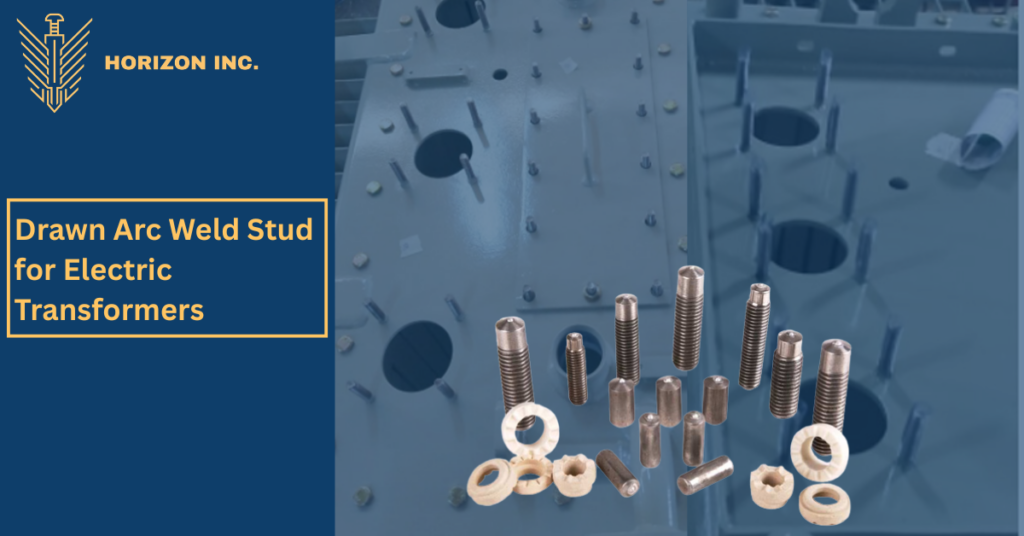
One often overlooked but critical component is the Drawn Arc Weld Stud. It plays a key role in ensuring strong mechanical attachment, reliable earthing, and efficient production—while eliminating several problems associated with traditional fastening methods.
What is a Drawn Arc Weld Stud?
A drawn arc weld stud is a metal fastener that is permanently welded onto a base material using a stud welding process. The stud is momentarily lifted, an arc is drawn, and molten metal forms a full cross-sectional weld between the stud and the parent material.
The result is:
- A high-strength bond
- Excellent electrical continuity
- A permanent, vibration-resistant joint
Why It Matters in Transformer Manufacturing
Transformers operate in demanding environments—mechanically, thermally, and electrically. Drawn arc weld studs provide distinct advantages in such conditions:
1. Reliable Earthing (Grounding)
Weld studs create a direct metal-to-metal connection, ensuring low resistance paths for grounding. Unlike bolted joints, they don’t loosen over time due to vibration or thermal cycling.
2. High Mechanical Strength
From mounting brackets to internal supports, studs provide strong, load-bearing attachment points without weakening the base material.
3. Faster Production
Stud welding is a single-step process. No drilling, no tapping, no assembly—just weld and move on. This significantly improves productivity on the shop floor.
4. Leak-Proof Construction
This is especially critical in transformer tanks and oil-filled systems. Since no holes are drilled, leakage paths are completely eliminated.
The Problem with Traditional Nut & Bolt Fastening
Despite its widespread use, conventional nut-and-bolt fastening introduces multiple inefficiencies and risks in transformer manufacturing.
1. Drilling Adds Time and Complexity
Each fastening point requires a drilled hole. This not only increases cycle time but also introduces the possibility of misalignment and rework.
2. Multi-Step, Labor-Intensive Process
After drilling, operators must:
- Insert the bolt
- Align components
- Tighten the nut
In many cases, bolts are even tack welded to hold them in place, adding another step to the process.
3. Messy and Inconsistent Workflow
Handling loose bolts, nuts, and performing additional welding operations leads to a cluttered fabrication process. It also increases dependency on operator skill.
4. Risk of Oil Leakage
This is a major concern in transformer tanks.
Drilled holes create potential leakage points. Even with sealing methods like gaskets or sealants, there is always a long-term risk of oil seepage, which can lead to failures, maintenance issues, and environmental concerns.
The Drawn Arc Stud Advantage
Drawn arc weld studs eliminate all these problems in one go:
- No drilling required → Saves time and preserves material integrity
- Single-step installation → Faster and more efficient
- Clean fabrication → No loose hardware, no secondary operations
- Permanent fixing → No loosening or re-tightening required
- Zero leakage risk → No holes, no compromise
This results in a streamlined manufacturing process with higher consistency and reliability.
Typical Applications in Transformers
Drawn arc weld studs are widely used across transformer assemblies, including:
- Earthing points inside transformer tanks
- Mounting brackets for radiators and cooling systems
- Cable routing and support structures
- Busbar fixing points
- Nameplates and external attachments
Importance of Quality in Weld Studs
Not all weld studs perform the same. Poor-quality studs can create serious problems:
- Weak or incomplete welds
- Inconsistent welding performance
- Material defects affecting conductivity
- Dimensional inaccuracies leading to weld failure
In high-reliability industries like transformers, these issues can result in downtime, rework, and safety risks.
What Defines a Good Drawn Arc Weld Stud?
A high-quality stud should offer:
- Precise dimensions for consistent welding
- Proper weld tip design for complete fusion
- Uniform material composition
- Clean surface finish
- Compatibility with standard stud welding equipment
Why Choose Horizon Inc.?
At Horizon Inc., we understand the critical requirements of transformer manufacturing. Our drawn arc weld studs are selected and supplied with a focus on:
- Consistent welding performance
- High mechanical strength
- Reliable electrical conductivity
- Process efficiency for your production line
We don’t just supply fasteners—we help you optimize your manufacturing process.
Conclusion
In transformer manufacturing, small improvements can lead to significant gains. Replacing traditional nut-and-bolt fastening with drawn arc weld studs is one such upgrade.
You eliminate drilling, reduce assembly time, avoid messy processes, and most importantly—remove the risk of leakage.
The result is a cleaner, faster, and more reliable production system, backed by stronger joints and better long-term performance.