
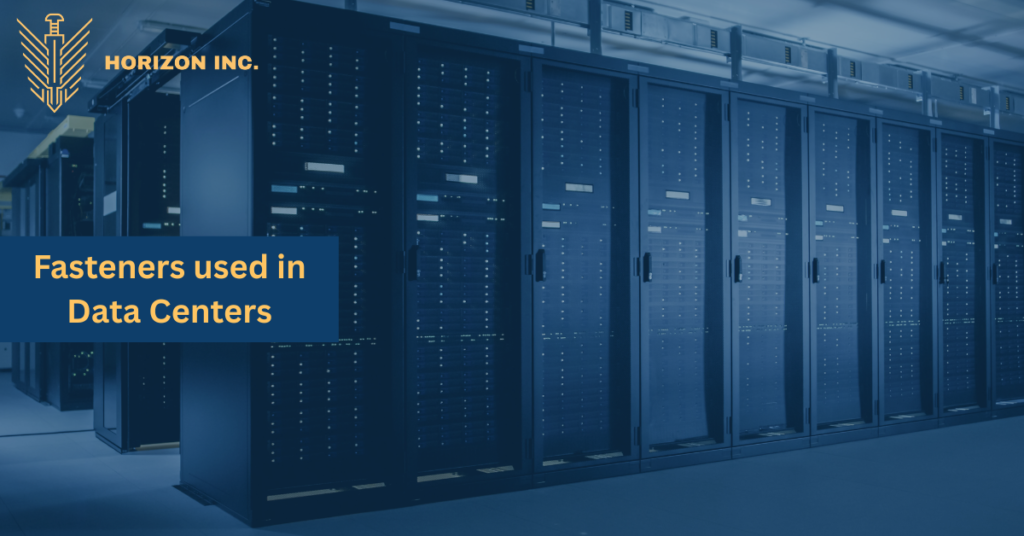
Data centers form the backbone of today’s connected world, powering everything from cloud computing to enterprise networks and AI infrastructure. Behind the complex servers and advanced cooling systems lies a foundation of something simple yet crucial — fasteners. Every rack, enclosure, and panel in a data center depends on precise fastening to ensure stability, electrical continuity, and ease of maintenance.
In this blog, Horizon Inc explores the key types of fasteners used in data center manufacturing and assembly, along with their functions and benefits.
1. Self-Clinching Fasteners
Application: Sheet metal server racks, control enclosures, and chassis assemblies.
Self-clinching fasteners are designed to provide strong, reusable threads in thin sheet metal without welding or loose hardware.
Common types include:
- Self-Clinching Nuts – For threaded joints in thin panels and covers.
- Self-Clinching Studs – For grounding terminals, PCBs, or mounting internal components.
- Self-Clinching Standoffs – For spacing between circuit boards and panels.
Why they’re essential: They offer high strength, vibration resistance, and a flush surface finish ideal for compact data center enclosures.
2. Captive Screws
Application: Server front panels, access covers, and rack doors.
Captive screws remain attached to the panel even when loosened. This prevents hardware loss during maintenance or upgrades, a critical factor in high-density data center environments.
Why they’re essential: They simplify servicing, enhance safety, and eliminate the risk of loose screws dropping into electronic assemblies.
3. Cage Nuts
Application: Mounting equipment onto 19-inch server racks and enclosures.
Cage nuts consist of a square nut encased in a spring steel cage, allowing them to clip into square rack mounting holes. This design provides a floating thread, which helps align bolts even when the panel holes don’t perfectly match.
Why they’re essential:
- Enable flexible equipment mounting on standard rack rails.
- Allow easy replacement if threads strip or get damaged.
- Absorb slight misalignments and vibration.
- Commonly used with rack mounting screws and flat/spring washers for secure installations.
Cage nuts are typically made from zinc-plated steel or stainless steel for durability and corrosion resistance.
4. Rivet Nuts and Jack Nuts
Application: Frame assemblies, brackets, and cable management systems.
Rivet nuts (nut inserts) provide load-bearing threads in thin or hollow sections and can be installed from one side only — ideal for closed-frame server racks or pre-painted panels.
Types include:
- Round Body and Hex Body Rivet Nuts for metal panels.
- Jack Nuts and Split Rivet Nuts for softer materials or plastic panels.
Why they’re essential: They deliver consistent thread strength and fast installation in hard-to-access locations.
5. Blind Rivets
Application: Brackets, fan housings, cable trays, and frame joints.
Blind rivets, also called pop rivets, are installed from one side of the assembly. Structural variants like Monobolt and Interlock Rivets are preferred for high-load or vibration-prone joints in cooling units and support frames.
Why they’re essential: They provide strong, tamper-resistant joints while maintaining surface aesthetics.
6. Machine Screws
Application: Power units, control modules, and sub-assemblies.
Machine screws fasten components with tapped holes or nuts and come in many drive styles (Phillips, Torx, Allen) and heads (Pan, CSK, Button, Hex).
Why they’re essential: Their precision threads ensure consistent clamping torque and alignment in electronic assemblies.
7. Spacers and Standoffs
Application: PCB mounting, electrical insulation, and airflow optimization.
Used to maintain spacing between circuit boards or between boards and panels, spacers and standoffs ensure safe distances and proper heat dissipation.
Available in metal (steel, brass, aluminum) and insulating nylon versions.
Why they’re essential: They ensure structural stability and insulation in compact electronic systems.
8. Washers
Application: Rack mounting, electrical contact, and vibration control.
Washers improve load distribution, prevent loosening, and maintain electrical grounding.
Types include:
- Plain Washers – Load distribution.
- Spring and Star Washers – Anti-vibration locking.
- Conical/Wave Washers – Maintain preload under thermal expansion.
- Nylon Washers – Electrical insulation.
Why they’re essential: They enhance joint reliability and extend service life in vibration-heavy environments.
9. Self-Drilling and Self-Tapping Screws
Application: External panels, frame reinforcements, and cooling assemblies.
These screws create their own holes and threads during installation, reducing assembly time and tool changes.
Why they’re essential: They offer speed, consistency, and secure fastening in both metal and composite materials.
Conclusion
From self-clinching studs to cage nuts, every fastener in a data center assembly plays a role in ensuring mechanical integrity, precision alignment, and service accessibility. Choosing the right fastener directly impacts uptime, reliability, and the ease of equipment installation and maintenance.
At Horizon Inc, we offer a complete range of high-quality fasteners for the data center industry — including self-clinching fasteners, cage nuts, rivet nuts, structural rivets, screws, and standoffs — all designed for durability, precision, and high performance in mission-critical environments.
📌 Connect With Us
Need rivets for your fabrication or structural projects?
📞 Call: 080-41179152
📱 WhatsApp: +91 9916777262
✉️ Email: sales@horizonincindia.com
🌐 Visit: www.horizonincindia.com