
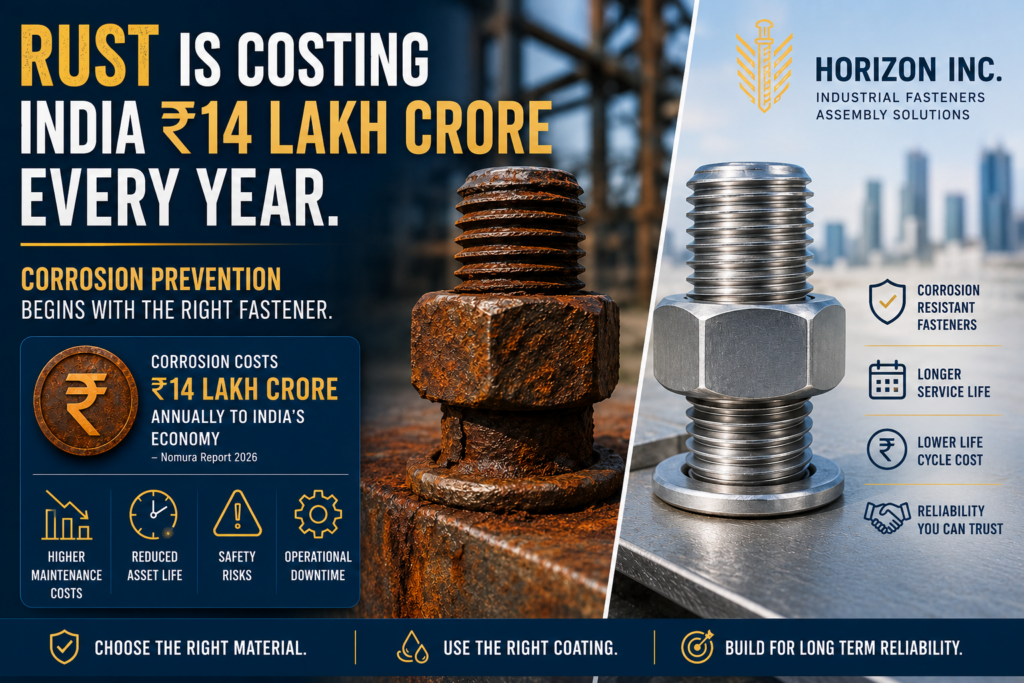
Rust is Costing India ₹14 Lakh Crore Every Year: Why Corrosion-Resistant Fasteners Matter
According to a recent Nomura report, corrosion costs the Indian economy approximately ₹14 lakh crore every year, affecting industries including infrastructure, power, telecom, manufacturing and transportation. While corrosion cannot be eliminated completely, its impact can be significantly reduced through better engineering practices. Selecting corrosion-resistant fasteners, appropriate materials and protective coatings during the design stage helps extend equipment life, reduce maintenance costs and improve safety. For industries operating in demanding environments, choosing the correct fastener is not just a procurement decision—it is an engineering decision that affects the reliability of the entire assembly.
Key Takeaways
- Corrosion is estimated to cost India around 4.3% of GDP annually.
- Fasteners are often among the first components to fail due to corrosion.
- Material selection is just as important as fastener strength.
- Protective coatings significantly improve service life.
- Selecting the correct fastener early reduces lifetime ownership costs.
Introduction
A recent report highlighting that corrosion costs India approximately ₹14 lakh crore every year is a reminder that rust is far more than a cosmetic problem. Across industries, corrosion results in equipment failures, production downtime, expensive repairs and shortened asset life.
Whether it is a telecom tower, an electrical enclosure, a solar mounting structure or an industrial machine, every assembly depends on hundreds—or sometimes thousands—of fasteners. If these fasteners corrode prematurely, the integrity of the entire assembly may be compromised.
For engineers and procurement teams, corrosion prevention begins long before installation. It starts with selecting the right material, coating and fastening solution for the intended operating environment.
Why are fasteners particularly vulnerable to corrosion?
Fasteners are often exposed to moisture, humidity, chemicals and temperature changes. Because they connect different materials, they can also become the starting point for galvanic corrosion when incompatible metals are used together.
Common causes include:
- Outdoor exposure
- Coastal environments
- Industrial pollution
- Chemical processing plants
- Poor drainage around joints
- Incorrect material combinations
Once corrosion starts around a fastener, removal becomes difficult and maintenance costs increase significantly.
How can engineers reduce corrosion?
There is no universal solution. The correct choice depends on the operating environment.
| Environment | Recommended Fastener Material |
|---|---|
| Indoor dry applications | Zinc-plated steel |
| Electrical panels | Stainless Steel 304 or suitable plated steel |
| Outdoor equipment | Hot-dip galvanised steel |
| Coastal installations | Stainless Steel 316 |
| Chemical plants | Stainless Steel 316 or specialised alloys |
| Solar structures | HDG or SS316 depending on location |
Matching the fastener material to the application is one of the simplest and most effective ways to improve durability.
Why are coatings important?
Protective coatings act as a barrier between steel and the surrounding environment.
Some commonly used options include:
- Zinc plating
- Hot-dip galvanising
- Zinc flake coatings such as Geomet® and Dacromet®
- Mechanical galvanising
- Organic protective coatings
Each coating offers different levels of corrosion resistance and should be selected based on environmental exposure, required service life and applicable industry standards.
Corrosion is more expensive than better fasteners
A common misconception is that corrosion-resistant fasteners significantly increase project costs.
In reality, the cost of replacing corroded fasteners, carrying out maintenance or experiencing equipment downtime often far exceeds the additional investment in selecting the appropriate fastening system during the design stage.
This is particularly important for infrastructure projects where maintenance access is difficult or expensive.
Practical observations from Horizon Inc.
Through supplying industrial fasteners for electrical panels, telecom infrastructure, data centres, solar installations and industrial manufacturing, Horizon Inc. has observed that corrosion-related issues often arise from selecting fasteners based solely on initial purchase price rather than total lifecycle cost.
Typical issues include:
- Using zinc-plated fasteners in coastal environments.
- Mixing stainless steel and carbon steel without considering galvanic corrosion.
- Selecting incorrect coatings for outdoor installations.
- Replacing failed fasteners multiple times instead of specifying a suitable material from the outset.
A small change in fastener specification can often prevent years of maintenance problems.
Conclusion
The recent estimate that corrosion costs India ₹14 lakh crore annually highlights the importance of making better engineering decisions during product design and project execution.
Fasteners may represent only a small proportion of the overall project cost, but they play a critical role in ensuring structural integrity and long-term reliability. By selecting suitable materials, protective coatings and fastening systems for the operating environment, manufacturers and project teams can significantly reduce maintenance costs, improve safety and extend asset life.
For engineers, corrosion prevention is not simply about preventing rust—it is about designing for durability.
Frequently Asked Questions
Are stainless steel fasteners completely rust-proof?
No. Stainless steel offers excellent corrosion resistance but can still corrode under certain conditions, particularly in chloride-rich or highly aggressive environments.
Is SS304 suitable for outdoor applications?
SS304 performs well in many outdoor environments, but SS316 is generally preferred for coastal and marine locations.
Is hot-dip galvanising better than zinc plating?
Hot-dip galvanising typically provides a thicker protective coating and longer corrosion resistance for outdoor applications.
Can corrosion weaken a bolted joint?
Yes. Corrosion can reduce the effective cross-section of a fastener, making it more susceptible to loosening or failure.
How do I choose the right fastener for a corrosive environment?
Consider the environment, base materials, required service life, load conditions and applicable standards before selecting the fastener material and coating.
Related Links
Various types of surface plating to prevent corrosion in fasteners
Selecting the right fastener is about more than strength—it is about long-term reliability. If you’re specifying fasteners for electrical panels, telecom infrastructure, solar projects, data centres or industrial manufacturing, Horizon Inc. can help you choose materials and coatings suited to your operating environment, helping reduce corrosion-related failures and extend the service life of your assemblies.

Yusuf T. Unjhawala is Co-founder of Horizon Inc., a supplier of industrial fasteners serving electrical control panel manufacturers, sheet metal fabricators, telecom equipment manufacturers, solar industry, HVAC, and industrial OEMs across South India.
Public Policy and Research:
Yusuf is an Adjunct Scholar at the Takshashila Institution, Bengaluru, where his work focuses on defence, strategic affairs.