
Hex Bolts Technical Datasheets
Hex bolts, also known as hex head bolts or hexagon head bolts, are among the most widely used threaded fasteners for assembling machinery, structural steelwork, industrial equipment, electrical enclosures, automotive components, construction systems, and general engineering applications. Their six-sided head allows easy tightening using standard spanners or sockets while providing high clamping force and reliable mechanical performance.
Horizon Inc. supplies a comprehensive range of industrial hex bolts manufactured to internationally recognised DIN and ISO standards in various materials, property classes, thread configurations, and surface finishes. This technical resource provides downloadable datasheets, engineering specifications, material information, application guidance, and frequently asked questions to help engineers and buyers select the correct hex bolt for their application.
Explore Horizon Inc.’s technical resource for hex bolts, including downloadable datasheets for DIN 931 (ISO 4014) and DIN 933 (ISO 4017). Learn about full-thread and partial-thread hex bolts, property classes, materials, finishes, dimensions, applications, and selection guidelines for industrial and engineering fastening solutions.
Table of Contents
Technical Datasheets
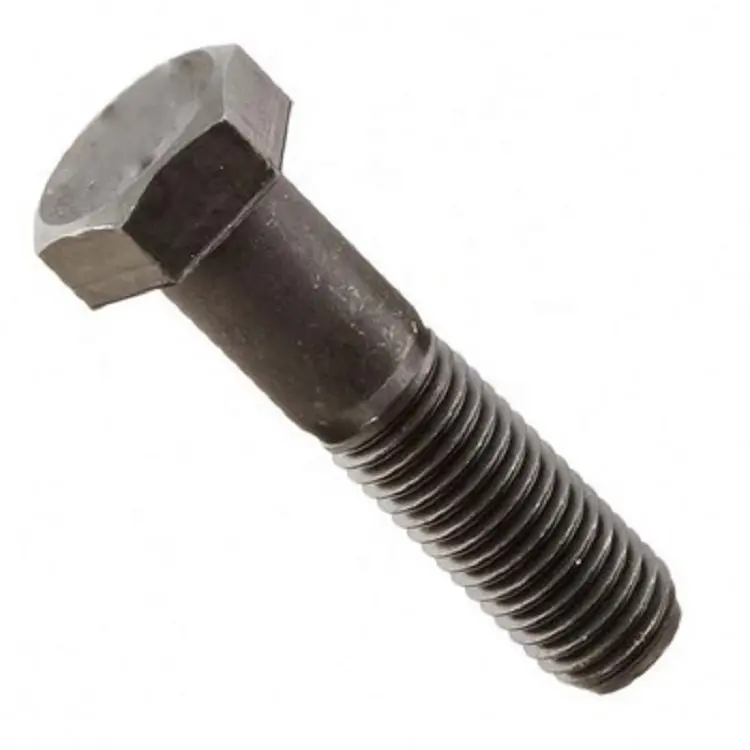
Hex Bolt
DIN 931
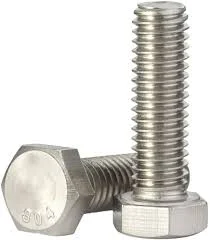
Hex Screw
DIN 933
Understanding Hex Bolt Standards
| Standard | Description |
|---|---|
| DIN 933 | Full Thread Hex Bolt |
| ISO 4017 | International equivalent of DIN 933 |
| DIN 931 | Partial Thread Hex Bolt |
| ISO 4014 | International equivalent of DIN 931 |
Mechanical Properties of Hex Bolt Materials
Hex bolts are manufactured in a range of material grades and property classes to suit different mechanical and environmental requirements. Carbon and alloy steel bolts are classified according to ISO 898-1, while corrosion-resistant stainless steel bolts are classified according to ISO 3506-1.
Carbon & Alloy Steel Fasteners (ISO 898-1)
| Property Class | Min. Tensile Strength (MPa) | Yield Ratio | Min. Yield Strength (MPa) | Typical Material | Typical Applications |
|---|---|---|---|---|---|
| 4.6 | 400 | 0.6 | 240 | Low Carbon Steel | Light-duty fastening |
| 4.8 | 400 | 0.8 | 320 | Low Carbon Steel | General engineering |
| 5.6 | 500 | 0.6 | 300 | Medium Carbon Steel | Machinery |
| 5.8 | 500 | 0.8 | 400 | Medium Carbon Steel | Industrial equipment |
| 6.8 | 600 | 0.8 | 480 | Medium Carbon Steel | Mechanical assemblies |
| 8.8 | 800 | 0.8 | 640 | Quenched & Tempered Steel | General industrial applications |
| 9.8 | 900 | 0.8 | 720 | Quenched & Tempered Steel | Heavy-duty applications |
| 10.9 | 1040 | 0.9 | 940 | Alloy Steel | High-strength joints |
| 12.9 | 1220 | 0.9 | 1100 | Alloy Steel | Critical engineering applications |
Stainless Steel Fasteners (ISO 3506-1)
| Steel Group | Property Class | Min. Tensile Strength (MPa) | Min. Yield Strength (MPa) | Typical Material | Typical Applications |
|---|---|---|---|---|---|
| A2 | 50 | 500 | 210 | SS304 | Light-duty corrosion-resistant applications |
| A2 | 70 | 700 | 450 | SS304 | General industrial applications |
| A2 | 80 | 800 | 600 | SS304 | High-strength stainless applications |
| A4 | 50 | 500 | 210 | SS316 | Light-duty marine applications |
| A4 | 70 | 700 | 450 | SS316 | Marine & chemical environments |
| A4 | 80 | 800 | 600 | SS316 | High-strength corrosion-resistant applications |
Chemical Composition
Rather than listing every steel designation from the standards, keep it concise.
Stainless Steel
| Grade | Carbon (%) | Chromium (%) | Nickel (%) | Molybdenum (%) | Key Benefit |
|---|---|---|---|---|---|
| A2 (SS304) | ≤0.08 | 17.5–20.0 | 8.0–11.0 | — | Excellent general corrosion resistance |
| A4 (SS316) | ≤0.08 | 16.5–18.5 | 10.0–14.0 | 2.0–3.0 | Superior resistance to chlorides and chemicals |
Carbon & Alloy Steel
| Property Class | Material | Carbon (%) | Heat Treatment | Characteristics |
|---|---|---|---|---|
| 4.6–6.8 | Low / Medium Carbon Steel | Up to 0.55 | Generally untreated or normalized | Economical, suitable for general fastening |
| 8.8 | Medium Carbon Steel | 0.25–0.55 | Quenched & Tempered | High strength for industrial use |
| 9.8 | Medium Carbon Steel | 0.25–0.55 | Quenched & Tempered | Higher strength than Class 8.8 |
| 10.9 | Alloy Steel | 0.20–0.55 | Quenched & Tempered | Very high tensile strength |
| 12.9 | Alloy Steel | 0.20–0.50 | Quenched & Tempered | Maximum strength for critical applications |
Materials & Surface Finishes
| Material / Finish | Typical Application |
|---|---|
| Carbon Steel | General industrial use |
| Alloy Steel | High-strength applications |
| Stainless Steel A2 (304) | Corrosion-resistant indoor environments |
| Stainless Steel A4 (316) | Marine and chemical environments |
| Zinc Plated | Indoor corrosion protection |
| Hot Dip Galvanized | Outdoor structural applications |
| Black Oxide | Machinery and tooling |
| Geomet / Dacromet | High corrosion resistance without hydrogen embrittlement |
How to Choose the Right Hex Bolt
| Requirement | Recommended Choice |
|---|---|
| Maximum thread engagement | DIN 933 (Full Thread) |
| Higher shear strength | DIN 931 (Partial Thread) |
| Outdoor installation | Hot Dip Galvanized |
| Corrosive environment | Stainless Steel 316 |
| Heavy mechanical loading | Property Class 10.9 |
| General industrial assembly | Property Class 8.8 |
Advantages of Hex Bolts
- High clamping force
- Excellent tensile strength
- Easy installation using standard tools
- Available in a wide range of sizes and materials
- Suitable for repeated assembly and maintenance
- Compatible with standard nuts and washers
- Available in metric and imperial standards
- Widely recognised international standards
- Suitable for both structural and mechanical applications
Common Applications
- Industrial machinery
- Sheet metal fabrication
- Structural steel
- Electrical control panels
- Telecom equipment
- Construction
- Renewable energy systems
- Automotive manufacturing
- Agricultural machinery
- Material handling equipment
- Machine tools
- General engineering
Dos & Don’ts
| ✔ Do | ✖ Don’t |
|---|---|
| Select the correct property class for the load | Use low-strength bolts in high-load applications |
| Tighten using the recommended torque | Over-tighten and exceed proof load |
| Use matching nuts and washers | Mix incompatible thread standards |
| Inspect threads before installation | Force damaged or cross-threaded bolts |
| Select suitable corrosion protection | Use zinc-plated bolts in highly corrosive environments |
Common Problems & Troubleshooting
| Problem | Possible Cause | Solution |
|---|---|---|
| Bolt loosening | Insufficient preload | Tighten to recommended torque or use locking devices |
| Corrosion | Incorrect material selection | Choose stainless steel or suitable coating |
| Thread stripping | Over-tightening | Follow recommended tightening torque |
| Bolt fracture | Incorrect property class | Select higher-strength bolt |
| Difficult assembly | Damaged threads | Replace damaged fasteners and inspect mating threads |
Frequently Asked Questions
What is the difference between DIN 931 and DIN 933?
The primary difference is the thread length. DIN 931 (ISO 4014) hex bolts have a partial thread, leaving a smooth shank between the head and the threaded portion, whereas DIN 933 (ISO 4017) hex bolts are fully threaded along their entire length. Partial thread bolts are often preferred where the joint is subjected to shear loads, while full thread bolts provide maximum thread engagement.
When should I use a full thread hex bolt?
A full thread hex bolt (DIN 933 / ISO 4017) should be used when maximum thread engagement is required or when fastening into tapped holes. They are commonly used in machinery, fabrication, maintenance, and general industrial assemblies where the entire bolt length contributes to clamping.
When is a partial thread bolt preferred?
Partial thread hex bolts (DIN 931 / ISO 4014) are preferred when the joint experiences significant shear forces. The unthreaded shank provides better alignment and improved shear strength compared to the threaded section, making them suitable for structural and heavy-duty mechanical applications.
What does Property Class 8.8 mean?
Property Class 8.8 indicates a medium carbon steel bolt that has been heat-treated for higher strength. It has a minimum tensile strength of 800 MPa and a yield strength equal to 80% of its tensile strength (640 MPa). Class 8.8 is the most commonly used strength grade for industrial applications.
What is the difference between Property Class 8.8 and Stainless Steel A2-70?
Property Class 8.8 offers higher mechanical strength than A2-70 stainless steel, making it suitable for heavy-duty applications. A2-70 stainless steel provides superior corrosion resistance but has lower tensile strength. The choice depends on whether strength or corrosion resistance is the primary requirement.
Can hex bolts be reused?
Hex bolts may be reused if they have not been permanently stretched, damaged, corroded, or subjected to critical loading conditions. However, for structural, safety-critical, or high-strength applications, replacing the bolt after removal is generally recommended to ensure joint integrity.
What is the recommended tightening torque for hex bolts?
The recommended tightening torque depends on the bolt diameter, property class, lubrication, and surface finish. Always refer to the manufacturer’s torque specifications or recognised engineering standards, as applying incorrect torque can lead to bolt failure, thread stripping, or joint loosening.
Are DIN and ISO hex bolts interchangeable?
In most cases, DIN 933 corresponds to ISO 4017, and DIN 931 corresponds to ISO 4014. Their dimensions are nearly identical for most practical applications, making them interchangeable in many engineering assemblies. However, critical applications should always verify dimensional and tolerance requirements.
Which coating offers the best corrosion resistance?
The best coating depends on the operating environment. Hot-dip galvanizing is widely used for outdoor structural applications, while Geomet® and Dacromet® coatings provide excellent corrosion resistance without introducing hydrogen embrittlement. For highly corrosive environments, stainless steel A4 (316) is often the preferred choice.
How do I identify the correct bolt length?
Hex bolt length is measured from the underside of the head to the end of the threaded shank. The correct length should provide sufficient thread engagement while allowing the nut to fully engage without excessive thread projection.
Should I always use washers with hex bolts?
Washers are recommended in many applications because they distribute the clamping force, protect the mating surface, and reduce the risk of loosening. However, whether a washer is required depends on the joint design, surface material, and engineering specifications.
What industries commonly use hex bolts?
Hex bolts are widely used across industries including construction, structural steel fabrication, automotive, industrial machinery, electrical equipment, renewable energy, telecommunications, agricultural equipment, railways, marine, oil & gas, and general manufacturing due to their versatility and high load-carrying capability.