
Self Clinching Heavy Duty Studs Technical Datasheet
Product Overview
Self Clinching Heavy Duty Studs (HFH and HFHS series equivalent) are high-strength, press-fit threaded studs designed for permanent installation into thin sheet metal. These studs provide superior push-out and torque-out performance compared to conventional self-clinching studs and are often used as an alternative to welded studs in sheet metal assemblies. The large bearing head distributes axial loads over a wider area, significantly improving pull-through resistance and structural integrity. HFH studs are manufactured from heat-treated carbon steel for high-strength applications, while HFHS studs are manufactured from stainless steel for corrosion-resistant applications.
These fasteners are installed using a parallel squeezing force, causing the displaced sheet material to flow into the annular groove and permanently lock the stud into place. HFH and HFHS studs are widely used in electrical enclosures, telecom cabinets, data centers, transportation equipment, EV charging systems, industrial machinery, and heavy-duty sheet metal fabrications.
ITEM CODE: 5016
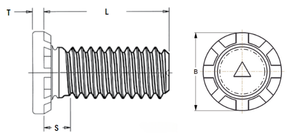
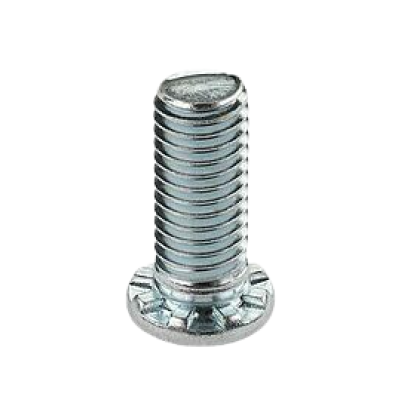
Standards
Primary Standard: PEM® Type HFH, HFHS equivalent
Dimensions
| Size | Min sheet thickness | Hole size | H | S max | T max | Max hole in attached parts | Min hole distance to edge |
|---|---|---|---|---|---|---|---|
| M5 | 1.3 | 5 | 7.8 | 2.7 | 1.14 | 6.4 | 10.7 |
| M6 | 1.5 | 6 | 9.4 | 2.8 | 1.27 | 7.5 | 11.5 |
| M8 | 2 | 8 | 12.5 | 3.5 | 1.7 | 9.5 | 12.7 |
| M10 | 2.3 | 10 | 15.7 | 4.1 | 2.29 | 11.5 | 13.7 |
all dimensions in mm
Download Datasheets
Self Clinching Stud – HFH and HFHS
Material Characteristics and Recommended Applications
| Material | Characteristics | Typical Applications |
|---|---|---|
| Heat Treated Carbon Steel (HFH) | High strength, high torque-out, economical | Electrical panels, telecom cabinets, industrial machinery |
| Stainless Steel (HFHS) | Corrosion resistant, durable, high strength | Outdoor cabinets, food processing, medical equipment, marine applications |
Technical Specifications
| Parameter | HFH | HFHS |
|---|---|---|
| Product Type | Heavy Duty Self Clinching Stud | Heavy Duty Self Clinching Stud |
| Installation Method | Press Fit / Self Clinching | Press Fit / Self Clinching |
| Thread Type | Metric / Unified | Metric / Unified |
| Material | Heat Treated Carbon Steel | Stainless Steel |
| Finish | Zinc Plated / Passivated | Plain Stainless |
| Minimum Sheet Thickness | From 1.3 mm | From 1.3 mm |
| Recommended Sheet Material | Steel, Aluminum | Steel, Aluminum |
| Sheet Hardness | HRB 85 max | HRB 70 max |
| Torque Resistance | Very High | High |
| Push-out Resistance | Very High | High |
| Pull-through Resistance | Excellent | Excellent |
| Installation Equipment | Press Machine | Press Machine |
| Head Style | Non-Flush Heavy Duty Head | Non-Flush Heavy Duty Head |
Applications
- Electrical control panels
- Sheet metal enclosures
- Telecom cabinets
- Data center racks and cabinets
- EV charging equipment
- Industrial machinery
- Railway equipment
- Automotive components
- Medical equipment
- Renewable energy systems
- Heavy fabrication assemblies
- Outdoor cabinets and kiosks
Advantages
- Provides significantly higher push-out and torque-out resistance than standard clinch studs.
- Can replace welded studs in many sheet metal applications.
- Large head design improves pull-through resistance.
- Permanent installation without welding or secondary operations.
- Suitable for thin sheet materials.
- Fast and economical assembly process.
- No heat distortion of sheet metal.
- Available in both carbon steel and stainless steel versions.
- Excellent vibration resistance.
- Suitable for automated installation systems.
Related Products
- Self Clinching Studs
- Self Clinching Standoffs
- Self Clinching Nuts
- Self Clinching Blind Fasteners
- Captive Panel Screws
- Nut Inserts
- Weld Studs
Frequently Asked Questions
What is the difference between HFH and HFHS studs?
HFH studs are manufactured from heat-treated carbon steel for maximum strength, whereas HFHS studs are manufactured from stainless steel for corrosion-resistant applications
Can HFH studs replace weld studs?
Yes. Heavy duty clinch studs are commonly used as an alternative to weld studs because they eliminate welding operations while providing excellent mechanical performance.
What sheet materials can these studs be installed into?
HFH and HFHS studs are primarily installed into mild steel and aluminum sheets with hardness values within the specified limits
What is the minimum sheet thickness required?
Heavy duty clinch studs can be installed in sheet thicknesses starting from approximately 1.3 mm, depending on the stud size.
What is the minimum sheet thickness required?
The minimum sheet thickness depends on the stud series and thread size. Typical installations begin from sheet thicknesses of approximately 0.8 mm and above.
Do heavy duty clinch studs require special installation equipment?
They require installation using a parallel squeezing force generated by arbor presses, hydraulic presses, pneumatic presses, or automated insertion equipment.
Technical Disclaimer
The technical information, specifications, dimensions, mechanical properties, drawings, and performance data provided on this website are intended for general reference and engineering guidance only. Values shown are representative of products manufactured under normal production conditions and may vary depending on material grade, manufacturing tolerances, installation method, application, and operating environment.
While Horizon Inc. makes every reasonable effort to ensure the accuracy of the information provided, we make no warranties, express or implied, regarding its completeness, accuracy, or suitability for any particular purpose. Customers are responsible for verifying that the selected product is appropriate for their specific application and operating conditions. Where safety, structural integrity, or regulatory compliance is critical, independent engineering evaluation and product testing should be performed.
Horizon Inc. reserves the right to modify product specifications, dimensions, materials, and technical data without prior notice.
To the fullest extent permitted by applicable law, Horizon Inc. shall not be liable for any direct, indirect, incidental, consequential, or special damages arising from the use of, or reliance upon, the information contained on this website.
Copyright
© 2026 Horizon Inc. All Rights Reserved.
All content, product data, specifications, technical drawings, images, and documents published on this website are the property of Horizon Inc. and may not be reproduced, distributed, modified, or transmitted without prior written permission.