
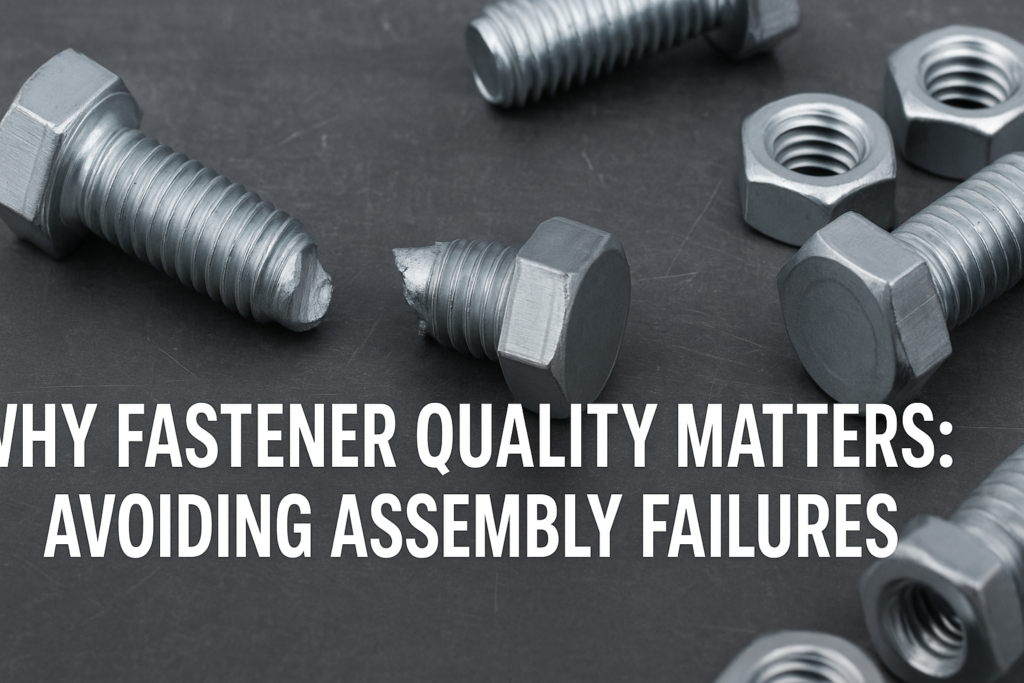
Why Does Fastener Quality Matter?
Fastener quality directly affects the safety, reliability, durability, and performance of an assembly. A poorly manufactured screw, rivet, nut insert, weld stud, or bolt can cause installation problems, production delays, corrosion, vibration loosening, joint failure, and expensive warranty claims. Although fasteners often represent a small percentage of the total product cost, they play a critical role in maintaining structural integrity and long-term performance. Manufacturers of electrical panels, telecom cabinets, data centre infrastructure, solar mounting systems, industrial equipment, and sheet metal assemblies frequently discover that the cost of a fastener failure far exceeds the initial savings from buying lower-priced components. Selecting tested, specification-compliant fasteners helps reduce assembly issues, improve productivity, and minimise lifecycle costs.
Key Takeaways
- Fasteners are often low-cost components but high-risk failure points.
- Poor-quality fasteners can cause assembly delays and rework.
- Corrosion resistance depends on both material and coating quality.
- Incorrect heat treatment can lead to head breakage and thread failure.
- Dimensional inconsistencies affect automated and manual assembly.
- Quality fasteners reduce downtime, warranty claims, and field failures.
- Total cost of ownership is more important than unit price alone.
Introduction
Many procurement decisions focus on obtaining the lowest unit price.
However, when it comes to industrial fasteners, the cheapest option is not always the most economical.
A failed screw, rivet, weld stud, or nut insert can stop production, damage components, create safety risks, and generate warranty costs that are many times higher than the original fastener cost.
At Horizon Inc, we regularly support customers who have experienced installation problems, corrosion failures, stripped threads, and inconsistent assembly performance caused by poor-quality fasteners. In many cases, replacing the fastener supplier resolved the issue without changing the product design.
Why Are Fasteners So Important in an Assembly?
Fasteners create the mechanical connection that holds an assembly together.
Whether in:
- Electrical control panels
- Telecom cabinets
- Data centre infrastructure
- Solar mounting systems
- HVAC equipment
- Industrial machinery
- Sheet metal enclosures
the entire assembly depends on the fastener maintaining the required clamping force throughout its service life.
A failure in a small fastener can compromise a much larger and more expensive system.
What Problems Can Poor-Quality Fasteners Cause?
Common issues include:
- Head breakage during installation
- Stripped threads
- Drill point failure
- Incorrect dimensions
- Premature corrosion
- Loosening under vibration
- Reduced load-bearing capacity
- Water ingress in outdoor applications
Many of these defects are not visible during a basic visual inspection. Material composition, heat treatment quality, plating consistency, and manufacturing tolerances all influence fastener performance.
How Does Fastener Quality Affect Production Efficiency?
Fastener quality directly impacts assembly productivity.
Poorly manufactured fasteners can result in:
- Driver bit slippage
- Feeding issues in automated systems
- Cross-threading
- Increased installation torque variation
- Additional operator time
- Rework and scrap
Even a few seconds of extra assembly time per fastener can create substantial productivity losses in high-volume manufacturing environments.
What Causes Fastener Failures?
Fastener failures generally occur due to one or more of the following:
| Failure Cause | Typical Result |
|---|---|
| Poor material quality | Reduced strength |
| Incorrect heat treatment | Head breakage, cracking |
| Improper coating | Corrosion |
| Dimensional variation | Assembly issues |
| Incorrect fastener selection | Joint failure |
| Improper installation torque | Loosening or breakage |
| Hydrogen embrittlement | Sudden fracture |
| Environmental exposure | Corrosion damage |
Many failures attributed to the fastener are actually caused by a combination of manufacturing defects, incorrect selection, and installation errors.
How Does Corrosion Affect Fastener Performance?
Corrosion is one of the most common causes of long-term fastener failure.
When corrosion develops:
- Joint strength decreases
- Disassembly becomes difficult
- Water ingress may occur
- Structural integrity can be compromised
Selecting the correct material and protective coating is critical.
Common options include:
| Environment | Recommended Material |
| Indoor dry applications | Zinc-plated steel |
| Outdoor structures | Mechanical zinc plating |
| Coastal environments | Stainless steel A2 or A4 |
| Chemical exposure | Stainless steel or specialised coatings |
| Solar installations | Stainless steel or high-corrosion-resistant coatings |
How Can Buyers Evaluate Fastener Quality?
Quality evaluation should go beyond visual inspection.
Key factors include:
| Quality Parameter | Why It Matters |
| Material certification | Confirms chemical composition |
| Mechanical properties | Verifies strength |
| Dimensional inspection | Ensures fitment |
| Coating verification | Improves corrosion resistance |
| Traceability | Supports quality control |
| Batch consistency | Reduces assembly variation |
| Standards compliance | Ensures predictable performance |
Relevant standards may include:
- ISO 898
- ISO 3506
- ASTM standards
- DIN standards
- ISO 13918 for weld studs
- BIS Quality Control Orders (where applicable)
What Is the Real Cost of a Fastener Failure?
The direct cost of replacing a failed fastener is usually insignificant.
The indirect costs are often much larger:
- Production downtime
- Rework labour
- Component damage
- Emergency purchases
- Project delays
- Warranty claims
- Reputation damage
A fastener that represents less than 1% of assembly cost can easily become responsible for a significant portion of overall failure costs.
How Does Horizon Inc Help Customers Reduce Assembly Failures?
Horizon Inc supplies fastening solutions for:
- Sheet metal fabrication
- Electrical panels and enclosures
- Telecom infrastructure
- Data centres
- Solar installations
- Industrial OEMs
Our approach focuses on:
- Application-specific fastener selection
- Reputed manufacturing sources
- Dimensional verification
- Material traceability
- Consistent supply quality
- Technical support for fastening challenges
Rather than simply supplying a part number, we help customers select fasteners suitable for the application environment, material thickness, load requirements, and installation method.
Real-World Example
A sheet metal enclosure manufacturer experienced frequent screw head failures during assembly.
Initial investigation suggested operator error.
However, detailed evaluation revealed inconsistent heat treatment and dimensional variation in the imported screws being used.
After switching to a higher-quality specification, installation speed improved, rejection rates dropped, and production downtime was significantly reduced.
The increase in fastener cost was substantially lower than the savings achieved through improved productivity.
Frequently Asked Questions
Are expensive fasteners always better?
No. The goal is not to buy the most expensive fastener but the correct fastener for the application.
Why do screw heads break during installation?
Common causes include improper heat treatment, material defects, excessive torque, or incorrect fastener selection.
Can poor-quality fasteners affect automated assembly lines?
Yes. Dimensional variation and manufacturing defects can cause feeding problems and downtime.
How can I verify fastener quality?
Review material certificates, inspection reports, dimensional checks, and applicable standards compliance.
Which industries are most affected by fastener quality?
Electrical panels, telecom infrastructure, solar systems, transportation equipment, industrial machinery, and sheet metal fabrication are particularly sensitive to fastener performance.
Why is total cost of ownership important when purchasing fasteners?
Because the purchase price represents only a small portion of the overall cost associated with installation, maintenance, reliability, and potential failures.
Conclusion
Fasteners may be among the smallest components in an assembly, but they have a disproportionate impact on performance, safety, and reliability.
Focusing solely on purchase price can lead to production inefficiencies, field failures, warranty claims, and reputational damage.
Manufacturers that evaluate fasteners based on quality, consistency, and total lifecycle cost are more likely to achieve reliable assemblies and lower long-term operating costs.
For engineers, procurement teams, and manufacturers, investing in the right fastener is often one of the simplest ways to improve product reliability.
Looking to reduce assembly failures, improve installation consistency, and source application-specific fastening solutions?
Contact Horizon Inc for technical guidance on self-drilling screws, blind rivets, nut inserts, weld studs, self-clinching fasteners, and industrial fastening solutions designed for demanding manufacturing environments.
📞 Call: 080-41179152
📱 WhatsApp: +91 9916777262
✉️ Email: sales@horizonincindia.com
🌐 Visit: www.horizonincindia.com

Yusuf T. Unjhawala is Co-founder of Horizon Inc., a supplier of industrial fasteners serving electrical control panel manufacturers, sheet metal fabricators, telecom equipment manufacturers, solar industry, HVAC, and industrial OEMs across South India.
Public Policy and Research:
Yusuf is an Adjunct Scholar at the Takshashila Institution, Bengaluru, where his work focuses on defence, strategic affairs.