
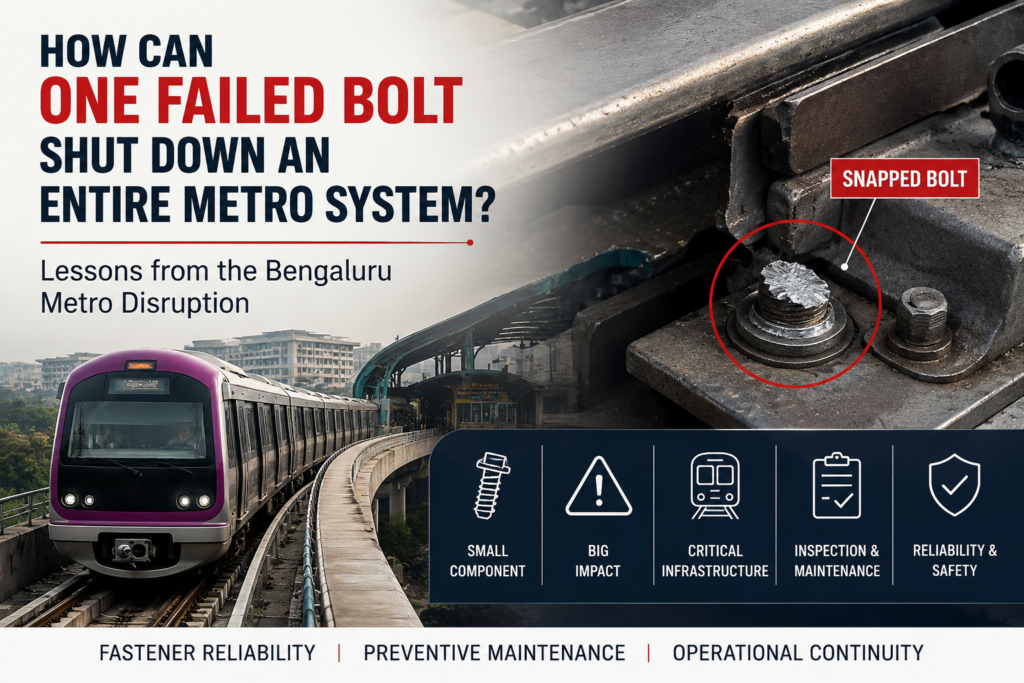
How Can One Failed Bolt Shut Down an Entire Metro System? Lessons from the Bengaluru Metro Disruption
A single bolt can shut down an entire transport system when it is part of a critical load-bearing or alignment-sensitive assembly. According to reports, the recent Bengaluru Metro disruption was linked to a snapped bolt associated with the current collection system that supplies electrical power to trains. In such systems, even a minor change in alignment can affect power collection, equipment positioning, operational safety, and service continuity. The incident serves as a reminder that the reliability of large infrastructure projects often depends on seemingly small components. Proper fastener selection, installation, inspection, and maintenance are essential to preventing costly disruptions, safety risks, and operational downtime in transportation, energy, telecom, data centre, and industrial applications.
Key Takeaways
- Small fasteners can have system-wide consequences.
- Bolt failures are often caused by fatigue, vibration, corrosion, or improper installation.
- Critical infrastructure requires preventive inspection programmes.
- Correct fastener selection is as important as structural design.
- Engineers should evaluate fasteners based on reliability, not merely cost.
- A failure costing a few rupees can result in losses worth millions.
Introduction
Modern engineering systems are often judged by their most visible components—trains, bridges, electrical panels, solar structures, telecom towers, or data centres. However, the reliability of these systems frequently depends on small components such as bolts, screws, rivets, studs, and fastening assemblies.
The recent Bengaluru Metro disruption reportedly caused by a snapped bolt provides an excellent case study in how a single fastener failure can trigger widespread operational consequences. Thousands of passengers were affected, services were disrupted, and questions were raised regarding maintenance and component reliability.
While investigations will determine the exact root cause, the incident highlights important lessons for engineers, maintenance teams, procurement professionals, and infrastructure operators.
Why Can a Single Bolt Cause a Major System Failure?
Many people assume bolts merely hold parts together. In reality, critical fasteners perform several engineering functions:
- Maintaining alignment between components
- Transferring loads safely
- Resisting vibration and dynamic forces
- Maintaining electrical clearances
- Preserving structural integrity
When a bolt is part of a critical assembly, its failure may cause:
- Component movement
- Loss of alignment
- Increased vibration
- Electrical contact issues
- Safety-related shutdowns
In rail systems, even minor alignment changes can create operational risks that require immediate service suspension.
What Is Fastener Fatigue Failure?
Fatigue failure occurs when a fastener experiences repeated loading and unloading cycles over time.
Unlike overload failures, fatigue failures can occur even when loads remain below the material’s ultimate tensile strength.
The typical fatigue process involves:
- Crack initiation
- Crack growth during repeated loading cycles
- Sudden final fracture
Because fatigue cracks often begin microscopically, they may remain undetected during routine visual inspections until failure occurs.
This is one reason why transportation, aerospace, and industrial infrastructure sectors place significant emphasis on preventive maintenance and scheduled replacement programmes.
What Causes Bolts to Fail in Service?
| Failure Mode | Typical Cause | Common Warning Signs |
|---|---|---|
| Fatigue Failure | Repeated cyclic loading | Crack formation near threads |
| Overloading | Excessive force | Permanent deformation |
| Corrosion | Environmental attack | Rust, pitting, material loss |
| Improper Tightening | Incorrect preload | Loosening or movement |
| Vibration Loosening | Dynamic loads | Reduced clamping force |
| Material Defects | Manufacturing issues | Premature unexpected failure |
| Wear and Fretting | Repeated movement | Surface damage and debris |
In many real-world failures, multiple factors contribute simultaneously.
Why Is Proper Fastener Installation Critical?
A premium fastener can still fail prematurely if installed incorrectly.
Common installation mistakes include:
- Under-tightening
- Over-tightening
- Incorrect torque tools
- Reusing damaged fasteners
- Using incompatible materials
- Failure to follow installation specifications
In Horizon Inc.’s experience supplying fasteners to electrical panel manufacturers, telecom cabinet fabricators, solar contractors, and industrial OEMs, installation-related issues are often more common than actual material defects.
Proper installation procedures significantly improve long-term reliability.
How Do Engineers Prevent Critical Fastener Failures?
Preventive maintenance programmes typically include:
| Maintenance Activity | Purpose |
| Visual Inspection | Identify corrosion or damage |
| Torque Verification | Confirm clamping force |
| Vibration Monitoring | Detect abnormal conditions |
| Scheduled Replacement | Prevent fatigue-related failures |
| Corrosion Assessment | Evaluate environmental damage |
| Root Cause Analysis | Investigate recurring issues |
For critical infrastructure, inspection intervals are usually defined based on operating conditions, loading cycles, environmental exposure, and safety requirements.
Which Industries Face Similar Fastener Reliability Risks?
The lessons from the metro disruption extend far beyond rail transportation.
| Industry | Critical Fastener Applications |
| Metro Rail | Power collection systems, trackside equipment |
| Data Centres | Equipment racks, cable support systems |
| Electrical Panels | Self-clinching fasteners, grounding assemblies |
| Telecom Infrastructure | Outdoor cabinets, mounting systems |
| Solar Installations | Module mounting structures |
| EV Charging Equipment | Internal assemblies and mounting systems |
| Industrial Manufacturing | Machinery and automation equipment |
In all these industries, a small fastener failure can result in significant downtime and maintenance costs.
What Can Engineers Learn from the Bengaluru Metro Incident?
Several important lessons emerge from this case:
- Never underestimate the importance of small components.
- Reliability engineering begins at the component level.
- Fasteners should not be treated as commodity items.
- Preventive maintenance is often less expensive than emergency repairs.
- Installation quality and inspection programmes are essential.
- Procurement decisions should consider lifecycle performance, not only purchase price.
A fastener may represent a tiny fraction of the overall project cost, yet its failure can affect an entire system.
Fastener Selection Guide for Critical Applications
| Requirement | Recommended Consideration |
| High Vibration | Locking features or prevailing torque systems |
| Corrosive Environment | Stainless steel or coated fasteners |
| Safety-Critical Assemblies | Traceable certified fasteners |
| Dynamic Loads | Fatigue-resistant designs |
| Outdoor Infrastructure | Corrosion-resistant materials |
| Maintenance Access Difficult | Long-life fastening solutions |
Real-World Engineering Insight
Infrastructure operators often invest heavily in sophisticated equipment while overlooking basic fastening systems.
However, field failures repeatedly demonstrate that system reliability is only as strong as its weakest component.
Whether it is a metro rail system, a telecom network, a solar plant, or an electrical enclosure, fastener reliability remains a fundamental aspect of engineering performance.
The Bengaluru Metro disruption serves as a timely reminder that small components deserve the same engineering attention as major equipment.
Can a single bolt really stop an entire metro system?
Yes. If the bolt is part of a critical assembly affecting alignment, power collection, structural integrity, or safety systems, failure can require immediate shutdown.
What is the most common cause of bolt failure?
Fatigue caused by repeated cyclic loading is one of the most common causes of unexpected bolt failure.
How can fatigue failures be detected?
Through regular inspection, non-destructive testing, torque verification, and monitoring of critical assemblies.
Why is correct bolt tightening important?
Proper tightening creates the required clamping force. Under-tightening and over-tightening can both lead to premature failure.
Are fastener failures common in infrastructure projects?
They are relatively uncommon when proper design, installation, and maintenance practices are followed, but when they occur, the consequences can be significant.
Why should engineers avoid choosing fasteners solely based on price?
The cost of downtime, repairs, and operational disruption often exceeds the savings achieved through lower-cost fasteners.
Conclusion
The Bengaluru Metro disruption demonstrates a fundamental engineering principle: large systems often depend on small components. While investigations will determine the exact root cause, the incident highlights the importance of fastener reliability, preventive maintenance, and proper installation practices.
For engineers, maintenance teams, and procurement professionals, the lesson is clear. Fasteners should never be viewed as insignificant hardware. They are critical components that directly influence safety, reliability, and operational continuity.
At Horizon Inc., we work closely with manufacturers, fabricators, and infrastructure projects to supply fastening solutions that support long-term reliability in demanding industrial environments.

Yusuf T. Unjhawala is Co-founder of Horizon Inc., a supplier of industrial fasteners serving electrical control panel manufacturers, sheet metal fabricators, telecom equipment manufacturers, solar industry, HVAC, and industrial OEMs across South India.
Public Policy and Research:
Yusuf is an Adjunct Scholar at the Takshashila Institution, Bengaluru, where his work focuses on defence, strategic affairs.