
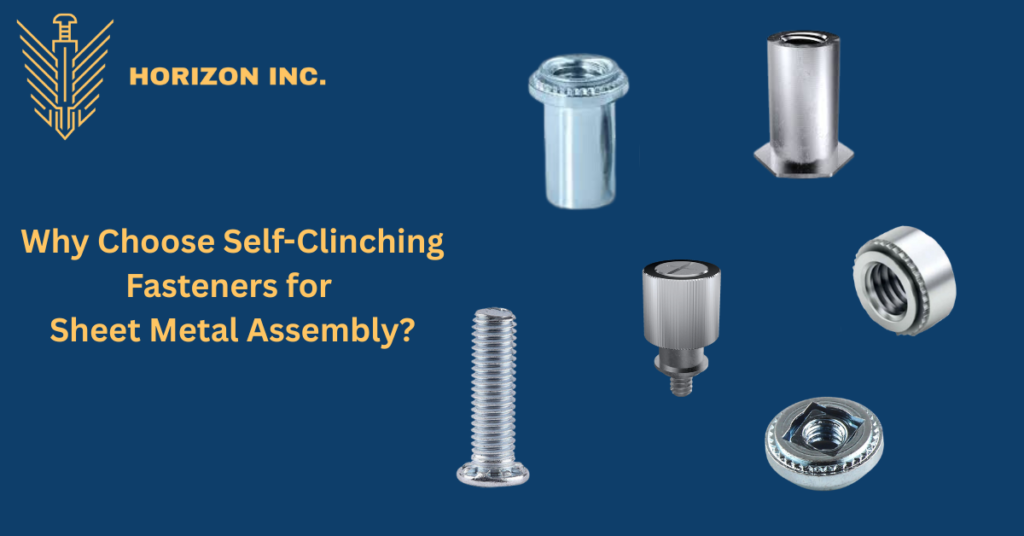
Self clinching fasteners are used in sheet metal assemblies because they create strong, permanent threads and mounting points in thin metal sheets without welding, tapping, or loose hardware. When pressed into a properly sized hole, the surrounding sheet metal cold-flows into the fastener’s undercut features, locking it securely in place. This provides excellent resistance to rotation and pull-out while maintaining a flush surface. Self-clinching fasteners are commonly used in electrical panels, telecom cabinets, data centre enclosures, EV charging equipment, medical devices, and industrial machinery where thin sheet metal must support repeated assembly and disassembly. They improve manufacturing efficiency, reduce assembly time, preserve protective coatings, and provide reliable fastening even in sheets as thin as 0.8 mm.
Key Takeaways
- Ideal for thin sheet metal where tapping is impractical.
- Create permanent threads without welding.
- Maintain flush panel surfaces.
- Suitable for steel, stainless steel and aluminium sheets.
- Improve assembly speed and consistency.
- Available as nuts, studs, standoffs, panel screws and locating pins.
- Widely used in electrical enclosures, telecom equipment and industrial cabinets.
- Reduce fabrication costs and minimise rework.
Introduction
Thin sheet metal fabrication presents unique fastening challenges. Conventional threading often lacks sufficient engagement in thin materials, while welding can introduce heat distortion, coating damage and additional labour.
Self-clinching fasteners solve these challenges by providing permanent, load-bearing attachment points directly within the sheet metal. Their ability to create strong threads in thin panels has made them a preferred fastening method across numerous industries.
What Are Self Clinching Fasteners?
Self-clinching fasteners are mechanical fastening components designed to be permanently installed into ductile sheet metal using a press.
During installation:
- A hole is punched or laser cut in the sheet.
- The fastener is positioned in the hole.
- A controlled pressing force is applied.
- Sheet metal flows into the fastener’s undercut features.
- The fastener becomes mechanically locked into the panel.
Unlike weld nuts or threaded inserts, self-clinching fasteners become an integral part of the sheet metal assembly.
Why Are Self Clinching Fasteners Better for Thin Sheet Metal?
Thin sheet metal often lacks enough thickness to support durable threads.
For example:
| Sheet Thickness | Direct Tapping Suitability |
|---|---|
| Below 1 mm | Poor |
| 1–2 mm | Limited |
| Above 3 mm | Generally acceptable |
Self-clinching fasteners provide full-strength threads without requiring thicker material. This allows designers to maintain lightweight constructions while achieving reliable fastening performance.
What Advantages Do Self-Clinching Fasteners Offer?
Strong and Durable Threads
Self-clinching fasteners provide significantly stronger threads than tapped holes in thin materials.
Benefits include:
- High torque resistance
- High pull-out resistance
- Repeated assembly capability
- Long service life
No Welding Required
Welding can cause:
- Heat distortion
- Surface finish damage
- Additional processing steps
Self-clinching fasteners eliminate these concerns while simplifying manufacturing.
Flush Surface Installation
Most self-clinching designs sit flush with the panel surface.
Advantages include:
- Improved appearance
- Easier stacking of components
- Better use of internal enclosure space
Faster Assembly
Because the fastener is permanently installed during fabrication:
- Fewer loose components are required.
- Final assembly becomes faster.
- Inventory complexity is reduced.
Which Types of Self-Clinching Fasteners Are Available?
| Type | Function | Common Applications |
|---|---|---|
| Self Clinching Nuts | Permanent internal threads | Electrical panels, cabinets |
| Self Clinching Studs | Permanent external threads | Covers, brackets |
| Self Clinching Standoffs | PCB and component spacing | Electronics |
| Self Clinching Panel Screws | Captive access panel fastening | Telecom and IT equipment |
| Self Clinching Locating Pins | Component alignment | Precision assemblies |
At Horizon Inc., these products are regularly supplied to panel builders, enclosure manufacturers, telecom infrastructure companies and industrial equipment OEMs.
Self-Clinching Fasteners vs Alternative Fastening Methods
| Feature | Self-Clinching Fasteners | Weld Nuts | Rivet Nuts (Nut Inserts) | Tapped Holes |
|---|---|---|---|---|
| Suitable for Thin Sheet | Excellent | Moderate | Excellent | Poor |
| Requires Welding | No | Yes | No | No |
| Surface Distortion | None | Possible | None | None |
| Thread Strength | High | High | High | Limited |
| Repeated Assembly | Excellent | Excellent | Excellent | Moderate |
| Installation Speed | Fast | Slower | Fast | Fast |
How Do You Select the Right Self-Clinching Fastener?
Selection depends on several factors.
| Selection Factor | Consideration |
|---|---|
| Sheet Material | Steel, Stainless Steel, Aluminium |
| Sheet Thickness | Minimum thickness requirement |
| Load Requirement | Tensile and torque loads |
| Thread Size | M2 to M12 |
| Corrosion Resistance | Zinc plated, stainless steel |
| Assembly Access | One-side or two-side access |
| Application Environment | Indoor, outdoor, marine, industrial |
The sheet material must generally be softer than the fastener to allow proper cold flow during installation.
Where Are Self-Clinching Fasteners Commonly Used?
Electrical Control Panels
Used for mounting:
- Busbar supports
- Internal assemblies
- Cable management accessories
Telecom Cabinets
Provide secure attachment points for:
- Equipment trays
- Cooling systems
- Access panels
Data Centre Infrastructure
Used extensively in:
- Server racks
- Power distribution units
- Network cabinets
EV Charging Equipment
Support lightweight enclosure designs while maintaining structural integrity.
Industrial Machinery
Enable repeatable assembly and servicing of machine guards, panels and control systems.
Common Installation Mistakes to Avoid
Incorrect Hole Size
Oversized holes may reduce retention strength.
Installing Into Harder Material
The sheet must be softer than the fastener.
Hammer Installation
Self-clinching fasteners should always be installed using controlled press force.
Poor Edge Distance
Insufficient material around the hole can reduce pull-out strength.
Installing After Powder Coating
In many applications, installation should occur before finishing operations to ensure proper seating.
Practical Insights from Horizon Inc.
In electrical enclosure manufacturing, one common issue we observe is the use of welded nuts on thin sheet panels. While functional, welding often introduces distortion and requires additional finishing work.
Many customers transitioning to self-clinching nuts and studs report:
- Faster assembly times
- Improved consistency
- Better cosmetic finishes
- Reduced fabrication costs
- Easier maintenance and servicing
For high-volume panel production, these advantages can significantly improve manufacturing efficiency.
FAQs
Are self-clinching fasteners permanent?
Yes. Once installed correctly, they become a permanent part of the sheet metal assembly.
What is the minimum sheet thickness required?
Many designs can be installed in sheet metal as thin as 0.8 mm, depending on fastener type.
Can self-clinching fasteners be installed in stainless steel?
Yes, provided the stainless steel sheet meets the hardness requirements specified by the fastener manufacturer.
Are self-clinching fasteners stronger than tapped holes?
In thin sheet metal, they typically provide significantly greater thread strength and durability.
Can they be removed after installation?
They are intended to be permanent. Removal generally damages the sheet metal.
Do self-clinching fasteners require special tools?
Installation requires a press capable of applying controlled force, such as an arbor press or hydraulic press.
Conclusion
Self-clinching fasteners have become one of the most effective fastening solutions for modern sheet metal fabrication. They provide strong, reusable threads in thin materials without welding, preserve panel integrity, accelerate assembly, and improve overall product reliability.
For manufacturers of electrical enclosures, telecom cabinets, data centre infrastructure, EV charging equipment and industrial machinery, self-clinching fasteners offer a practical and cost-effective alternative to traditional fastening methods.
Whether you require self-clinching nuts, studs, standoffs, panel screws or locating pins, selecting the correct fastener can significantly improve assembly performance and long-term reliability.
Looking for self-clinching fasteners for your sheet metal assemblies?
Horizon Inc. supplies a comprehensive range of self-clinching nuts, studs, standoffs, panel screws and locating pins for electrical panels, telecom enclosures, data centres, EV charging equipment and industrial manufacturing applications. Contact our team to discuss your sheet thickness, material and load requirements and receive expert guidance on the right fastening solution.
📞 Call: 080-41179152
📱 WhatsApp: +91 9916777262
✉️ Email: sales@horizonincindia.com
🌐 Visit: www.horizonincindia.com

Yusuf T. Unjhawala is Co-founder of Horizon Inc., a supplier of industrial fasteners serving electrical control panel manufacturers, sheet metal fabricators, telecom equipment manufacturers, solar industry, HVAC, and industrial OEMs across South India.
Public Policy and Research:
Yusuf is an Adjunct Scholar at the Takshashila Institution, Bengaluru, where his work focuses on defence, strategic affairs.