
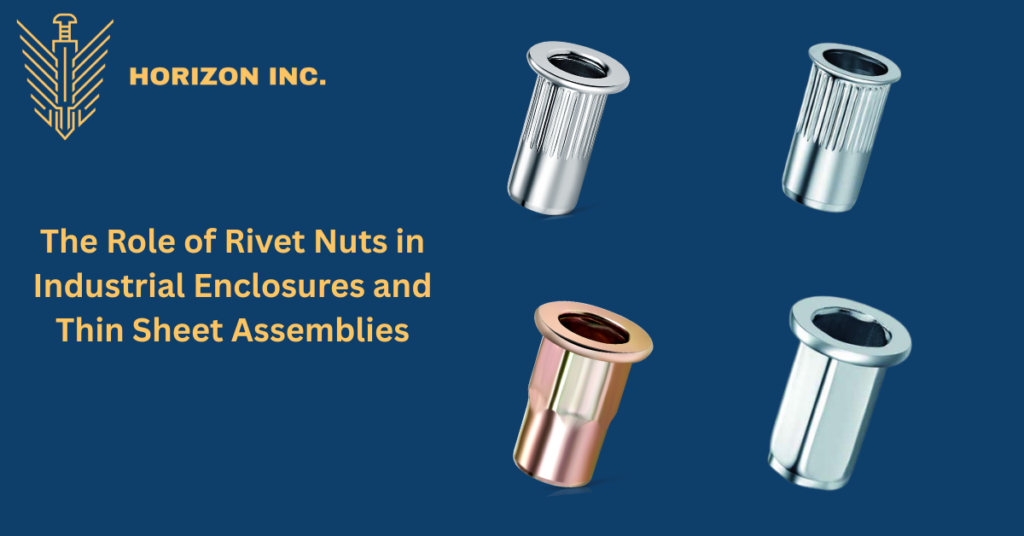
Nut inserts are internally threaded fasteners designed to create strong, reusable threads in thin sheet materials where conventional tapping is impractical. They are installed from one side of the workpiece and deform behind the panel during installation, creating a secure mechanical attachment. Nut inserts are widely used in electrical enclosures, control panels, telecom cabinets, HVAC equipment, data centre racks, solar equipment, EV charging systems, and industrial machinery.
Compared with welded nuts or tapped holes, nut inserts provide faster installation, eliminate welding distortion, allow blind-side installation, and create reliable threads even in sheet thicknesses as low as 0.5 mm. Available in steel, stainless steel, and aluminium, they can be selected for different strength, corrosion resistance, and torque requirements. For many modern sheet metal assemblies, nut inserts have become the preferred solution for creating serviceable threaded connections.
Key Takeaways
- Nut inserts create reusable threads in thin sheet metal.
- Installation requires access from only one side.
- Suitable for steel, stainless steel, aluminium, composites, and plastics.
- Available in round, semi-hex, hex, open-end, and closed-end designs.
- Reduce the need for welding and tapping operations.
- Improve serviceability and maintenance access.
- Commonly used in electrical enclosures, telecom cabinets, data centres, HVAC systems, and industrial equipment.
Introduction
Creating durable threaded connections in thin sheet metal has always been a challenge for design engineers and fabricators. Traditional tapping requires sufficient material thickness to develop thread engagement, while welding nuts adds manufacturing complexity, heat distortion, and additional processing steps.
Nut inserts solve these problems by providing a permanent threaded attachment point in thin materials. Their ability to create strong threads from one side of the assembly has made them a standard fastening solution across numerous industries.
From electrical control panels to data centre infrastructure, nut inserts help manufacturers improve assembly efficiency while maintaining serviceability throughout the product lifecycle.
What Are Nut Inserts?
Nut inserts are internally threaded mechanical fasteners installed into pre-drilled or punched holes.
During installation, a specialised tool pulls the threaded section while supporting the flange. This causes the unthreaded body to collapse behind the sheet, permanently securing the insert in place.
Once installed, the insert provides a durable thread capable of accepting standard machine screws or bolts.
Typical installation materials include:
- Mild steel
- Stainless steel
- Aluminium
- Galvanised sheet
- Composite panels
- Plastics
Why Are Nut Inserts Preferred in Thin Sheet Assemblies?
Thin sheet materials often do not provide enough thickness for reliable thread engagement.
A tapped M6 thread typically requires multiple threads of engagement to achieve full strength. In a 1 mm thick panel, this is often impossible.
Nut inserts solve this challenge by creating:
- Full-depth threads
- High pull-out resistance
- Better load distribution
- Reusable fastening points
- Improved serviceability
Unlike welded nuts, they require no heat input and preserve surface finishes.
How Do Nut Inserts Compare with Other Threaded Fastening Methods?
| Fastening Method | Thin Sheet Capability | One-Side Access | Reusable Threads | Heat Required |
|---|---|---|---|---|
| Nut Inserts | Excellent | Yes | Yes | No |
| Tapped Holes | Limited | Yes | Limited | No |
| Weld Nuts | Good | No | Yes | Yes |
| Self-Clinching Nuts | Good | No | Yes | No |
| Through Bolting | Excellent | No | Yes | No |
For many enclosure manufacturers, nut inserts provide the best balance of strength, cost, and assembly flexibility.
What Types of Nut Inserts Are Available?
Round Body Nut Inserts
The most widely used option.
Applications:
- Electrical enclosures
- Control panels
- Telecom cabinets
- HVAC equipment
Advantages:
- Easy installation
- Cost-effective
- Wide availability
Hex Body Nut Inserts
Designed for higher torque applications.
Advantages:
- Excellent anti-rotation performance
- Increased torque resistance
- Better for dynamic loads
Common uses include:
- Industrial machinery
- Automotive assemblies
- EV equipment
Semi-Hex Nut Inserts
Provide improved anti-rotation characteristics while simplifying hole preparation.
Suitable for:
- Sheet metal fabrications
- Equipment housings
- Structural panels
Closed-End Nut Inserts
Feature a sealed end that prevents contaminants from entering the assembly.
Benefits:
- Improved environmental protection
- Reduced moisture ingress
- Suitable for outdoor equipment
Open-End Nut Inserts
The standard design used for general-purpose applications.
Advantages:
- Greater screw engagement depth
- Lower cost
- Easier availability
Which Materials Are Used for Nut Inserts?
| Material | Corrosion Resistance | Strength | Typical Applications |
| Steel Zinc Plated | Moderate | High | Indoor equipment |
| Stainless Steel 304 | High | High | Outdoor enclosures |
| Stainless Steel 316 | Very High | High | Marine and coastal environments |
| Aluminium | Good | Moderate | Lightweight assemblies |
Material selection should consider:
- Environmental exposure
- Galvanic compatibility
- Mechanical loading
- Weight requirements
Where Are Nut Inserts Commonly Used?
Electrical Control Panels
Nut inserts provide mounting points for:
- DIN rails
- Cable management systems
- Door hardware
- Internal accessories
Telecom Infrastructure
Used extensively in:
- Outdoor cabinets
- Network enclosures
- Communication shelters
Data Centre Equipment
Applications include:
- Server racks
- Network cabinets
- Cooling equipment
Solar Industry
Used in:
- Inverter enclosures
- Monitoring systems
- Junction boxes
Industrial Machinery
Commonly used for:
- Access panels
- Equipment covers
- Maintenance doors
What Are the Most Common Installation Mistakes?
From Horizon Inc.’s experience supplying fastening solutions to sheet metal manufacturers, the most common failures include:
Incorrect Hole Size
Oversized holes can reduce pull-out performance and increase insert rotation.
Wrong Grip Range Selection
Using an insert outside its specified grip range may result in poor clamp performance.
Over-Setting During Installation
Excessive installation force can damage threads or distort the insert body.
Material Mismatch
Using carbon steel inserts in highly corrosive environments often leads to premature failure.
Improper Tooling
Poor-quality installation tools frequently result in inconsistent setting performance.
How Should Engineers Select the Right Nut Insert?
| Selection Factor | Recommendation |
| High Torque | Hex Body |
| Corrosion Resistance | Stainless Steel |
| Lightweight Assembly | Aluminium |
| Outdoor Use | Closed-End Stainless Steel |
| General Industrial Use | Round Body Steel |
| High Vibration | Hex or Semi-Hex Design |
The correct selection should consider:
- Sheet thickness
- Material type
- Installation access
- Environmental exposure
- Service requirements
- Torque loads
Real-World Applications
Electrical Panel Manufacturing
A control panel manufacturer using 1.2 mm CRCA sheet may install M5 and M6 nut inserts for mounting cable trays, DIN rails, and electrical accessories.
Telecom Outdoor Cabinets
Stainless steel closed-end nut inserts help prevent moisture ingress while providing durable serviceable threads.
Data Centre Rack Systems
Nut inserts allow repeated equipment installation and removal without damaging panel threads.
EV Charging Equipment
Manufacturers use nut inserts to create strong mounting points while avoiding weld distortion in powder-coated enclosures.
FAQ
What is the minimum sheet thickness required for nut inserts?
Many designs can be installed in sheet thicknesses starting from approximately 0.5 mm, depending on the insert type and size.
Are nut inserts stronger than tapped threads?
In thin sheet materials, nut inserts generally provide significantly greater thread strength than direct tapping.
Can nut inserts be installed from one side only?
Yes. This is one of their primary advantages.
What is the difference between open-end and closed-end nut inserts?
Closed-end inserts prevent contaminants and moisture from passing through the fastener, while open-end designs allow longer screw engagement.
Which nut insert material is best for outdoor applications?
Stainless steel, particularly 304 or 316 grades, is typically preferred for outdoor environments.
Can nut inserts be used in aluminium sheets?
Yes. They are widely used in aluminium fabrications, EV enclosures, and lightweight equipment.
Conclusion
Nut inserts have become one of the most effective methods of creating strong, reusable threads in thin sheet materials. Their ability to provide blind-side installation, eliminate welding operations, and improve serviceability makes them indispensable in modern industrial assembly.
Whether used in electrical enclosures, telecom cabinets, data centre infrastructure, solar equipment, or industrial machinery, the correct nut insert selection can significantly improve assembly reliability, manufacturing efficiency, and long-term maintenance performance.
For engineers and procurement teams working with thin sheet metal assemblies, understanding body style, material selection, grip range, and installation requirements is essential for achieving reliable fastening performance.
Looking for reliable nut inserts for electrical enclosures, telecom cabinets, data centre infrastructure, solar equipment, EV charging systems, or industrial sheet metal assemblies?
Horizon Inc. supplies steel, stainless steel, and aluminium nut inserts in multiple body styles, flange configurations, and thread sizes, supported by technical guidance to help engineers select the right fastening solution for every application.
Contact our team today to discuss your project requirements and identify the most suitable nut insert for your assembly.
📞 Call: 080-41179152
📱 WhatsApp: +91 9916777262
✉️ Email: sales@horizonincindia.com
🌐 Visit: www.horizonincindia.com

Yusuf T. Unjhawala is Co-founder of Horizon Inc., a supplier of industrial fasteners serving electrical control panel manufacturers, sheet metal fabricators, telecom equipment manufacturers, solar industry, HVAC, and industrial OEMs across South India.
Public Policy and Research:
Yusuf is an Adjunct Scholar at the Takshashila Institution, Bengaluru, where his work focuses on defence, strategic affairs.