
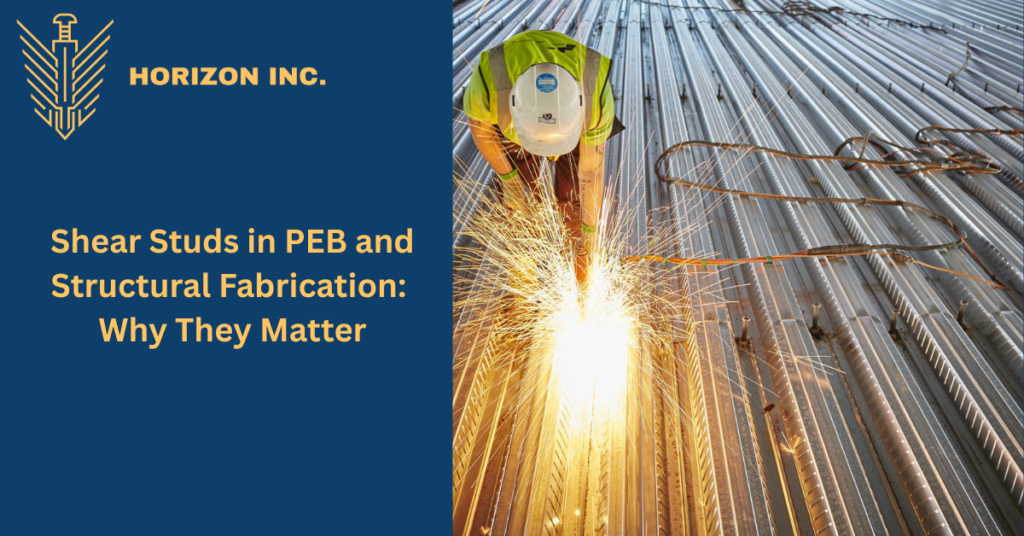
What Are Shear Studs and Why Are They Important in Structural Fabrication?
Shear studs are headed steel fasteners welded directly onto structural steel members to create a mechanical connection between steel and concrete. Their primary function is to transfer shear forces between the steel beam and the concrete slab, allowing both materials to act together as a single structural unit.
In Pre-Engineered Buildings (PEBs), industrial structures, bridges, mezzanine floors, and composite construction projects, shear studs significantly improve load transfer, stiffness, and overall structural performance. Without properly installed shear studs, steel beams and concrete slabs may slip relative to each other, reducing the effectiveness of the structure.
Most structural shear studs are manufactured according to ISO 13918 and installed using Drawn Arc Stud Welding in accordance with recognised welding standards. Proper stud selection, welding quality, and inspection are critical because shear studs directly influence structural safety, load-bearing capacity, and long-term durability.
Key Takeaways
- Shear studs create composite action between steel and concrete.
- Widely used in PEB mezzanine floors, bridges, industrial platforms, and commercial buildings.
- Increase structural stiffness and load-bearing capacity.
- Installed using Drawn Arc Stud Welding.
- Common diameters range from 10 mm to 25 mm.
- Usually manufactured according to ISO 13918.
- Correct welding procedures are as important as stud quality.
- Poor-quality studs can cause weld failures, rework, and project delays.
Introduction
Modern structural engineering increasingly relies on composite construction, where steel and concrete work together to achieve higher strength and greater efficiency.
One component makes this composite action possible: the shear stud.
Although relatively small compared to beams, columns, and slabs, shear studs perform a critical structural function. They transfer loads between steel and concrete, prevent slippage, and help engineers achieve higher load capacities using less material.
For PEB manufacturers, structural fabricators, bridge contractors, and infrastructure developers, understanding the role of shear studs is essential for achieving safe, durable, and code-compliant structures.
What Is a Shear Stud?
A shear stud is a headed steel fastener designed to be welded directly onto a structural steel member.
Once concrete is poured around the stud, the head acts as an anchor within the concrete while the shank transfers horizontal shear forces between the two materials.
The result is a composite structure where the concrete slab and steel beam behave as a single load-bearing element.
How Do Shear Studs Work?
When a composite beam experiences loading:
- The steel beam primarily resists tensile forces.
- The concrete slab primarily resists compressive forces.
- Shear studs transfer forces between the two.
Without shear connectors, the concrete slab and steel beam would move independently.
With properly installed studs:
- Load transfer becomes efficient.
- Deflection is reduced.
- Structural stiffness increases.
- Overall load capacity improves.
Where Are Shear Studs Used?
Common applications include:
PEB Structures
- Mezzanine floors
- Composite deck systems
- Industrial buildings
- Warehouses
Infrastructure Projects
- Bridges
- Flyovers
- Railway structures
- Metro stations
Industrial Facilities
- Equipment platforms
- Access walkways
- Pipe rack structures
- Process plants
Renewable Energy Projects
- Inverter platforms
- Structural foundations
- Equipment support systems
Why Are Shear Studs Important in PEB Construction?
PEB structures often use composite flooring systems to maximise usable space while minimising structural weight.
Shear studs provide several benefits:
- Increased floor load capacity
- Reduced beam sizes
- Improved structural rigidity
- Better vibration control
- Faster construction
For mezzanine floors in warehouses and manufacturing facilities, properly designed shear stud systems often allow significant steel savings compared to non-composite designs.
What Standards Govern Shear Studs?
The most commonly referenced standards include:
| Standard | Description |
|---|---|
| ISO 13918 | Stud welding fasteners and dimensions |
| EN ISO 14555 | Stud welding procedures |
| AWS D1.1 | Structural welding code |
| JIS B1198 | Japanese stud welding standard |
For structural applications, compliance with recognised standards is critical for project approvals and quality assurance.
Common Shear Stud Materials
Low-carbon steel remains the most widely used material because it offers excellent weldability and adequate mechanical strength.
How Do You Select the Right Shear Stud?
Selection depends on several engineering factors.
| Selection Factor | Consideration |
| Beam Size | Influences stud diameter |
| Concrete Thickness | Determines stud length |
| Load Requirements | Determines quantity and spacing |
| Environmental Exposure | Influences material selection |
| Welding Method | Must match stud design |
| Project Specifications | May dictate standards and certifications |
Structural calculations should always be performed by qualified engineers.
Common Shear Stud Sizes
| Diameter | Typical Length Range |
| 10 mm | 50–100 mm |
| 13 mm | 65–125 mm |
| 16 mm | 75–150 mm |
| 19 mm | 80–200 mm |
| 22 mm | 100–250 mm |
| 25 mm | 100–300 mm |
Actual dimensions depend on slab thickness and structural design requirements.
What Are the Most Common Installation Mistakes?
Poor Surface Preparation
Rust, paint, oil, and mill scale can prevent proper fusion during welding.
Missing or Defective Flux Inserts
The aluminium flux tip plays a critical role in arc initiation and weld quality. Missing inserts often result in failed welds.
Incorrect Welding Parameters
Improper current, lift, or plunge settings can produce incomplete weld penetration.
Using Non-Certified Studs
Poor dimensional accuracy affects chuck fitment, welding consistency, and structural performance.
Ignoring Weld Inspection
Every structural stud installation should include visual inspection and bend testing where required.
Real-World Example: Shear Studs in a PEB Mezzanine Floor
A warehouse developer constructing a mezzanine floor may use composite steel decking supported by structural steel beams.
By welding shear studs to the beams before concrete pouring:
- The slab becomes structurally integrated with the beam.
- Beam deflection decreases.
- Floor stiffness increases.
- Material usage can be optimised.
This allows the structure to carry higher loads while maintaining efficient steel consumption.
Why Does Shear Stud Quality Matter?
In structural projects involving thousands of studs, even a small failure rate can create significant costs.
Quality shear studs provide:
- Consistent arc initiation
- Reliable weld quality
- Lower rejection rates
- Faster installation
- Improved productivity
Poor-quality studs often lead to:
- Welding failures
- Rework
- Inspection delays
- Project schedule overruns
The true cost of a shear stud is not its purchase price but its cost per successful weld.
Frequently Asked Questions
What is the purpose of a shear stud?
A shear stud transfers shear forces between steel and concrete, allowing both materials to act as one structural element.
Which standard covers shear studs?
ISO 13918 is the most commonly referenced international standard for structural shear studs.
What welding process is used for shear studs?
Most structural shear studs are installed using Drawn Arc Stud Welding.
Can shear studs be used outdoors?
Yes. Carbon steel, stainless steel, and coated versions are available depending on environmental exposure.
How are shear stud welds inspected?
Inspection typically includes visual examination, weld collar verification, and bend testing.
What industries use shear studs?
PEB construction, bridges, infrastructure, renewable energy, industrial facilities, marine projects, and commercial buildings.
Conclusion
Shear studs are among the most important components in composite steel-concrete construction. They enable efficient load transfer, increase structural capacity, improve stiffness, and contribute directly to long-term safety.
For PEB manufacturers, structural fabricators, bridge contractors, and infrastructure developers, selecting certified shear studs and ensuring proper welding practices are critical to project success. While they may appear small compared to the overall structure, their contribution to performance and reliability is substantial.
📞 Call: 080-41179152
📱 WhatsApp: +91 9916777262
✉️ Email: sales@horizonincindia.com
🌐 Visit: www.horizonincindia.com

Yusuf T. Unjhawala is Co-founder of Horizon Inc., a supplier of industrial fasteners serving electrical control panel manufacturers, sheet metal fabricators, telecom equipment manufacturers, solar industry, HVAC, and industrial OEMs across South India.
Public Policy and Research:
Yusuf is an Adjunct Scholar at the Takshashila Institution, Bengaluru, where his work focuses on defence, strategic affairs.