
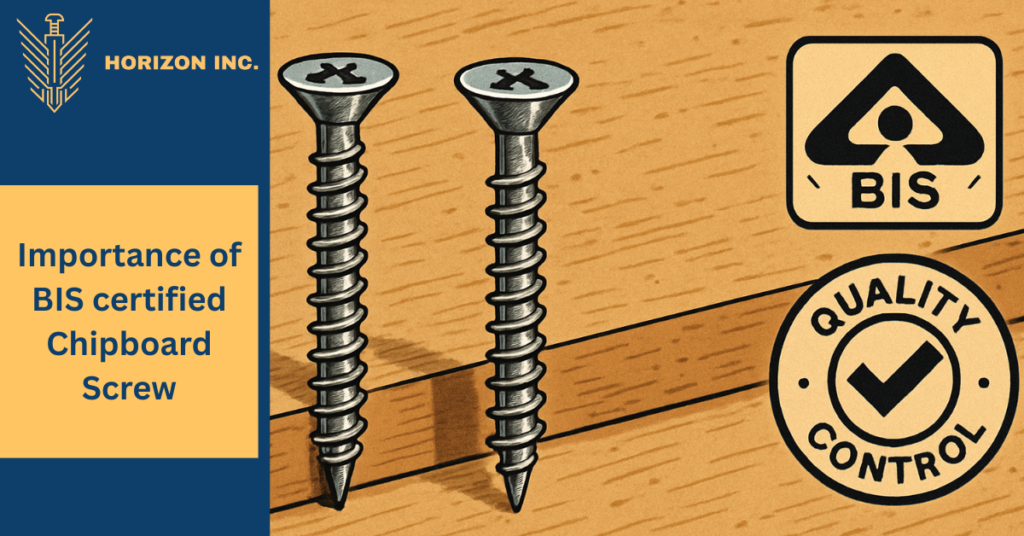
BIS certified chipboard screws are chipboard screws that comply with applicable Indian Standards and are supplied in accordance with BIS requirements where relevant under India’s Quality Control Order framework. These screws are commonly used in furniture manufacturing, modular kitchens, wardrobes, office furniture, retail fixtures and wood-based panel assemblies.
When selecting chipboard screws, buyers should consider not only compliance requirements but also thread design, material quality, surface finish, screw geometry and suitability for the board material being used. Poor screw selection can lead to board splitting, weak holding strength, assembly failures and increased production costs.
Key Takeaways
- Chipboard screws are widely used in furniture and wood panel assemblies.
- Buyers should verify both compliance requirements and application suitability.
- Thread design plays a major role in holding performance.
- Poor quality screws can cause splitting and assembly failures.
- Furniture manufacturers should evaluate screw performance in actual board materials.
- Procurement teams should consider consistency, availability and technical support.
Introduction
Chipboard screws are among the most commonly used fasteners in the furniture and woodworking industries.
They are specifically designed for engineered wood products such as particle board, MDF, HDF, plywood and laminated boards.
With the implementation of fastener QCOs, many buyers now enquire about BIS certified chipboard screws as part of their procurement process.
However, compliance is only one aspect of successful fastener selection. The performance of a chipboard screw depends heavily on its design, manufacturing quality and compatibility with the board material being used.
What Are Chipboard Screws?
Chipboard screws are specialised screws designed to provide strong holding power in wood-based boards.
They typically feature:
- Deep threads
- Sharp points
- Optimised thread geometry
- Countersunk heads
- Surface coatings for corrosion protection
They are commonly used in:
- Modular furniture
- Kitchen cabinets
- Wardrobes
- Office furniture
- Retail display systems
- Interior fit-outs
- Woodworking applications
Why Are Buyers Asking For BIS Certified Chipboard Screws?
Many furniture manufacturers and procurement teams have updated their purchasing specifications following the implementation of fastener QCOs.
Common reasons include:
- Internal compliance requirements
- Customer specifications
- Vendor approval systems
- Procurement policies
- Project documentation requirements
As a result, suppliers increasingly need to support customers with product information and documentation.
What Should Buyers Verify Before Purchasing?
When evaluating chipboard screws, buyers should consider:
| Requirement | Importance |
|---|---|
| Applicable Standard | Compliance verification |
| Screw Diameter | Load carrying capability |
| Screw Length | Board engagement |
| Thread Design | Holding strength |
| Surface Finish | Corrosion protection |
| Head Design | Installation quality |
| Drive Recess | Reduced cam-out |
| Supplier Reliability | Consistent supply |
Why Does Thread Design Matter?
Thread design has a major influence on performance.
Well-designed chipboard screws help:
- Reduce board splitting
- Improve pull-out resistance
- Improve assembly speed
- Minimise material damage
Poor thread geometry may result in:
- Cracked boards
- Weak joints
- Stripped holes
- Rework during assembly
What Causes Wood Splitting During Installation?
Wood splitting is one of the most common complaints in furniture assembly.
Common causes include:
| Cause | Result |
| Poor screw design | Board cracking |
| Incorrect pilot hole size | Material damage |
| Excessive installation torque | Splitting |
| Low-quality heat treatment | Screw breakage |
| Incorrect screw length | Weak joints |
At Horizon Inc., customers evaluating chipboard screws frequently compare performance by installing screws into different board materials and observing splitting behaviour, insertion torque and holding strength.
In many cases, screw design has a significant impact on assembly quality.
How Are Chipboard Screws Used In Furniture Manufacturing?
Typical applications include:
| Application | Typical Use |
| Modular Kitchens | Cabinet assembly |
| Wardrobes | Panel joining |
| Office Furniture | Structural assembly |
| Retail Fixtures | Display construction |
| Interior Fit-Outs | Wood panel fastening |
| Educational Furniture | Panel connections |
How To Select The Correct Chipboard Screw
| Material | Recommended Consideration |
| Particle Board | Deep thread design |
| MDF | Optimised thread engagement |
| Plywood | Appropriate screw length |
| Laminated Boards | Reduced splitting design |
| Hardwood | Pilot hole considerations |
The correct screw depends on board density, thickness and load requirements.
Common Procurement Challenges
Furniture manufacturers may experience:
| Challenge | Impact |
| Inconsistent screw quality | Assembly issues |
| Poor recess quality | Driver slipping |
| Variable dimensions | Production delays |
| Supply interruptions | Manufacturing disruptions |
| Incorrect specification selection | Reduced performance |
Working with suppliers that understand furniture manufacturing requirements can help reduce these issues.
Chipboard Screws vs Conventional Wood Screws
| Feature | Chipboard Screw | Conventional Wood Screw |
| Thread Design | Optimised for engineered boards | General purpose |
| Holding Power | Higher in chipboard and MDF | Variable |
| Installation Speed | Faster | Slower |
| Splitting Risk | Lower when properly designed | Often higher |
| Furniture Applications | Preferred | Limited |
Frequently Asked Questions
What are BIS certified chipboard screws?
They are chipboard screws supplied in accordance with applicable BIS requirements where relevant.
What are chipboard screws used for?
They are used for furniture manufacturing, cabinetry, modular furniture, wardrobes and wood-based panel assembly.
Why do chipboard screws have deeper threads?
Deeper threads improve holding performance in particle board, MDF and similar materials.
What causes chipboard to split during screw installation?
Common causes include poor screw design, excessive torque and incorrect installation practices.
Are chipboard screws suitable for MDF?
Yes. They are widely used in MDF furniture and cabinetry applications.
What is the difference between chipboard screws and wood screws?
Chipboard screws are specifically designed for engineered wood products and typically provide improved holding performance.
Conclusion
BIS certified chipboard screws are increasingly being specified by furniture manufacturers and procurement teams operating within India’s evolving regulatory environment.
However, successful furniture assembly depends on more than compliance alone.
Thread design, material quality, dimensional consistency, installation performance and long-term supply reliability remain critical factors when selecting chipboard screws for furniture manufacturing and woodworking applications.
Need chipboard screws for furniture manufacturing, modular kitchens, wardrobes or woodworking applications?
Horizon Inc. supplies chipboard screws from Bangalore and Chennai, supporting furniture manufacturers, cabinet makers and industrial woodworking businesses across South India with technical guidance and application support.

Yusuf T. Unjhawala is Co-founder of Horizon Inc., a supplier of industrial fasteners serving electrical control panel manufacturers, sheet metal fabricators, telecom equipment manufacturers, solar industry, HVAC, and industrial OEMs across South India.
Public Policy and Research:
Yusuf is an Adjunct Scholar at the Takshashila Institution, Bengaluru, where his work focuses on defence, strategic affairs.