
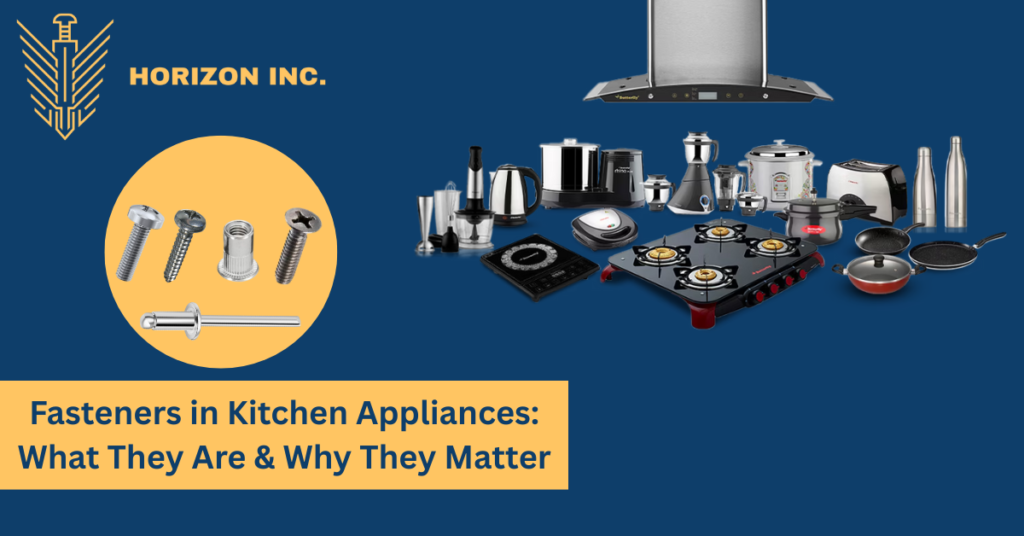
Kitchen appliances rely on a wide range of fasteners to ensure structural integrity, safety, corrosion resistance, vibration resistance and ease of assembly. Common fasteners used in refrigerators, ovens, microwave ovens, dishwashers, chimneys, induction cooktops and commercial kitchen equipment include machine screws, self-tapping screws, blind rivets, rivet nuts, weld studs and self-clinching fasteners.
The choice of fastener depends on factors such as sheet metal thickness, assembly method, vibration levels, exposure to moisture, temperature conditions and maintenance requirements. Stainless steel fasteners are often preferred because they offer corrosion resistance and durability in humid kitchen environments. International standards such as ISO 3506 define the mechanical properties of corrosion-resistant stainless steel fasteners used in demanding applications.
For appliance manufacturers, selecting the correct fastener can significantly impact product reliability, appearance, production efficiency and warranty costs.
Key Takeaways
- Kitchen appliances use screws, rivets, rivet nuts, weld studs and self-clinching fasteners.
- Stainless steel fasteners are commonly selected for corrosion resistance.
- Different appliances require different fastening solutions depending on temperature and vibration exposure.
- Blind rivets are frequently used where access is available from only one side.
- Rivet nuts provide reusable threads in thin sheet metal.
- Self-clinching fasteners eliminate welding and improve assembly efficiency.
- Fastener quality directly affects appliance life, safety and serviceability.
Introduction
Modern kitchen appliances contain hundreds of individual components that must be securely joined while maintaining aesthetics, reliability and ease of manufacture.
Whether manufacturing refrigerators, ovens, dishwashers, microwave ovens, range hoods or commercial kitchen equipment, engineers must select fastening systems that can withstand vibration, thermal cycling, moisture exposure and repeated use.
Although often overlooked, fasteners play a critical role in appliance performance and durability.
Why Are Fasteners Important in Kitchen Appliances?
Fasteners perform several essential functions:
- Structural assembly
- Mounting motors and compressors
- Securing electronic components
- Fixing insulation panels
- Attaching decorative panels
- Mounting hinges and handles
- Supporting shelves and accessories
A failure of a seemingly small fastener can result in:
- Excessive vibration
- Door misalignment
- Water leakage
- Noise issues
- Electrical safety concerns
- Premature appliance failure
What Types of Fasteners Are Used in Kitchen Appliances?
| Fastener Type | Typical Application | Main Advantage |
|---|---|---|
| Machine Screws | Electronic assemblies | Serviceability |
| Self-Tapping Screws | Plastic and sheet metal parts | Fast assembly |
| Blind Rivets | Permanent sheet metal joints | One-sided installation |
| Rivet Nuts | Thread creation in thin sheets | Reusable threads |
| Weld Studs | Internal mounting points | Strong attachment |
| Self-Clinching Fasteners | Panels and enclosures | No welding required |
| Captive Fasteners | Service panels | Prevents loss during maintenance |
Which Fasteners Are Used in Refrigerators?
Refrigerators contain:
- Sheet metal cabinets
- Compressors
- Plastic liners
- Shelving systems
- Hinges
- Electronic control systems
Common fasteners include:
- Self-tapping screws
- Machine screws
- Blind rivets
- Weld studs
- Rivet nuts
Stainless steel or zinc-plated steel fasteners are often selected to resist condensation and moisture-related corrosion.
Which Fasteners Are Used in Ovens and Cooking Equipment?
Ovens present unique challenges because of elevated temperatures.
Engineers typically use:
- Stainless steel machine screws
- Weld studs
- Self-clinching studs
- Threaded inserts
Fasteners near heating zones must maintain mechanical integrity at elevated temperatures and resist oxidation. Stainless steel grades specified under ISO 3506 are commonly used where corrosion resistance is required.
Why Are Blind Rivets Used in Kitchen Appliances?
Blind rivets are extensively used because many appliance assemblies allow access from only one side.
Applications include:
- Refrigerator cabinets
- Chimneys
- Ventilation assemblies
- Appliance panels
- Internal brackets
Benefits include:
- Quick installation
- Consistent clamp force
- Reduced assembly time
- Permanent vibration-resistant joints
When Should Rivet Nuts Be Used?
Thin sheet metal often lacks sufficient thickness for threading.
Rivet nuts solve this problem by creating durable internal threads.
Typical applications:
- Control panels
- Compressor brackets
- Mounting rails
- Serviceable components
Advantages:
- Reusable threads
- Strong pull-out resistance
- Suitable for thin materials
- No access required from the rear side
How Are Self-Clinching Fasteners Used in Appliances?
Self-clinching fasteners are pressed into sheet metal and become permanently locked.
Common types include:
- Self-clinching nuts
- Self-clinching studs
- Self-clinching standoffs
Applications:
- Control panels
- Electronic assemblies
- PCB mounting
- Internal support structures
Benefits:
- Eliminate welding
- Improve assembly speed
- Maintain clean appearance
- Reduce manufacturing costs
Fastener Comparison for Kitchen Appliance Manufacturing
| Requirement | Self-Tapping Screw | Blind Rivet | Rivet Nut | Self-Clinching Fastener |
| Removable | Yes | No | Yes | Yes |
| One-Side Access | Yes | Yes | Yes | No |
| Thin Sheet Suitability | Good | Excellent | Excellent | Excellent |
| Serviceability | Good | Poor | Excellent | Excellent |
| Installation Speed | Fast | Fast | Moderate | Fast |
| Permanent Joint | No | Yes | No | No |
How Does Corrosion Affect Kitchen Appliance Fasteners?
Kitchen appliances operate in environments exposed to:
- Moisture
- Cleaning chemicals
- Steam
- Condensation
- Food acids
Corrosion can lead to:
- Structural weakening
- Rust staining
- Fastener seizure
- Service difficulties
Stainless steel fasteners are widely used because corrosion resistance is an inherent property of the material rather than relying solely on coatings. ISO 3506 establishes property classes for corrosion-resistant stainless steel fasteners.
Common Fastener Selection Mistakes in Appliance Manufacturing
Using Low-Quality Plated Fasteners
Poor plating can fail prematurely in humid environments.
Ignoring Vibration Loads
Compressor and motor assemblies generate continuous vibration.
Overlooking Thermal Expansion
Different materials expand at different rates during heating and cooling cycles.
Choosing Permanent Fasteners for Service Areas
Components requiring maintenance should use removable fastening systems.
Selecting Incorrect Material Grades
Corrosion and temperature requirements must be considered during design.
Horizon Inc. Experience in Appliance Manufacturing Applications
Based on Horizon Inc.’s experience supplying fasteners to sheet metal fabricators and OEM manufacturers, the most common requirements in kitchen appliance production include:
- Reliable threaded connections in thin sheet metal
- Corrosion-resistant fastening systems
- Fast assembly-line installation
- Consistent torque performance
- Clean cosmetic appearance
Products frequently specified include:
- Blind rivets
- Rivet nuts
- Weld studs
- Self-clinching fasteners
- Machine screws
- Stainless steel fasteners
Manufacturers increasingly prefer fastening systems that reduce welding operations and improve assembly efficiency.
How Do Engineers Select the Right Fastener for Kitchen Appliances?
| Design Requirement | Recommended Fastener |
| Permanent Sheet Metal Joint | Blind Rivet |
| Thread in Thin Sheet | Rivet Nut |
| Internal Mounting Point | Weld Stud |
| Electronic Assembly | Self-Clinching Fastener |
| Plastic Housing Assembly | Self-Tapping Screw |
| Serviceable Assembly | Machine Screw |
Real-World Application Examples
Refrigerator Manufacturing
- Rivets for cabinet assembly
- Rivet nuts for compressor mounting
- Machine screws for electronics
Commercial Kitchen Equipment
- Stainless steel screws
- Weld studs
- Self-clinching nuts
Range Hoods and Chimneys
- Blind rivets
- Self-drilling screws
- Rivet nuts
Microwave Ovens
- Self-clinching studs
- Machine screws
- Weld studs
FAQs
What are the most common fasteners used in kitchen appliances?
Machine screws, self-tapping screws, blind rivets, rivet nuts, weld studs and self-clinching fasteners.
Why are stainless steel fasteners preferred in kitchen appliances?
They offer corrosion resistance, durability and long service life in humid environments.
What is the advantage of rivet nuts in appliance manufacturing?
They create reusable threads in thin sheet metal where conventional tapping is not practical.
Are blind rivets suitable for kitchen appliances?
Yes. They provide strong permanent joints and can be installed from one side.
What fasteners are used for mounting electronic assemblies?
Self-clinching fasteners, machine screws and threaded standoffs are commonly used.
Can self-clinching fasteners replace welding?
In many sheet metal applications, yes. They reduce manufacturing steps and improve consistency.
Conclusion
Kitchen appliances depend on carefully selected fastening systems to achieve durability, safety, corrosion resistance and efficient assembly. The ideal fastener varies depending on the appliance, material thickness, environmental exposure and maintenance requirements.
For manufacturers of refrigerators, ovens, dishwashers, chimneys and commercial kitchen equipment, selecting the correct combination of screws, blind rivets, rivet nuts, weld studs and self-clinching fasteners can improve product reliability while reducing production and warranty costs.

Yusuf T. Unjhawala is Co-founder of Horizon Inc., a supplier of industrial fasteners serving electrical control panel manufacturers, sheet metal fabricators, telecom equipment manufacturers, solar industry, HVAC, and industrial OEMs across South India.
Public Policy and Research:
Yusuf is an Adjunct Scholar at the Takshashila Institution, Bengaluru, where his work focuses on defence, strategic affairs.