
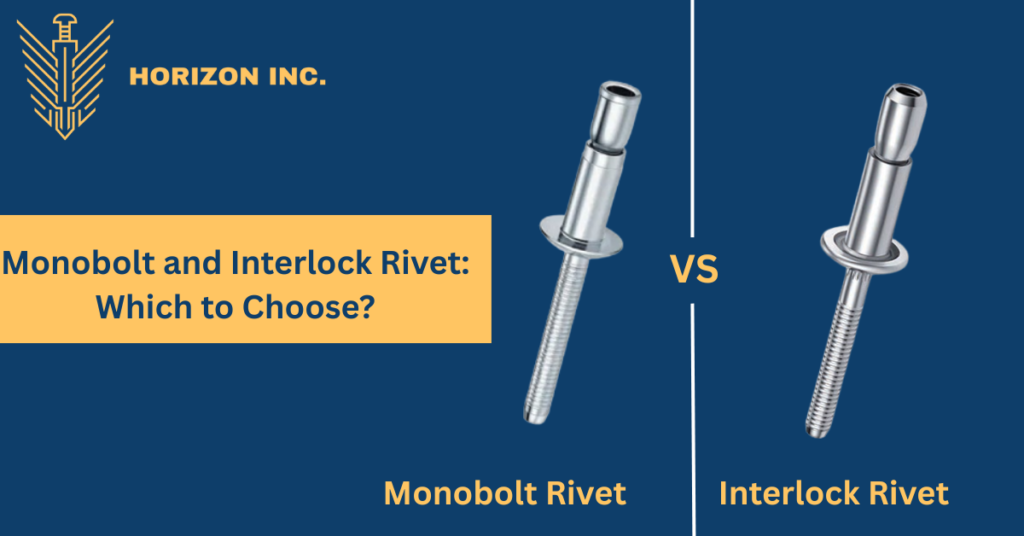
Monobolt rivets and Interlock rivets are both structural blind rivets designed for high-strength fastening where access is available from only one side of the assembly. Both retain the mandrel after installation, providing significantly higher tensile and shear strength than standard blind rivets.
The primary difference lies in the locking mechanism and installation method. Monobolt rivets use a visible mechanical locking system that provides easy inspection after installation and excellent hole-filling capability. Interlock rivets use an internal locking mechanism that offers excellent pull-out resistance and can often be installed using standard structural rivet tooling.
For applications requiring maximum joint integrity, visual inspection, sealing performance, and wide grip ranges, Monobolt rivets are often preferred. For sheet metal assemblies requiring high strength, vibration resistance, and cost-effective installation, Interlock rivets are frequently selected.
Key Takeaways
- Both are structural blind rivets suitable for high-strength applications.
- Both retain the mandrel inside the rivet body after installation.
- Monobolt rivets offer visible lock verification.
- Interlock rivets typically offer lower tooling costs.
- Both provide excellent vibration resistance.
- Monobolt rivets generally provide superior hole-filling characteristics.
- Interlock rivets are widely used in sheet metal enclosures and equipment assemblies.
- Both are suitable alternatives to welding and bolted joints in many applications.
Introduction
Structural blind rivets have become increasingly popular in industries where welding is impractical, access is available from only one side, or production speed is critical.
Among structural blind rivets, Monobolt and Interlock rivets are two of the most commonly specified fastening systems. While they may appear similar, their locking mechanisms, installation characteristics, and performance advantages differ in important ways.
For engineers, procurement teams, and fabricators, understanding these differences can help improve joint reliability while reducing manufacturing costs.
What Is a Monobolt Rivet?
A Monobolt rivet is a high-strength structural blind rivet designed for applications requiring superior tensile strength, shear strength, and vibration resistance.
After installation, the mandrel becomes mechanically locked inside the rivet body, creating a strong structural connection.
Key Features of Monobolt Rivets
- Mechanical stem lock
- Visible lock confirmation
- Excellent hole-filling capability
- Multi-grip design
- High tensile strength
- High shear strength
- Good sealing characteristics
- Suitable for oversized or irregular holes
Typical Applications
- Electrical enclosures
- Data centre cabinets
- Telecom cabinets
- Commercial vehicle bodies
- Railway equipment
- Solar mounting systems
- Industrial machinery
- Heavy fabrication
What Is an Interlock Rivet?
An Interlock rivet is also a structural blind rivet that achieves high joint strength through a mandrel retention system.
Unlike Monobolt rivets, the locking feature is generally internal and not easily visible after installation.
The design provides excellent pull-out resistance and performs well in vibration-prone environments.
Key Features of Interlock Rivets
- Internal mandrel retention
- High pull-out resistance
- Excellent vibration resistance
- High shear strength
- Structural-grade performance
- Suitable for sheet metal assemblies
- Cost-effective installation
Typical Applications
- HVAC equipment
- Electrical panels
- Industrial enclosures
- Trailer bodies
- Transportation equipment
- Material handling equipment
- Sheet metal fabrications
What Are the Main Differences Between Monobolt and Interlock Rivets?
| Feature | Monobolt Rivet | Interlock Rivet |
|---|---|---|
| Lock Visibility | Visible after installation | Internal lock |
| Mandrel Retention | Mechanical lock | Internal locking system |
| Hole Filling | Excellent | Good |
| Grip Range | Wide multi-grip capability | Moderate to wide |
| Inspection | Easy visual verification | More difficult |
| Vibration Resistance | Excellent | Excellent |
| Pull-Out Resistance | Very High | Very High |
| Installation Tooling | May require specific nose assemblies | Often simpler tooling |
| Sealing Performance | Excellent | Good |
| Typical Use | Heavy structural assemblies | Sheet metal structures |
Which Rivet Provides Higher Strength?
Both rivets are classified as structural blind rivets and provide significantly higher strength than standard blind rivets.
Actual performance depends on:
- Rivet diameter
- Material combination
- Grip range
- Installed thickness
- Joint design
In practical applications, both systems are capable of replacing many conventional fastening methods.
Monobolt rivets often excel where maximum hole filling and sealing are required.
Interlock rivets often excel where pull-out resistance and economical installation are priorities.
Which Rivet Is Better for Electrical Enclosures and Control Panels?
For electrical enclosures and control panels, both rivets can be suitable depending on design requirements.
Monobolt Rivets Are Often Selected When:
- Large enclosure assemblies are involved
- Weather sealing is important
- Outdoor installations are expected
- Visual inspection is required
Interlock Rivets Are Often Selected When:
- Production speed is important
- Standard tooling is preferred
- Sheet metal thicknesses are moderate
- Cost optimisation is a priority
At Horizon Inc., Interlock rivets are frequently used in electrical panel manufacturing, telecom cabinets, and industrial enclosures where structural integrity and vibration resistance are required.
How Do They Compare Against Standard Blind Rivets?
| Property | Standard Blind Rivet | Interlock Rivet | Monobolt Rivet |
| Structural Strength | Low to Medium | High | High |
| Mandrel Retention | No | Yes | Yes |
| Vibration Resistance | Moderate | Excellent | Excellent |
| Pull-Out Strength | Moderate | High | High |
| Sealing Capability | Limited | Good | Excellent |
| Fatigue Resistance | Moderate | High | High |
| Structural Applications | Limited | Suitable | Suitable |
How Do You Select Between Monobolt and Interlock Rivets?
Selection Guide
| Application Requirement | Recommended Option |
| Visible lock verification | Monobolt |
| Maximum hole filling | Monobolt |
| Outdoor sealing performance | Monobolt |
| Wide grip range | Monobolt |
| General structural sheet metal assembly | Interlock |
| High pull-out resistance | Interlock |
| Production efficiency | Interlock |
| Electrical enclosures | Interlock or Monobolt |
| Telecom cabinets | Interlock or Monobolt |
| Commercial vehicle bodies | Monobolt |
Common Installation Mistakes
Using Incorrect Grip Range
Selecting the wrong grip range can reduce joint strength and compromise performance.
Oversized Holes Beyond Specification
Structural rivets can accommodate some hole variation, but excessive oversizing reduces joint performance.
Incorrect Tooling
Improper nose assemblies or insufficient pulling force can prevent proper mandrel locking.
Material Compatibility Issues
Failure to consider galvanic corrosion can shorten service life in outdoor environments.
Real-World Applications
Data Centre Infrastructure
Structural blind rivets are used extensively in server racks, containment systems, and cabinet assemblies.
Telecom Cabinets
Outdoor telecom enclosures benefit from vibration resistance and weather-resistant fastening.
Electrical Control Panels
Structural rivets reduce assembly time while providing reliable permanent fastening.
Commercial Vehicles
Vehicle body manufacturers use structural rivets to achieve lightweight, vibration-resistant assemblies.
Frequently Asked Questions
Are Monobolt rivets stronger than Interlock rivets?
Both are structural rivets with very high strength. Selection should be based on application requirements rather than strength alone.
Can Monobolt rivets replace welding?
In many sheet metal and enclosure applications, Monobolt rivets can provide an effective alternative to welding.
Are Interlock rivets waterproof?
They provide good sealing performance, although Monobolt rivets often offer superior hole-filling and sealing characteristics.
Can structural rivets be removed?
Yes. They can be drilled out, although removal requires more effort than standard blind rivets.
Which industries use structural blind rivets most frequently?
Electrical panels, telecom infrastructure, transportation, HVAC equipment, industrial machinery, renewable energy, and data centres.
Are structural rivets reusable?
No. Structural rivets are permanent fasteners and must be replaced after removal.
Conclusion
Both Monobolt and Interlock rivets are proven structural blind fastening solutions capable of delivering high strength, vibration resistance, and long-term reliability.
Monobolt rivets are generally preferred when visual lock verification, sealing performance, and wide grip ranges are critical. Interlock rivets are often selected for structural sheet metal assemblies where installation efficiency and strong pull-out resistance are priorities.
The correct choice depends on joint design, service conditions, tooling availability, and performance requirements.
For electrical enclosures, telecom cabinets, HVAC systems, data centre infrastructure, transportation equipment, and industrial fabrication projects, both rivet systems offer significant advantages over conventional blind rivets.
Need help selecting the right structural rivet for your enclosure, cabinet, vehicle, HVAC, telecom, or industrial fabrication project?
Horizon Inc. supplies structural blind rivets, Monobolt rivets, Interlock rivets, rivet nuts, self-clinching fasteners, weld studs, and industrial fastening solutions for demanding engineering applications.
Contact our team to discuss your joint design, material thickness, load requirements, and production objectives.
📞 +91 9916777262
📧 sales@horizonincindia.com
🌐 www.horizonincindia.com
Read more:
Blind Rivets Explained: Types, Strength Ratings and Selection Guide for Industrial Applications
Product pages:

Yusuf T. Unjhawala is Co-founder of Horizon Inc., a supplier of industrial fasteners serving electrical control panel manufacturers, sheet metal fabricators, telecom equipment manufacturers, solar industry, HVAC, and industrial OEMs across South India.
Public Policy and Research:
Yusuf is an Adjunct Scholar at the Takshashila Institution, Bengaluru, where his work focuses on defence, strategic affairs.