
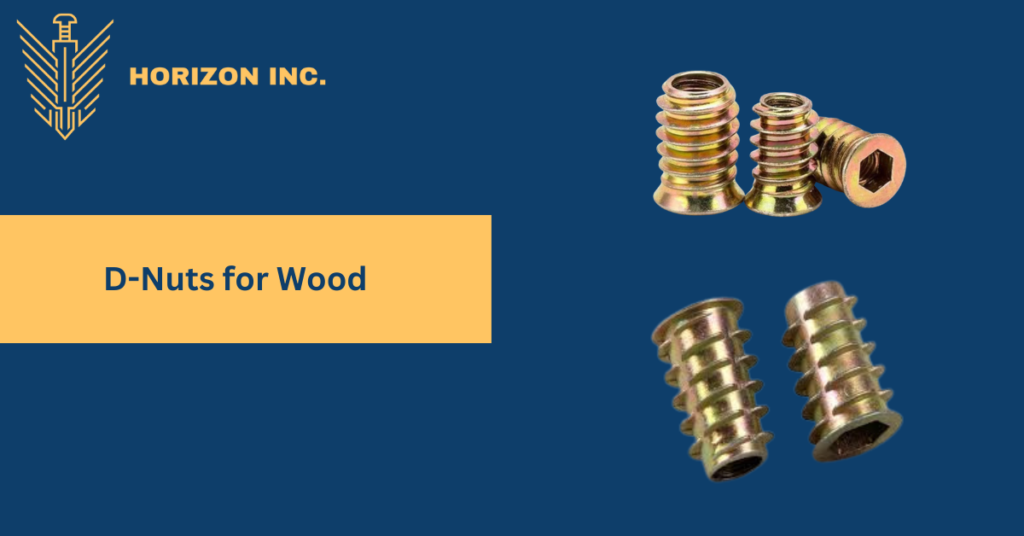
D-nuts are threaded insert nuts designed to create strong, reusable machine threads in wood, MDF, plywood, particle board, and hardwood. Unlike conventional wood screws that cut directly into wood fibres, D-nuts provide a permanent metal thread that can withstand repeated assembly and disassembly without loosening or stripping. They are widely used in knock-down furniture, modular furniture, office furniture, retail fixtures, speaker cabinets, and industrial wooden assemblies.
The two most common types are zinc alloy pineapple-style D-nuts and steel threaded D-nuts. Zinc alloy versions are typically used in MDF and particle board, while steel D-nuts are preferred for hardwood and higher load applications. Selecting the correct D-nut improves joint strength, increases service life, and enables reliable furniture assembly using machine screws or connector bolts.
Key Takeaways
- D-nuts create reusable machine threads in wood.
- Stronger and more durable than direct wood screw connections.
- Available in zinc alloy and steel constructions.
- Widely used in knock-down furniture and modular assemblies.
- Reduce thread stripping during repeated assembly.
- Suitable for MDF, plywood, particle board, softwood, and hardwood.
- Available in metric thread sizes from M4 to M10 and above.
- Improve furniture serviceability and maintenance.
What Is a D-Nut?
A D-nut, also called a Type D insert nut or wood insert nut, is a self-tapping threaded insert designed for installation into wood and engineered wood products.
Once installed, it provides a permanent internal machine thread that allows bolts or machine screws to be repeatedly tightened and removed without damaging the surrounding material.
Unlike traditional wood screws that rely solely on wood fibres for holding power, D-nuts create a metal-to-metal threaded connection.
Why Are D-Nuts Used Instead of Wood Screws?
Wood screws work well for many applications but can loosen over time, especially in softer materials such as MDF and particle board.
D-nuts offer several advantages:
- Reusable threaded connection
- Higher pull-out resistance
- Improved joint strength
- Better vibration resistance
- Easier furniture assembly and disassembly
- Reduced risk of stripped holes
- Improved product life
This is why they are commonly used in ready-to-assemble (RTA) furniture and modular furniture systems.
What Are the Different Types of D-Nuts?
Zinc Alloy D-Nuts (Pineapple Style)
These inserts feature a knurled or segmented exterior often described as a pineapple pattern.
Characteristics:
- Die-cast zinc alloy construction
- Excellent anti-rotation performance
- Easy installation
- Good pull-out resistance in softer boards
Best suited for:
- MDF
- Particle board
- Softwood
- Plywood
- Residential furniture
Steel D-Nuts (Threaded Style)
Steel D-nuts have an external screw thread that cuts into the wood during installation.
Characteristics:
- Higher mechanical strength
- Better fatigue resistance
- Superior load capacity
- Improved performance in hardwoods
Best suited for:
- Hardwood furniture
- Industrial furniture
- Commercial furniture
- Equipment enclosures
- Repeated assembly applications
Zinc Alloy vs Steel D-Nuts
| Feature | Zinc Alloy D-Nut | Steel D-Nut |
|---|---|---|
| Material | Die-cast Zinc Alloy | Carbon Steel |
| Exterior Design | Pineapple Pattern | External Thread |
| Best Material | MDF & Particle Board | Hardwood |
| Installation Effort | Lower | Moderate |
| Pull-Out Strength | Good | Excellent |
| Vibration Resistance | Good | Excellent |
| Heavy Load Capability | Moderate | High |
| Repeated Assembly | Good | Excellent |
Where Are D-Nuts Used?
Furniture Manufacturing
Common applications include:
- Beds
- Tables
- Cabinets
- Wardrobes
- Office furniture
- Modular furniture
Retail Fixtures
Used in:
- Shop displays
- Counters
- Shelving systems
- Exhibition furniture
Audio Equipment
Commonly found in:
- Speaker cabinets
- Audio racks
- Equipment enclosures
Industrial Applications
Used in:
- Wooden machine guards
- Industrial workstations
- Production fixtures
- Assembly jigs
How Do You Install a D-Nut Correctly?
Step 1: Drill the Correct Pilot Hole
The pilot hole should typically be slightly smaller than the D-nut’s external diameter.
Step 2: Align the Insert
Ensure the D-nut is square to the surface before installation.
Step 3: Drive the D-Nut
Install using:
- Allen key
- Hex driver
- Torque-controlled power driver
Step 4: Seat the Flange Flush
Stop when the flange sits flush against the surface.
Avoid over-tightening.
Common Installation Mistakes
Oversized Pilot Holes
This reduces holding power and pull-out resistance.
Misalignment
Crooked installation can damage the internal thread.
Over-Torquing
Excessive torque can crack wood or strip surrounding fibres.
Wrong Material Selection
Using zinc alloy inserts in heavy-duty hardwood applications may reduce joint life.
How Do You Select the Right D-Nut?
| Application | Recommended D-Nut |
| MDF Furniture | Zinc Alloy Pineapple Type |
| Particle Board Furniture | Zinc Alloy Pineapple Type |
| Plywood Furniture | Zinc Alloy or Steel |
| Hardwood Furniture | Steel Threaded Type |
| Industrial Furniture | Steel Threaded Type |
| High Vibration Applications | Steel Threaded Type |
| Frequent Assembly | Steel Threaded Type |
D-Nuts vs T-Nuts vs Barrel Nuts
| Feature | D-Nut | T-Nut | Barrel Nut |
| Installation Side | One Side | Opposite Side Access Required | Through Hole |
| Reusability | Excellent | Excellent | Excellent |
| Appearance | Hidden | Hidden | Visible |
| Ease of Installation | High | Moderate | Moderate |
| Furniture Industry Usage | Very High | Moderate | High |
| Suitable for Flat-Pack Furniture | Excellent | Good | Excellent |
Practical Observations from Furniture Manufacturing
From practical experience in furniture and fixture assembly applications:
- MDF furniture performs better with zinc alloy pineapple-style inserts.
- Steel D-nuts provide superior durability in hardwood furniture.
- Consistent pilot hole sizing significantly improves pull-out performance.
- Torque-controlled installation reduces rejection rates in production environments.
- D-nuts are particularly effective in furniture that requires periodic dismantling and transportation.
Frequently Asked Questions
Are D-nuts stronger than wood screws?
Yes. D-nuts create a metal thread inside the wood, resulting in higher strength and better durability during repeated assembly cycles.
Can D-nuts be used in MDF?
Yes. Zinc alloy pineapple-style D-nuts are commonly used in MDF furniture applications.
Can D-nuts be removed and reused?
Yes. Provided the surrounding wood is not damaged, D-nuts can generally be reused.
Which is better: zinc alloy or steel D-nuts?
For MDF and particle board, zinc alloy versions are usually preferred. For hardwood and heavy-duty applications, steel D-nuts are generally the better option.
What thread sizes are available?
Common sizes include M4, M5, M6, M8, and M10.
Can D-nuts be used outdoors?
Standard zinc-plated versions are typically intended for indoor use. Outdoor applications may require corrosion-resistant coatings or stainless steel alternatives.
Conclusion
D-nuts are among the most effective fastening solutions for creating strong, reusable machine threads in wood and engineered wood products. Whether used in modular furniture, office furniture, retail fixtures, or industrial woodworking applications, they provide superior performance compared to direct wood screw fastening.
Selecting the correct D-nut material, pilot hole size, and installation method can significantly improve furniture durability, reduce maintenance issues, and enhance overall product reliability.
Looking for D-Nuts, furniture fasteners, joint connector bolts, barrel nuts, or other furniture assembly hardware?
Horizon Inc. supplies fastening solutions for furniture manufacturers, modular furniture producers, office furniture OEMs, and woodworking industries across India.
Contact our team today to discuss your application and receive recommendations for the most suitable fastening solution.
📞 Call: 080-41179152
📱 WhatsApp: +91 9916777262
✉️ Email: sales@horizonincindia.com
🌐 Visit: www.horizonincindia.com

Yusuf T. Unjhawala is Co-founder of Horizon Inc., a supplier of industrial fasteners serving electrical control panel manufacturers, sheet metal fabricators, telecom equipment manufacturers, solar industry, HVAC, and industrial OEMs across South India.
Public Policy and Research:
Yusuf is an Adjunct Scholar at the Takshashila Institution, Bengaluru, where his work focuses on defence, strategic affairs.