
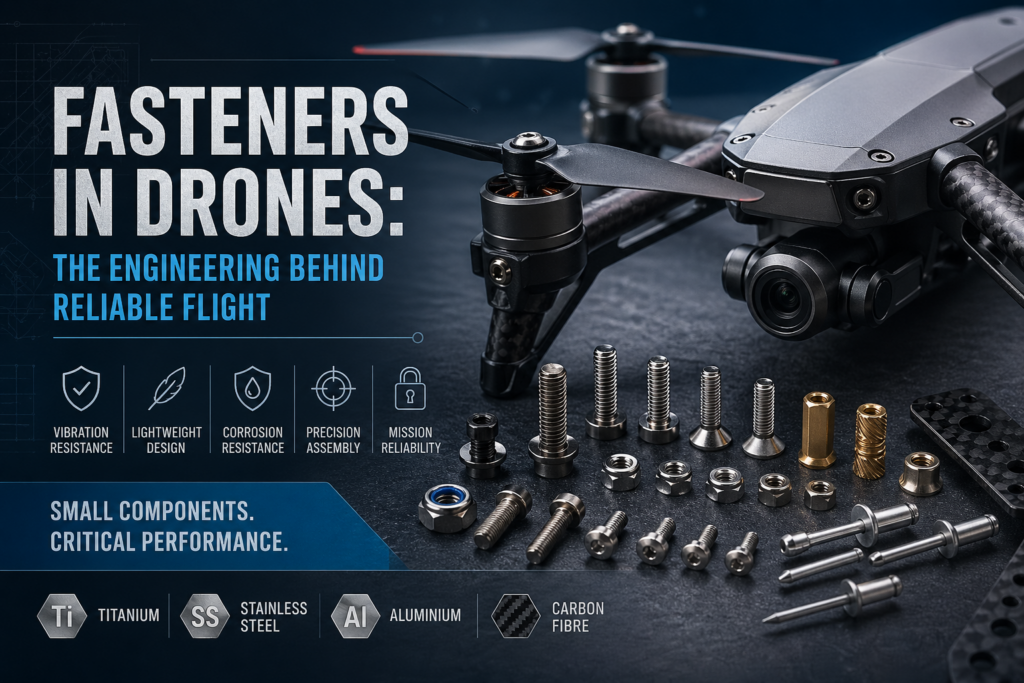
Fasteners play a critical role in drone (UAV) design by securing structural frames, motors, electronic assemblies, battery compartments, payload systems, and protective enclosures. The most common fasteners used in drones include machine screws, self-clinching fasteners, rivet nuts, blind rivets, lock nuts, standoffs, and specialised vibration-resistant hardware.
Drone manufacturers must balance three competing requirements: low weight, high strength, and resistance to vibration. Every gram added to a drone affects flight endurance and payload capacity, while poorly selected fasteners can loosen under continuous vibration and lead to structural failures. For this reason, aerospace-grade stainless steel, aluminium, titanium, and engineered fastening systems are commonly used in commercial and industrial UAVs. Proper fastener selection directly affects flight safety, reliability, maintenance requirements, and operational lifespan.
Key Takeaways
- Fasteners directly influence drone weight, endurance, and payload capacity.
- Vibration resistance is a critical requirement in UAV assemblies.
- Self-clinching fasteners eliminate loose hardware inside enclosures.
- Rivet nuts provide strong threads in thin sheet metal structures.
- Blind rivets offer lightweight permanent assembly solutions.
- Stainless steel and titanium are commonly selected for critical applications.
- Incorrect torque can damage carbon fibre structures.
- Thread-locking solutions help prevent loosening during flight.
Introduction
When discussing drone performance, attention is usually given to batteries, motors, flight controllers, GPS systems, and payloads. However, the mechanical integrity of a drone depends heavily on its fastening system.
A commercial UAV may contain dozens or even hundreds of fasteners securing structural components, electronic systems, protective housings, cameras, communication equipment, and payload attachments. These components must remain secure despite continuous vibration, repeated take-offs and landings, thermal cycling, and environmental exposure.
In many drone failures, the root cause is not an electronic fault but a mechanical connection that has loosened, shifted, or failed under operating conditions.
What Makes Fastener Selection Different in Drones?
Drone fasteners face unique engineering challenges:
Weight Sensitivity
Every additional gram reduces flight endurance and payload capability.
Continuous Vibration
Motors and propellers generate vibration that can loosen conventional threaded joints.
Thin-Walled Structures
Many UAV structures use lightweight aluminium or composite materials that cannot support conventional threads.
Frequent Maintenance
Inspection, repair, and component replacement require fasteners that can withstand repeated assembly cycles.
Environmental Exposure
Drones may operate in:
- Agricultural environments
- Coastal regions
- High humidity areas
- Industrial inspection sites
- Defence applications
These conditions require corrosion-resistant fastening solutions.
Which Fasteners Are Commonly Used in Drones?
| Fastener Type | Typical Drone Application | Key Advantage |
|---|---|---|
| Machine Screws | Frame assembly, motors, electronics | Removable assembly |
| Self-Clinching Nuts | Thin sheet enclosures | Permanent threads |
| Self-Clinching Studs | Electronic modules | Simplified assembly |
| Rivet Nuts | Battery compartments and mounting points | Strong threads in thin material |
| Blind Rivets | Structural joining | Lightweight permanent fixing |
| Lock Nuts | Motor and vibration-prone areas | Prevent loosening |
| Standoffs | PCB and controller mounting | Spacing and support |
| Captive Screws | Access panels | Prevent hardware loss |
Why Are Self-Clinching Fasteners Important in Drone Manufacturing?
Self-clinching fasteners create strong reusable threads in thin sheet metal without welding.
Benefits include:
- Reduced assembly time
- Elimination of loose nuts
- Consistent positioning
- Lightweight construction
- Improved serviceability
Applications include:
- Flight controller housings
- Communication modules
- Battery management systems
- Sensor enclosures
- Ground control equipment
For drone manufacturers using aluminium or stainless steel sheet metal enclosures, self-clinching fasteners are often preferred over welded nuts.
When Should Rivet Nuts Be Used in Drones?
Rivet nuts provide permanent internal threads where access is available from only one side.
Typical UAV applications include:
- Payload mounting systems
- Camera brackets
- Ground station equipment
- Battery trays
- Inspection drone accessories
Compared to welded nuts, rivet nuts:
- Require no heat input
- Preserve material properties
- Reduce distortion
- Enable installation after surface finishing
Blind Rivets vs Rivet Nuts in Drone Manufacturing
| Selection Criteria | Blind Rivets | Rivet Nuts |
| Creates Threads | No | Yes |
| Removable Joint | No | Yes |
| Weight | Lower | Higher |
| Serviceability | Limited | Excellent |
| Structural Joining | Excellent | Good |
| Maintenance Access | Not Required | Required |
How Do Drone Manufacturers Prevent Fasteners from Loosening?
Vibration-induced loosening is one of the biggest challenges in UAV assembly.
Common solutions include:
Nylon Insert Lock Nuts
Provide resistance against self-loosening.
Thread Locking Adhesives
Used on motor mounts and structural connections.
All-Metal Lock Nuts
Suitable for higher temperature environments.
Self-Clinching Hardware
Eliminates multiple loose components.
Proper Torque Control
Preventing both under-tightening and over-tightening is essential.
Which Materials Are Used for Drone Fasteners?
| Material | Weight | Strength | Corrosion Resistance | Typical Use |
| Stainless Steel 304 | Moderate | High | Excellent | General UAV assemblies |
| Aluminium Alloy | Very Low | Moderate | Good | Lightweight assemblies |
| Titanium Grade 5 | Very Low | Very High | Excellent | Premium and defence drones |
| Carbon Steel | High | High | Poor without coating | Limited use |
| Engineered Polymers | Ultra-Light | Moderate | Excellent | Electronic assemblies |
Titanium fasteners are often used where maximum strength-to-weight ratio is required, while stainless steel remains the most common choice due to its balance of cost, strength, and corrosion resistance.
What Are the Most Common Fastener Failures in Drones?
Loose Motor Mount Screws
Continuous vibration can gradually loosen threaded connections.
Stripped Threads
Common in lightweight aluminium structures.
Corrosion
Particularly in agricultural and coastal environments.
Over-Tightening
Can crack carbon fibre structures or deform thin sheet metal.
Hardware Loss During Maintenance
Occurs when small screws are repeatedly removed and replaced.
Real-World Applications of Fasteners in Drone Systems
Agricultural Drones
- Spray tank mounting
- Pump brackets
- Frame assembly
Inspection Drones
- Camera systems
- Thermal imaging modules
- Sensor housings
Defence UAVs
- Payload integration
- Communication equipment
- Mission-specific attachments
Surveying and Mapping Drones
- LiDAR systems
- GPS modules
- Data acquisition equipment
How Should Engineers Select Fasteners for Drone Applications?
| Requirement | Recommended Solution |
| Minimum Weight | Aluminium or titanium fasteners |
| High Vibration | Lock nuts and thread-locking systems |
| Thin Sheet Metal | Self-clinching fasteners |
| Serviceable Assembly | Rivet nuts |
| Permanent Assembly | Blind rivets |
| Corrosive Environment | Stainless steel 304 or 316 |
Frequently Asked Questions
What type of screws are used in drones?
Most drones use metric machine screws, typically M2, M2.5, and M3 sizes depending on the assembly.
Why is weight important when selecting drone fasteners?
Additional weight reduces flight endurance, manoeuvrability, and payload capacity.
Are titanium fasteners used in drones?
Yes. Titanium is used in premium, aerospace, and defence UAVs where weight reduction is critical.
How do manufacturers prevent screws from loosening in drones?
By using lock nuts, thread-locking compounds, self-clinching hardware, and controlled torque procedures.
Are rivet nuts suitable for UAV assemblies?
Yes. Rivet nuts provide strong reusable threads in thin materials and are widely used in lightweight structures.
What is the advantage of self-clinching fasteners in drones?
They provide permanent threads without welding and eliminate loose hardware inside enclosures.
Conclusion
Fasteners may represent a small percentage of a drone’s total cost, but they have a significant impact on structural integrity, reliability, maintenance, and flight safety. As UAV technology advances towards longer flight times, higher payloads, and more demanding operating environments, the importance of selecting the correct fastening solution continues to grow.
Engineers must consider weight, vibration resistance, material compatibility, corrosion resistance, and serviceability when specifying fasteners for drone assemblies. Whether the requirement is self-clinching fasteners for electronic enclosures, rivet nuts for lightweight structures, or blind rivets for permanent assembly, the correct choice can significantly improve UAV performance and reliability.
Designing or manufacturing drones, UAVs, sensor platforms, or aerial inspection equipment?
Horizon Inc. supplies self-clinching fasteners, rivet nuts, blind rivets, machine screws, captive fasteners, and specialised industrial fastening solutions used in lightweight sheet metal assemblies, electronic enclosures, and vibration-prone applications. Contact our team to discuss the right fastening solution for your UAV project.
📞 +91 9916777262
📧 sales@horizonincindia.com
🌐 www.horizonincindia.com

Yusuf T. Unjhawala is Co-founder of Horizon Inc., a supplier of industrial fasteners serving electrical control panel manufacturers, sheet metal fabricators, telecom equipment manufacturers, solar industry, HVAC, and industrial OEMs across South India.
Public Policy and Research:
Yusuf is an Adjunct Scholar at the Takshashila Institution, Bengaluru, where his work focuses on defence, strategic affairs.