
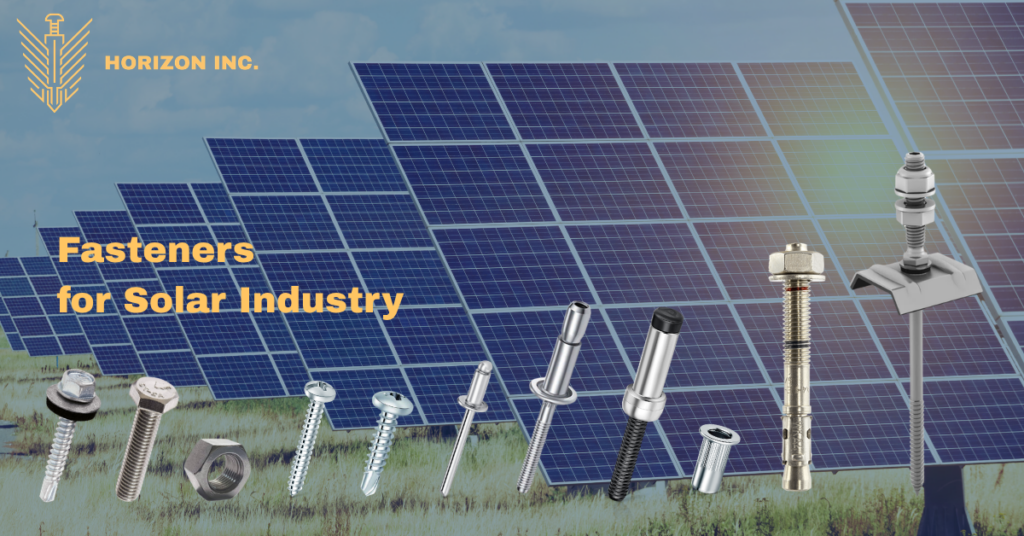
Fasteners are critical components in solar installations because they secure mounting structures, solar modules, cable management systems, and support frames throughout the system’s service life. Solar projects are typically expected to operate for 25 years or more while being exposed to rain, UV radiation, wind loads, temperature cycling, humidity, and corrosion.
The most commonly used fasteners in solar projects include stainless steel bolts, self-drilling screws, rivets, rivet nuts, structural bolts, lock nuts, and specialised mounting hardware. Material selection is particularly important because galvanic corrosion between dissimilar metals can significantly reduce service life.
For rooftop solar installations on sheet metal roofs, high-quality self-drilling screws with bonded EPDM washers are essential to prevent water leakage. For ground-mounted solar farms, corrosion-resistant structural fasteners capable of withstanding wind and fatigue loads are typically required. Proper fastener selection improves reliability, reduces maintenance, and protects the long-term performance of the solar asset.
Key Takeaways
- Solar systems are designed for 25+ years of outdoor service.
- Corrosion is the leading cause of fastener-related failures.
- Stainless steel 304 and 316 are widely used in solar applications.
- Self-drilling screws with EPDM washers are commonly used for rooftop solar installations.
- Galvanic corrosion must be considered when joining aluminium and steel components.
- Fastener failures can result in structural instability, water ingress, downtime, and costly repairs.
- Proper torque installation is as important as fastener selection.
Introduction
When discussing solar installations, most attention is given to solar modules, inverters, trackers, and mounting structures. However, the long-term reliability of the entire installation often depends on a much smaller component—the fastener.
A utility-scale solar plant may contain tens of thousands of fasteners. A rooftop solar project may contain hundreds. Each fastener contributes to structural integrity, weather resistance, and system longevity.
A failed module may be visible immediately. A failed fastener often remains unnoticed until it causes leakage, corrosion, loose panels, or structural damage.
For engineers, EPC contractors, solar installers, and procurement teams, understanding fastener selection is therefore critical.
Why Are Fasteners Critical in Solar Installations?
Solar installations face multiple environmental challenges:
- UV exposure
- Rain and moisture
- High wind loads
- Thermal expansion and contraction
- Vibration
- Coastal salt exposure
- Industrial pollution
Fasteners must maintain clamp load and structural integrity despite these conditions.
Failure can result in:
- Loose solar panels
- Water leakage
- Corrosion of supporting structures
- Reduced system life
- Increased maintenance costs
Where Are Fasteners Used in Solar Projects?
Solar Mounting Structures
Fasteners are used to assemble:
- Rails
- Brackets
- Support frames
- Cross members
- Tracker systems
Applications typically require:
- High tensile strength
- Corrosion resistance
- Fatigue resistance
Rooftop Solar on PEB and Sheet Metal Roofs
One of the most common applications is attaching solar mounting brackets to sheet metal roofing.
The preferred solution is usually:
- Hex head self-drilling screws
- Bonded EPDM washers
- Corrosion-resistant coatings
Common Failure Observed in the Field
At Horizon Inc., one of the most common issues reported by installers is failure of low-quality bonded washers.
Symptoms include:
- Washer cracking during installation
- Washer separation from the metal backing
- Water leakage during monsoon seasons
- Corrosion around fixing points
This problem often appears months after installation when rectification becomes expensive.
Solar Module Clamping Systems
Module clamps typically utilise:
These fasteners must provide:
- Consistent clamping force
- Vibration resistance
- Corrosion protection
Ground-Mounted Solar Farms
Ground-mounted systems require fasteners for:
- Structural joints
- Foundation assemblies
- Bracing systems
- Tracker mechanisms
Fasteners must withstand:
- Dynamic wind loads
- Fatigue stresses
- Outdoor corrosion
Which Fastener Materials Are Used in Solar Projects?
| Material | Corrosion Resistance | Strength | Typical Use |
|---|---|---|---|
| Stainless Steel 304 | Excellent | Good | General solar installations |
| Stainless Steel 316 | Outstanding | Good | Coastal and marine environments |
| Carbon Steel with Zinc Coating | Moderate | High | Cost-sensitive applications |
| Hot-Dip Galvanised Steel | Very Good | High | Ground-mounted structures |
| Aluminium | Good | Lower | Lightweight applications |
Stainless Steel vs Galvanised Fasteners for Solar Installations
| Parameter | Stainless Steel 304/316 | Hot Dip Galvanised Steel |
|---|---|---|
| Corrosion Resistance | Excellent | Very Good |
| Coastal Performance | Excellent | Moderate |
| Strength | Good | High |
| Maintenance Requirement | Low | Moderate |
| Initial Cost | Higher | Lower |
| Service Life | Longer | Moderate |
What Is Galvanic Corrosion and Why Does It Matter?
Galvanic corrosion occurs when dissimilar metals come into contact in the presence of moisture.
Common examples include:
- Stainless steel fasteners with aluminium structures
- Aluminium rails attached to galvanised steel structures
Potential consequences:
- Accelerated corrosion
- Joint degradation
- Structural weakening
Best practices include:
- Matching materials whenever possible
- Using isolation washers
- Following manufacturer recommendations
How Do Self-Drilling Screws Improve Solar Installation Efficiency?
Self-drilling screws eliminate separate drilling operations.
Benefits include:
- Faster installation
- Reduced labour time
- Consistent fastening
- Lower tool wear
For rooftop solar installations, high-quality self-drilling screws with bonded EPDM washers provide:
- Structural fixing
- Weather sealing
- Long-term leak protection
This makes them one of the most important fasteners in rooftop solar projects.
Common Fastener Failures in Solar Installations
| Failure Mode | Typical Cause |
|---|---|
| Water leakage | Poor EPDM washer quality |
| Rust formation | Inadequate coating |
| Screw breakage | Low-quality raw material |
| Joint loosening | Incorrect torque |
| Galvanic corrosion | Dissimilar metals |
| Reduced clamp load | Thermal cycling |
How Should Engineers Select Fasteners for Solar Projects?
| Selection Criteria | Recommendation |
|---|---|
| Coastal environment | Stainless Steel 316 |
| Inland environment | Stainless Steel 304 |
| Rooftop sheet metal | Self-drilling screws with EPDM washers |
| Ground-mounted solar farm | Structural bolts with corrosion protection |
| High vibration locations | Locking fasteners |
| Aluminium structures | Material compatibility review |
Real-World Example: Rooftop Solar on Industrial Buildings
A rooftop solar installation on a pre-engineered building may use:
- Aluminium mounting rails
- Galvanised support brackets
- Self-drilling roofing screws
- EPDM sealing washers
In many projects, panel performance remains excellent while leakage occurs because of washer failure rather than module failure.
This highlights why fastener quality should be considered during procurement rather than treated as a commodity purchase.
Frequently Asked Questions
What fasteners are commonly used in solar panel installations?
Stainless steel bolts, self-drilling screws, structural bolts, rivets, lock nuts, and mounting hardware are commonly used.
Why are stainless steel fasteners preferred for solar projects?
They provide excellent corrosion resistance and can often match the service life of the solar installation.
Which stainless steel grade is best for solar installations?
SS304 is suitable for most locations. SS316 is preferred in coastal or highly corrosive environments.
Why are EPDM washers important in rooftop solar installations?
EPDM washers create a weatherproof seal that prevents water ingress around roof penetrations.
What is the biggest cause of fastener failure in solar systems?
Corrosion, improper installation torque, and poor-quality washers are among the most common causes.
Can galvanic corrosion affect solar structures?
Yes. Improper material combinations can significantly accelerate corrosion and reduce service life.
Conclusion
Fasteners may represent a small percentage of a solar project’s total cost, but they have a disproportionate impact on reliability, safety, and service life.
Whether securing rooftop solar systems on sheet metal roofs or assembling utility-scale solar farms, the correct fastener selection helps ensure:
- Structural integrity
- Weather resistance
- Corrosion protection
- Reduced maintenance
- Long-term energy generation
For engineers and EPC contractors, fasteners should be treated as engineered components rather than commodity items. A small investment in proper fastening solutions today can prevent significant maintenance costs over the 25-year life of a solar installation.

Yusuf T. Unjhawala is Co-founder of Horizon Inc., a supplier of industrial fasteners serving electrical control panel manufacturers, sheet metal fabricators, telecom equipment manufacturers, solar industry, HVAC, and industrial OEMs across South India.
Public Policy and Research:
Yusuf is an Adjunct Scholar at the Takshashila Institution, Bengaluru, where his work focuses on defence, strategic affairs.