
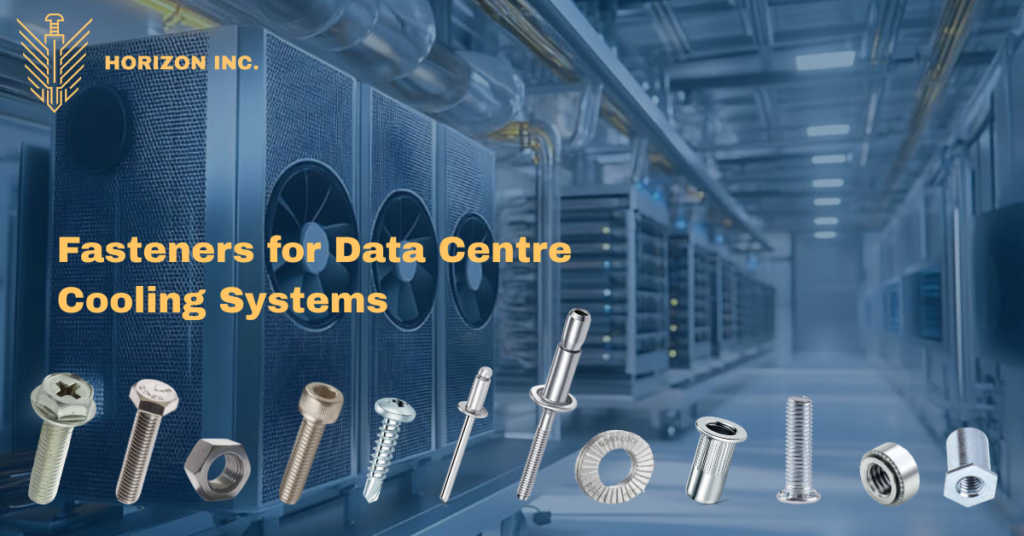
Data centre cooling systems rely on a wide range of fasteners to assemble cooling units, air handling equipment, liquid cooling infrastructure, ducting systems, electrical control panels, and supporting structures. Common fasteners include self-clinching fasteners, rivet nuts, machine screws, blind rivets, structural blind rivets, captive screws, and disc spring washers.
As modern AI data centres increase rack densities beyond 50 kW and, in some cases, 100 kW per rack, cooling systems are becoming larger and more complex. The reliability of every component, including fasteners, directly affects uptime, maintenance requirements, and thermal performance.
For cooling equipment manufacturers, HVAC contractors, data centre EPC companies, and sheet metal fabricators, selecting the correct fastening solution is essential to achieving long-term reliability and serviceability.
Key Takeaways
- Data centre cooling systems use hundreds or thousands of fasteners throughout cooling equipment.
- Self-clinching fasteners provide durable threads in thin sheet metal enclosures.
- Rivet nuts allow threaded connections where access is available from only one side.
- Blind rivets and structural rivets are widely used in ducting and equipment housings.
- Captive screws improve maintenance efficiency and prevent hardware loss.
- Stainless steel fasteners are preferred in moisture-prone and liquid cooling environments.
- Disc spring washers help maintain preload under vibration and thermal cycling.
- Fastener failure can result in leaks, vibration issues, airflow inefficiencies, and costly downtime.
Why Are Fasteners Important in Data Centre Cooling Systems?
Cooling systems operate continuously and are subjected to:
- Fan vibration
- Pump vibration
- Thermal expansion and contraction
- Humidity
- Condensation
- Regular maintenance cycles
A poorly selected fastener can lead to:
- Loose panels
- Coolant leakage
- Reduced airflow efficiency
- Equipment damage
- Increased maintenance costs
For mission-critical facilities, fastening reliability is a design requirement rather than an afterthought.
What Types of Cooling Systems Are Used in Modern Data Centres?
Air Cooling Systems
Common air cooling technologies include:
- Computer Room Air Conditioning (CRAC) Units
- Computer Room Air Handling (CRAH) Units
- In-row Cooling Systems
- Precision Air Conditioning Units
- Air Ducting Systems
These systems typically contain:
- Sheet metal enclosures
- Fan assemblies
- Access panels
- Electrical control cabinets
- Sensor mounting structures
Liquid Cooling Systems
The growth of AI computing has accelerated adoption of liquid cooling.
Common liquid cooling systems include:
- Direct-to-Chip Cooling
- Cold Plate Cooling
- Rear Door Heat Exchangers
- Coolant Distribution Units (CDUs)
- Immersion Cooling Systems
These systems require fastening solutions capable of handling:
- Thermal cycling
- Moisture exposure
- Frequent maintenance
- Corrosion risks
Which Fasteners Are Commonly Used in Data Centre Cooling Equipment?
Self-Clinching Fasteners
Self-clinching fasteners create permanent threads in thin sheet metal without welding.
Common Types
Applications
- Cooling unit enclosures
- Fan housings
- Electrical panels
- Controller assemblies
Advantages
| Benefit | Explanation |
|---|---|
| Strong Threads | Suitable for thin sheet metal |
| No Welding Required | Reduced manufacturing cost |
| Improved Appearance | No weld marks |
| Serviceability | Repeated assembly and disassembly |
Rivet Nuts
Rivet nuts create load-bearing internal threads in sheet metal and hollow sections.
Typical Applications
- Cooling equipment frames
- Pump supports
- Access doors
- Structural brackets
Common Materials
| Material | Typical Use |
| Zinc Plated Steel | Indoor cooling units |
| Stainless Steel 304 | Humid environments |
| Stainless Steel 316 | Corrosive environments |
Blind Rivets and Structural Blind Rivets
Blind rivets are widely used in HVAC and cooling equipment manufacturing.
Applications
- Air ducts
- Fan assemblies
- Cooling tower structures
- Sheet metal covers
Selection Guide
| Requirement | Recommended Product |
| General Sheet Metal Assembly | Standard Blind Rivet |
| High Vibration Environment | Structural Blind Rivet |
| High Shear Loads | Monobolt-Type Rivet |
| Critical Structural Assembly | Interlock-Type Rivet |
Machine Screws
Machine screws are used extensively throughout cooling systems.
Common styles include:
- Pan Head
- Truss Head
- Button Head
- Socket Head Cap Screws
- Hex Flange Screws
Typical standards include:
- ISO 7045
- ISO 14583
- DIN 7985
- DIN 912
Captive Screws
Captive screws remain attached to the panel when loosened.
Benefits
- Faster maintenance
- Reduced risk of lost hardware
- Improved serviceability
- Lower maintenance downtime
Applications include:
- CRAH units
- CRAC units
- Liquid cooling cabinets
- Data centre monitoring equipment
How Does Corrosion Affect Fasteners in Cooling Systems?
Although data centres are controlled environments, cooling equipment can still experience:
- Condensation
- Humidity
- Water treatment chemicals
- Outdoor exposure
Recommended Materials
| Environment | Recommended Material |
| Indoor Controlled Areas | Zinc Plated Steel |
| Humid Areas | Stainless Steel 304 |
| Outdoor Equipment | Stainless Steel 316 |
| Cooling Towers | Stainless Steel 316 |
| Chilled Water Systems | Stainless Steel 304 or 316 |
What Are the Most Common Fastener Failures in Data Centre Cooling Equipment?
Based on industry experience, common issues include:
Fastener Loosening
Caused by:
- Fan vibration
- Pump vibration
- Thermal cycling
Corrosion
Caused by:
- Moisture
- Condensation
- Chemical exposure
Thread Stripping
Common when:
- Thin sheet metal is tapped directly
- Improper fastener selection is used
Lost Hardware During Maintenance
Occurs when removable panels use conventional screws instead of captive fasteners.
How Does Horizon Inc. Support Cooling Equipment Manufacturers?
Horizon Inc. supplies fastening solutions used by:
- Sheet metal fabricators
- Electrical enclosure manufacturers
- HVAC equipment manufacturers
- Data centre contractors
- Telecom infrastructure manufacturers
- Industrial equipment OEMs
Products include:
- Self-Clinching Fasteners
- Rivet Nuts
- Blind Rivets
- Structural Blind Rivets
- Captive Screws
- Machine Screws
- Disc Spring Washers
- Industrial Fasteners
Our experience supporting enclosure manufacturers and sheet metal fabricators enables us to recommend fastening solutions that improve assembly efficiency, maintenance accessibility, and long-term reliability.
Frequently Asked Questions
What fasteners are used in data centre cooling systems?
Common fasteners include self-clinching nuts, self-clinching studs, rivet nuts, machine screws, blind rivets, structural blind rivets, captive screws, and disc spring washers.
Which fasteners are suitable for liquid cooling systems?
Stainless steel machine screws, self-clinching fasteners, rivet nuts, and captive screws are commonly used due to their corrosion resistance and serviceability.
Why are self-clinching fasteners used in cooling equipment?
They create strong reusable threads in thin sheet metal without welding, making them ideal for cooling unit enclosures.
What is the advantage of captive screws in cooling equipment?
Captive screws prevent loss of hardware during maintenance and improve service efficiency.
Are stainless steel fasteners necessary for cooling systems?
In areas exposed to condensation, humidity, or outdoor conditions, stainless steel fasteners provide significantly improved corrosion resistance.
Can rivet nuts replace welded nuts?
Yes. Rivet nuts are often used where access is available from only one side or where welding is undesirable.
What causes fasteners to loosen in cooling equipment?
Fan vibration, pump vibration, thermal expansion, and repeated maintenance cycles are the most common causes.
Conclusion
Data centre cooling systems depend on reliable fastening solutions to maintain structural integrity, airflow performance, serviceability, and long-term operational reliability. Whether the application involves CRAC units, CRAH systems, air handling equipment, or advanced liquid cooling infrastructure, selecting the correct fastener is essential.
Products such as self-clinching fasteners, rivet nuts, blind rivets, captive screws, and machine screws help cooling equipment manufacturers create durable and service-friendly assemblies capable of supporting mission-critical data centre operations.
Designing or manufacturing cooling equipment for data centres?
Horizon Inc. supplies self-clinching fasteners, rivet nuts, blind rivets, captive screws, machine screws, and industrial fastening solutions used in sheet metal fabrication, electrical enclosures, HVAC systems, telecom infrastructure, and data centre applications.
Contact our team to discuss the right fastening solution for your cooling equipment or infrastructure project.
📞 +91 9916777262
📧 sales@horizonincindia.com
🌐 www.horizonincindia.com

Yusuf T. Unjhawala is Co-founder of Horizon Inc., a supplier of industrial fasteners serving electrical control panel manufacturers, sheet metal fabricators, telecom equipment manufacturers, solar industry, HVAC, and industrial OEMs across South India.
Public Policy and Research:
Yusuf is an Adjunct Scholar at the Takshashila Institution, Bengaluru, where his work focuses on defence, strategic affairs.