
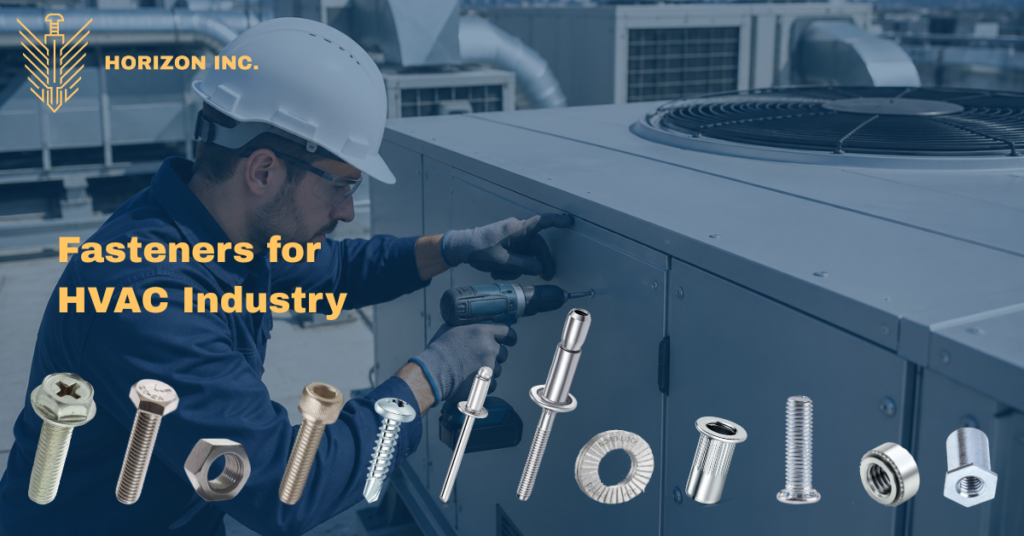
The HVAC (Heating, Ventilation, and Air Conditioning) industry relies heavily on specialized fasteners to assemble ductwork, air handling units (AHUs), rooftop units, chillers, ventilation systems, electrical control panels, insulation supports, and equipment enclosures.
Common HVAC fasteners include self-drilling screws, blind rivets, rivet nuts, weld studs, self-clinching fasteners, machine screws, captive panel screws, and panel hardware. The correct fastener selection depends on factors such as sheet thickness, vibration levels, corrosion exposure, maintenance requirements, load-bearing needs, and installation speed.
For most HVAC sheet metal fabrication applications, self-drilling screws and blind rivets provide quick assembly, while rivet nuts and captive fasteners enable repeated servicing. In outdoor HVAC installations, corrosion-resistant coatings and stainless steel fasteners are essential for long-term reliability and reduced maintenance costs.
Key Takeaways
- HVAC equipment is predominantly manufactured from sheet metal assemblies.
- Self-drilling screws eliminate pre-drilling operations and improve assembly productivity.
- Blind rivets are widely used where access is available from only one side.
- Rivet nuts provide reusable threads in thin sheet metal.
- Weld studs eliminate protruding screw heads inside equipment.
- Stainless steel fasteners improve corrosion resistance in outdoor installations.
- Vibration resistance is critical for fans, blowers, compressors, and rooftop units.
- Proper fastener selection reduces maintenance, rattling, and air leakage.
Introduction
The HVAC industry depends extensively on sheet metal fabrication. Products such as air handling units, duct systems, ventilation cabinets, filter housings, rooftop units, VAV boxes, electrical enclosures, and control panels are all assembled using a wide range of industrial fasteners.
While HVAC equipment manufacturers focus heavily on airflow performance, energy efficiency, and thermal insulation, fastener selection often receives less attention. However, improper fastener selection can result in vibration failures, corrosion, air leakage, difficult maintenance, and increased lifecycle costs.
This guide explains the major fastener types used in HVAC manufacturing and installation and helps engineers, buyers, and fabricators select the most suitable fastening solutions.
Why Are Fasteners Critical in HVAC Equipment?
Fasteners perform several critical functions:
- Structural assembly
- Access panel retention
- Ductwork joining
- Insulation support
- Equipment mounting
- Electrical panel assembly
- Serviceability and maintenance access
- Vibration resistance
HVAC equipment experiences:
- Continuous vibration
- Thermal expansion and contraction
- Moisture exposure
- Outdoor weather conditions
- Frequent maintenance cycles
The wrong fastener can lead to:
- Loose panels
- Increased noise
- Air leakage
- Corrosion
- Thread stripping
- Component failure
What Types of Fasteners Are Commonly Used in HVAC Manufacturing?
Comparison Table: HVAC Fastener Types
| Fastener Type | Primary Application | Advantages | Typical Materials |
|---|---|---|---|
| Self-Drilling Screws | Ducting, sheet metal assembly | Fast installation | Carbon Steel, SS304 |
| Blind Rivets | Ducts, ventilation systems | One-sided installation | Aluminum, Steel, Stainless Steel |
| Rivet Nuts | Service panels | Reusable threads | Steel, Stainless Steel |
| Weld Studs | Internal mounting | No protruding head | Mild Steel, Stainless Steel |
| Self-Clinching Fasteners | Electrical panels | Permanent threads in sheet metal | Steel, Stainless Steel |
| Machine Screws | Component assembly | Precision fastening | Various grades |
| Captive Panel Screws | Access panels | Prevent fastener loss | Steel, Stainless Steel |
| Panel Hardware | Doors and enclosures | Easy maintenance | Steel, Zinc Die Cast |
Why Are Self-Drilling Screws Popular in HVAC Applications?
Self-drilling screws combine drilling and fastening into a single operation.
Typical HVAC applications include:
- Duct assembly
- Sheet metal joining
- AHU fabrication
- Ventilation equipment
- Rooftop unit assembly
Benefits include:
- Faster assembly
- Reduced labor costs
- No pilot hole required
- Consistent installation quality
Common Head Types
| Head Type | Typical Application |
|---|---|
| Hex Washer Head | Structural sheet metal joints |
| Pan Head | Electrical panels |
| Truss Head | Thin sheet assemblies |
| CSK Head | Flush surface requirements |
From Horizon Inc.’s experience supplying HVAC manufacturers, Taiwanese-made self-drilling screws generally provide more consistent drill performance and thread formation compared to lower-grade imports, particularly in galvanized sheet steel commonly used for HVAC equipment.
When Should Blind Rivets Be Used in HVAC Systems?
Blind rivets are ideal when access is available from only one side of the assembly.
Typical applications include:
- Ductwork fabrication
- Ventilation ducts
- Fan housings
- Filter boxes
- Exhaust systems
Advantages:
- Fast installation
- Vibration-resistant joints
- Suitable for inaccessible locations
- Consistent clamp force
Common Blind Rivet Materials
| Rivet Type | Recommended Use |
|---|---|
| Aluminum Rivets | General indoor HVAC |
| Steel Rivets | Higher strength applications |
| Stainless Steel Rivets | Outdoor and corrosive environments |
Why Are Rivet Nuts Increasingly Used in HVAC Equipment?
Modern HVAC equipment requires frequent servicing.
Traditional sheet metal threads often strip after repeated maintenance.
Rivet nuts solve this problem by providing durable machine threads in thin sheet metal.
Applications include:
- Access doors
- Filter access panels
- Compressor covers
- Electrical compartments
- Service hatches
Benefits:
- Reusable threads
- Improved serviceability
- Stronger pull-out resistance
- Reduced maintenance costs
What Fasteners Are Used in Air Handling Units (AHUs)?
Air Handling Units contain multiple assemblies requiring different fastening methods.
Fastener Selection Guide for AHUs
| Component | Recommended Fastener |
|---|---|
| Structural Frame | Self-Drilling Screws, Weld Studs |
| Access Panels | Captive Screws, Rivet Nuts |
| Electrical Panels | Self-Clinching Fasteners |
| Insulation Retention | Weld Studs |
| Fan Assembly | Machine Screws with Locking Features |
| Filter Frames | Captive Fasteners |
How Are Fasteners Used in HVAC Ducting Systems?
Ducting systems require:
- Airtight joints
- Quick installation
- Vibration resistance
Common fasteners include:
- Self-drilling screws
- Blind rivets
- Cleats and flange hardware
- Machine screws
A common field mistake is excessive screw penetration inside ducts, which can create turbulence, collect dust, and reduce airflow efficiency.
What Materials Are Best for HVAC Fasteners?
HVAC Fastener Material Comparison
| Material | Corrosion Resistance | Strength | Typical HVAC Use |
|---|---|---|---|
| Zinc-Plated Steel | Moderate | High | Indoor equipment |
| SS304 Stainless Steel | High | Good | Outdoor installations |
| SS316 Stainless Steel | Very High | Good | Coastal environments |
| Aluminum | Excellent | Moderate | Lightweight assemblies |
For rooftop units and outdoor HVAC equipment, stainless steel fasteners are often preferred due to exposure to rain, humidity, and UV conditions.
What Are Common Fastener Failures in HVAC Systems?
1. Corrosion
Occurs when incorrect material grades are used outdoors.
Solution
Use SS304 or SS316 fasteners.
2. Thread Stripping
Common in thin sheet metal.
Solution
Use rivet nuts or self-clinching nuts.
3. Vibration Loosening
Occurs in fans, compressors, and blowers.
Solution
Use locking features or thread-locking compounds.
4. Air Leakage
Caused by improper fastening of duct joints.
Solution
Use proper fastener spacing and sealing methods.
5. Galvanic Corrosion
Occurs when incompatible metals are joined.
Solution
Verify material compatibility during design.
What Standards Are Relevant for HVAC Fasteners?
Common standards include:
| Standard | Description |
|---|---|
| DIN 7504 | Self-Drilling Screws |
| DIN 7337 | Blind Rivets |
| ISO 14583 | Torx Screws |
| ISO 7049 | Self-Tapping Screws |
| ASTM A653 | Galvanized Sheet Steel |
| ASTM A240 | Stainless Steel Materials |
| SMACNA Guidelines | HVAC Duct Construction Standards |
Real-World HVAC Applications
Air Handling Unit Manufacturer
Uses:
- Self-drilling screws for frame assembly
- Rivet nuts for service panels
- Weld studs for insulation retention
Commercial Duct Fabricator
Uses:
- Blind rivets
- Self-drilling screws
- Flange hardware
Rooftop HVAC Equipment Manufacturer
Uses:
- Stainless steel screws
- Rivet nuts
- Captive fasteners
to improve corrosion resistance and maintenance accessibility.
Frequently Asked Questions
What fasteners are most commonly used in HVAC ductwork?
Self-drilling screws and blind rivets are the most commonly used fasteners for HVAC duct assembly.
Are stainless steel fasteners necessary for HVAC systems?
For outdoor, coastal, or high-humidity environments, stainless steel fasteners significantly improve service life.
Why are rivet nuts used in HVAC equipment?
Rivet nuts provide reusable machine threads in thin sheet metal and improve serviceability.
What is the advantage of captive panel screws?
Captive screws remain attached to access panels, preventing loss during maintenance.
Can self-drilling screws replace welding in HVAC equipment?
In many sheet metal assemblies, self-drilling screws can reduce fabrication time and eliminate secondary welding operations.
Which fasteners are best for vibration-prone HVAC equipment?
Machine screws with locking features, rivet nuts, and properly specified self-drilling screws are commonly used.
Conclusion
Fasteners are a critical but often overlooked component of HVAC equipment design and manufacturing. Proper selection directly impacts structural integrity, vibration resistance, maintenance accessibility, corrosion performance, and equipment lifespan.
For HVAC manufacturers, duct fabricators, and installation contractors, choosing the right combination of self-drilling screws, blind rivets, rivet nuts, weld studs, self-clinching fasteners, and panel hardware can significantly improve assembly efficiency and long-term reliability.
As HVAC systems continue to become more energy efficient and service-oriented, fastening solutions that support quick assembly and repeated maintenance will play an increasingly important role.
Specify the Right Fastener for Your HVAC Application
Choosing between self-drilling screws, blind rivets, rivet nuts, weld studs, and self-clinching fasteners depends on your design, maintenance, and environmental requirements.
Horizon Inc. works with HVAC manufacturers, duct fabricators, ventilation equipment producers, and sheet metal enclosure manufacturers to identify the most suitable fastening solutions for each application.
Need assistance with an HVAC project? Contact our technical team for fastener selection guidance, samples, and quotations.
📞 +91 9916777262
📧 sales@horizonincindia.com
🌐 www.horizonincindia.com

Yusuf T. Unjhawala is Co-founder of Horizon Inc., a supplier of industrial fasteners serving electrical control panel manufacturers, sheet metal fabricators, telecom equipment manufacturers, solar industry, HVAC, and industrial OEMs across South India.
Public Policy and Research:
Yusuf is an Adjunct Scholar at the Takshashila Institution, Bengaluru, where his work focuses on defence, strategic affairs.