
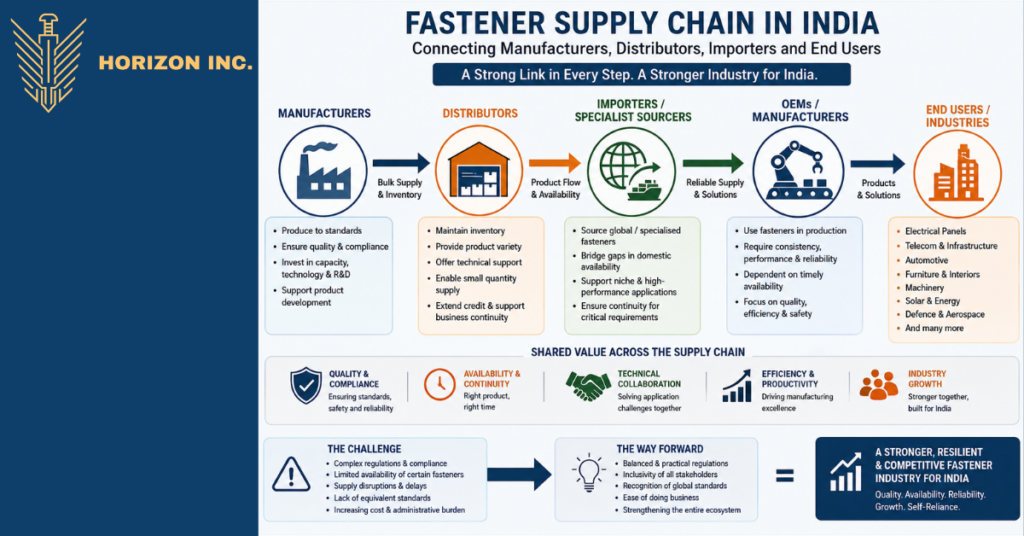
India’s Quality Control Orders (QCOs) for fasteners have introduced mandatory compliance requirements for several categories of screws, bolts, nuts and threaded fasteners. The stated objective is to improve product quality and reduce the use of substandard products in the market.
However, the implementation of these regulations has generated considerable discussion within the fastener industry. While some manufacturers view the framework as an opportunity to improve standardisation and quality control, distributors, importers, SMEs and procurement teams have reported challenges relating to sourcing flexibility, certification costs, supplier availability and access to specialised fasteners.
For manufacturers, distributors and industrial users, understanding both the intended objectives and the practical implications of these regulations has become increasingly important when planning procurement and supply chain strategies.
Key Takeaways
- Fastener QCOs have introduced mandatory compliance requirements for several fastener categories.
- The regulations affect manufacturers, distributors, importers and industrial users differently.
- The fastener industry has unique characteristics compared to many other manufacturing sectors.
- Supply chain flexibility and access to specialised fasteners are key concerns raised by industry participants.
- Procurement teams increasingly need to consider both technical requirements and regulatory compliance.
- Long-term success depends on balancing quality objectives with supply chain efficiency and manufacturing competitiveness.
Introduction
Fasteners are among the most widely used industrial products in the world.
From electrical panels and telecom cabinets to automobiles, aircraft, data centres and furniture, virtually every manufactured product relies on fasteners.
Yet fasteners are unlike many other industrial products. The industry contains tens of thousands of variants covering different standards, materials, coatings, thread forms, dimensions and specialised applications.
With the introduction of Quality Control Orders (QCOs) covering various fastener categories, the Indian fastener industry has entered a new regulatory environment that affects manufacturers, distributors, importers, procurement teams and end users alike.
What Are Fastener Quality Control Orders (QCOs)?
Quality Control Orders are regulatory notifications issued by the Government of India under the Bureau of Indian Standards (BIS) framework.
For products covered by a QCO:
- Compliance with the applicable Indian Standard becomes mandatory.
- Manufacturers must obtain the relevant BIS licence where required.
- Products must conform to prescribed standards.
- Compliance documentation may be required throughout the supply chain.
The objective is to improve product quality and reduce the circulation of non-conforming products.
Which Fasteners Are Covered By QCO Requirements?
Several categories of threaded fasteners are covered under notified standards.
Examples include:
| Product Category | Example Standards |
|---|---|
| Machine Screws | IS 1363 Series |
| Hex Bolts | IS 1364 Series |
| Hex Nuts | Relevant IS Standards |
| Self Tapping Screws | IS 18480 Series |
| Self Drilling Screws | IS 18509 |
| Other Threaded Fasteners | Various notified standards |
Procurement teams should verify the latest regulatory position applicable to their products.
Why Were Fastener QCOs Introduced?
The stated objectives include:
- Improving product quality.
- Reducing the availability of substandard fasteners.
- Increasing standardisation.
- Supporting domestic manufacturing.
- Improving safety and reliability in critical applications.
These are legitimate objectives that most participants in the industry support.
However, implementation challenges remain a subject of debate within the sector.
Why Is The Fastener Industry Different From Many Other Manufacturing Sectors?
One of the most important aspects of the discussion is the nature of the fastener industry itself.
Unlike products with a limited number of models, fasteners exist in enormous variety.
A typical industrial supply chain may require:
- DIN-standard fasteners
- ISO-standard fasteners
- ASTM fasteners
- Aerospace fasteners
- Electronics fasteners
- Proprietary OEM fasteners
- Custom-designed fasteners
Many are required in relatively small quantities for specialised applications.
This creates sourcing challenges that are not always present in more standardised industries.
What Challenges Have Distributors And Traders Reported?
Distributors play an important role in the fastener ecosystem.
In addition to supplying products, distributors often provide:
- Inventory management
- Technical assistance
- Small-quantity supply
- Credit facilities
- Vendor consolidation
- Global sourcing support
Some distributors have raised concerns regarding:
| Challenge | Potential Impact |
| Inability to obtain BIS licences | Dependence on manufacturers |
| Disclosure of manufacturing sources | Reduced brand differentiation |
| Limited supplier options | Reduced sourcing flexibility |
| Additional documentation requirements | Increased administrative burden |
| Product availability constraints | Supply disruptions |
These concerns are particularly relevant for specialised fasteners that are not widely manufactured in India.
How Are Importers Being Affected?
Importers of industrial fasteners often supply products that are:
- Low-volume
- Specialised
- Application-specific
- Not readily available from domestic sources
Industry participants have reported challenges relating to:
- Certification requirements
- Customs interpretation
- Shipment delays
- Additional compliance costs
- Availability of niche products
The impact may be greater for sectors requiring specialised fasteners for electronics, instrumentation, telecom equipment and industrial machinery.
What Happens When No Equivalent Indian Standard Exists?
One of the recurring concerns raised by industry participants involves products for which no direct Indian Standard exists.
Examples frequently discussed include:
| Product Type | Availability of Dedicated IS Standard |
| Self Clinching Fasteners | None |
| Rivet Nuts | None |
| Blind Rivets | None |
| Proprietary Fasteners | None |
| Specialised DIN/ISO Fasteners | May not have direct equivalents |
When domestic standards do not exist, sourcing and compliance can become more complex.
How Are Procurement Teams Being Affected?
Procurement professionals increasingly need to balance:
- Technical requirements
- Quality requirements
- Commercial considerations
- Supply continuity
- Compliance obligations
Challenges may include:
- Longer lead times
- Reduced supplier options
- Additional documentation requirements
- Increased inventory planning
- Vendor qualification processes
For manufacturers operating lean supply chains, fastener availability can directly affect production schedules.
Why Do Fasteners Matter More Than Their Cost Suggests?
Fasteners often represent a very small percentage of the total product cost.
However, a missing fastener can halt production of:
- Electrical panels
- Telecom equipment
- Machinery
- Appliances
- Furniture
- Infrastructure projects
A component representing less than 1% of product value can sometimes delay delivery of an entire finished product.
This is one reason why fastener availability remains a critical supply chain issue.
What Could A More Balanced Framework Look Like?
Several industry participants have proposed measures such as:
- Wider stakeholder participation in standards development.
- Greater representation of distributors and importers.
- Clearer guidance for products outside notified standards.
- Faster approval pathways for specialised products.
- Recognition of equivalent international standards.
- Risk-based compliance mechanisms.
The objective would be to maintain quality standards while preserving supply chain flexibility and industrial competitiveness.
Frequently Asked Questions
What is a Fastener QCO?
A Fastener QCO is a Quality Control Order that makes compliance with specified standards mandatory for certain fastener categories.
Why were Fastener QCOs introduced?
The regulations were introduced to improve quality, standardisation and product reliability.
Do Fastener QCOs affect imports?
Yes. Imported products covered by notified standards may be subject to applicable compliance requirements.
Are all fasteners covered under QCOs?
No. Coverage depends on the product category and applicable standards.
Why are distributors concerned about QCOs?
Some distributors have reported concerns relating to supplier flexibility, sourcing options and compliance obligations.
Can a missing fastener affect production?
Yes. Despite their low cost, fasteners are often critical components whose absence can delay manufacturing operations.
Conclusion
India’s Fastener QCO framework represents one of the most significant regulatory changes affecting the fastener industry in recent years.
The goals of improving quality and standardisation are widely recognised. At the same time, manufacturers, distributors, importers and procurement teams continue to discuss the practical challenges associated with implementation.
As the regulatory environment evolves, successful outcomes are likely to depend on maintaining a balance between quality assurance, manufacturing competitiveness, supply chain resilience and access to specialised products.
Understanding these issues is increasingly important for every participant in the industrial fastener ecosystem.
Need assistance sourcing standard or specialised industrial fasteners?
Horizon Inc. supports manufacturers, procurement teams, fabricators and OEMs across South India with fastening solutions, inventory support and technical guidance for a wide range of industrial applications.

Yusuf T. Unjhawala is Co-founder of Horizon Inc., a supplier of industrial fasteners serving electrical control panel manufacturers, sheet metal fabricators, telecom equipment manufacturers, solar industry, HVAC, and industrial OEMs across South India.
Public Policy and Research:
Yusuf is an Adjunct Scholar at the Takshashila Institution, Bengaluru, where his work focuses on defence, strategic affairs.