
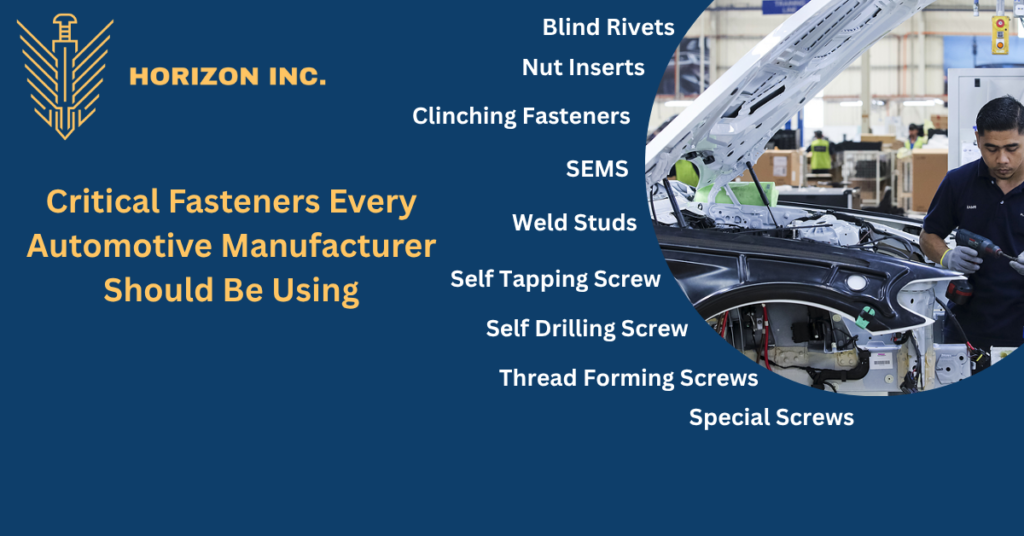
Automotive manufacturing relies on thousands of fasteners to secure structural, electrical, electronic, and cosmetic components throughout a vehicle. Critical automotive fasteners include high-tensile bolts, weld studs, rivet nuts, self-clinching fasteners, SEMS screws, blind rivets, and machine screws. These components are used in chassis assemblies, battery packs, body panels, dashboards, electrical systems, HVAC modules, and interior trim.
The correct fastener selection affects vehicle safety, durability, vibration resistance, corrosion performance, serviceability, and manufacturing efficiency. Modern vehicles contain thousands of fasteners, each designed to withstand specific loads, temperature cycles, vibration levels, and environmental conditions. Poor fastener selection can lead to loosening, rattling, corrosion, assembly failures, warranty claims, and safety risks. Automotive manufacturers therefore specify fasteners according to strength grades, material compatibility, corrosion resistance, and assembly requirements.
Key Takeaways
- Modern vehicles contain thousands of fasteners.
- Different vehicle systems require different fastening technologies.
- EV battery packs have introduced new fastening challenges.
- Corrosion resistance is as important as strength.
- Fastener installation torque directly affects performance.
- Rivet nuts and self-clinching fasteners are increasingly replacing traditional welded nuts in thin sheet metal assemblies.
- Fastener quality directly impacts warranty costs and vehicle reliability.
Introduction
When people think about automotive engineering, they typically focus on engines, batteries, electronics, safety systems, or body design. However, every one of these systems depends on fasteners.
From battery enclosures and dashboards to suspension systems and electrical modules, fasteners hold together thousands of individual components. While they represent a small percentage of a vehicle’s overall cost, they have a disproportionate impact on reliability, manufacturing efficiency, serviceability, and safety.
For automotive OEMs and Tier-1 suppliers, selecting the correct fastener is an engineering decision rather than a purchasing decision.
What Makes an Automotive Fastener Critical?
A fastener becomes critical when failure could result in:
- Safety risks
- Structural damage
- Vehicle downtime
- Electrical failure
- Water ingress
- Increased warranty claims
Critical automotive fasteners must withstand:
- Continuous vibration
- Dynamic loading
- Thermal cycling
- Corrosion exposure
- Mechanical shock
- Long service life requirements
Automotive fasteners must also maintain clamp load under harsh operating conditions.
Which Fasteners Are Most Commonly Used in Automotive Manufacturing?
| Fastener Type | Typical Automotive Application | Primary Benefit |
|---|---|---|
| High-Tensile Bolts | Chassis, suspension, engine mounts | High strength |
| Weld Studs | Body panels, battery enclosures | Fast assembly |
| Rivet Nuts | Thin sheet metal structures | Strong threads in thin materials |
| Self-Clinching Fasteners | Electronics and panels | Permanent threaded attachment |
| SEMS Screws | Electrical assemblies | Reduced assembly time |
| Blind Rivets | Interior and exterior panels | Access from one side |
| Machine Screws | Electronics and modules | Serviceability |
| Captive Screws | Covers and maintenance panels | Prevent fastener loss |
Why Are Weld Studs Widely Used in Automotive Production?
Weld studs provide a permanent threaded attachment point on metal panels.
Common applications include:
- Battery enclosures
- Heat shields
- HVAC assemblies
- Brackets
- Interior structural assemblies
Benefits include:
- High production speed
- Automated assembly compatibility
- Reduced component count
- Consistent positioning
In EV manufacturing, weld studs are extensively used on battery trays and enclosure assemblies.
Where Are Rivet Nuts Used in Vehicles?
Rivet nuts are increasingly popular because modern vehicles use thinner sheet metal and lightweight materials.
Typical applications include:
- EV battery enclosures
- Seat mounting structures
- Interior modules
- Body panels
- HVAC equipment
Advantages include:
- Strong reusable threads
- Installation from one side
- Suitable for thin materials
- Elimination of welded nuts
From Horizon Inc.’s experience supplying sheet metal manufacturers, rivet nuts are often selected when welding could distort thin panels or damage protective coatings.
Why Are Self-Clinching Fasteners Important for Automotive Electronics?
Vehicles contain an increasing number of electronic systems:
- Infotainment units
- Battery management systems
- ADAS modules
- Power distribution systems
- Charging systems
Self-clinching fasteners create permanent threads in thin sheet metal without welding.
Common types include:
- Self-clinching nuts
- Self-clinching studs
- Self-clinching standoffs
- Floating nuts
Advantages:
- Space saving
- Consistent thread quality
- High pull-out resistance
- Reduced assembly costs
These fasteners are particularly common in automotive electronic enclosures.
Why Are SEMS Screws Preferred for Automotive Electrical Assemblies?
SEMS screws combine a screw and captive washer into a single assembly.
Applications include:
- PCB assemblies
- Automotive control modules
- Fuse boxes
- Battery management systems
- Sensors
Benefits:
- Faster installation
- Reduced component handling
- Lower assembly errors
- Improved productivity
As automotive electronics continue to expand, SEMS screws are becoming increasingly important in automated production lines.
Which Fasteners Are Most Important in Electric Vehicle Battery Packs?
EV battery packs introduce unique fastening requirements.
Key fasteners include:
| Fastener Type | Application |
|---|---|
| Weld Studs | Battery tray assemblies |
| Rivet Nuts | Battery enclosures |
| SEMS Screws | BMS electronics |
| Self-Clinching Fasteners | Battery module frames |
| Stainless Steel Machine Screws | Electrical connections |
| Blind Rivets | Lightweight enclosure assemblies |
Battery fasteners must withstand:
- Vibration
- Thermal expansion
- Corrosion
- Electrical isolation requirements
The shift toward EVs has significantly increased demand for specialised fastening solutions.
How Should Automotive Manufacturers Select Fasteners?
| Selection Factor | Importance |
|---|---|
| Load Requirements | Prevents structural failure |
| Corrosion Resistance | Extends service life |
| Vibration Resistance | Prevents loosening |
| Material Compatibility | Prevents galvanic corrosion |
| Serviceability | Simplifies maintenance |
| Production Efficiency | Reduces assembly cost |
| Weight Reduction | Supports vehicle lightweighting |
Engineers should evaluate the complete assembly rather than selecting fasteners based solely on price.
What Are the Most Common Automotive Fastener Failures?
Under-Torquing
Insufficient clamp load leads to loosening and vibration failures.
Over-Torquing
Excessive torque can strip threads or damage components.
Corrosion
Poor coatings or material selection can lead to premature failure.
Galvanic Corrosion
Occurs when incompatible metals are used together.
Wrong Fastener Grade
Using lower-strength fasteners in structural applications can compromise safety.
Poor Quality Washers
A common issue observed in outdoor automotive and transport equipment is washer cracking, which can lead to water ingress and corrosion.
How Important Are Fastener Coatings in Automotive Applications?
Automotive fasteners are frequently supplied with protective coatings such as:
- Zinc Plating
- Zinc Nickel
- Geomet®
- Dacromet®
- Mechanical Zinc
- Stainless Steel Passivation
These coatings improve:
- Corrosion resistance
- Appearance
- Service life
- Warranty performance
Underbody and exterior fasteners typically require higher corrosion resistance than interior applications.
Real-World Automotive Applications
EV Battery Manufacturing
- Weld studs
- Rivet nuts
- SEMS screws
- Self-clinching fasteners
Vehicle Electronics
- Machine screws
- Standoffs
- Self-clinching nuts
Interior Assemblies
- Blind rivets
- Captive screws
- Machine screws
Chassis Assemblies
- High-tensile bolts
- Structural nuts
- Locking fasteners
FAQ
How many fasteners are typically used in a vehicle?
A modern vehicle can contain several thousand fasteners depending on its design and complexity.
Which fasteners are commonly used in EV battery packs?
Weld studs, rivet nuts, self-clinching fasteners, SEMS screws, and stainless steel machine screws.
Why are rivet nuts preferred in thin sheet metal?
They create strong reusable threads without requiring access to both sides of the assembly.
What causes automotive fasteners to loosen?
Improper torque, vibration, thermal cycling, and incorrect fastener selection.
Are stainless steel fasteners always the best option?
Not necessarily. Material selection depends on strength requirements, corrosion exposure, weight, and compatibility with surrounding materials.
What standards apply to automotive fasteners?
Common standards include ISO, DIN, SAE, and OEM-specific automotive specifications.
Conclusion
Automotive fasteners may be small components, but they have a significant influence on vehicle safety, reliability, manufacturability, and long-term performance. As vehicles become more electrified, lightweight, and electronically complex, the role of specialised fastening solutions continues to expand.
Whether designing EV battery packs, electronic control units, body structures, or interior assemblies, engineers must select fasteners based on application requirements rather than cost alone. The right choice can reduce assembly time, improve serviceability, minimise warranty claims, and enhance overall vehicle reliability.
Designing automotive components, EV battery enclosures, electronics housings, or sheet metal assemblies? Horizon Inc. supplies rivet nuts, weld studs, self-clinching fasteners, SEMS screws, blind rivets, and specialised fastening solutions used across automotive, EV, electronics, and industrial manufacturing applications. Contact our team to discuss the right fastening solution for your design, production, and performance requirements.
📞 Call: +91 9916777262
✉️ Email: sales@horizonincindia.com
🌐 Visit: www.horizonincindia.com

Yusuf T. Unjhawala is Co-founder of Horizon Inc., a supplier of industrial fasteners serving electrical control panel manufacturers, sheet metal fabricators, telecom equipment manufacturers, solar industry, HVAC, and industrial OEMs across South India.
Public Policy and Research:
Yusuf is an Adjunct Scholar at the Takshashila Institution, Bengaluru, where his work focuses on defence, strategic affairs.