
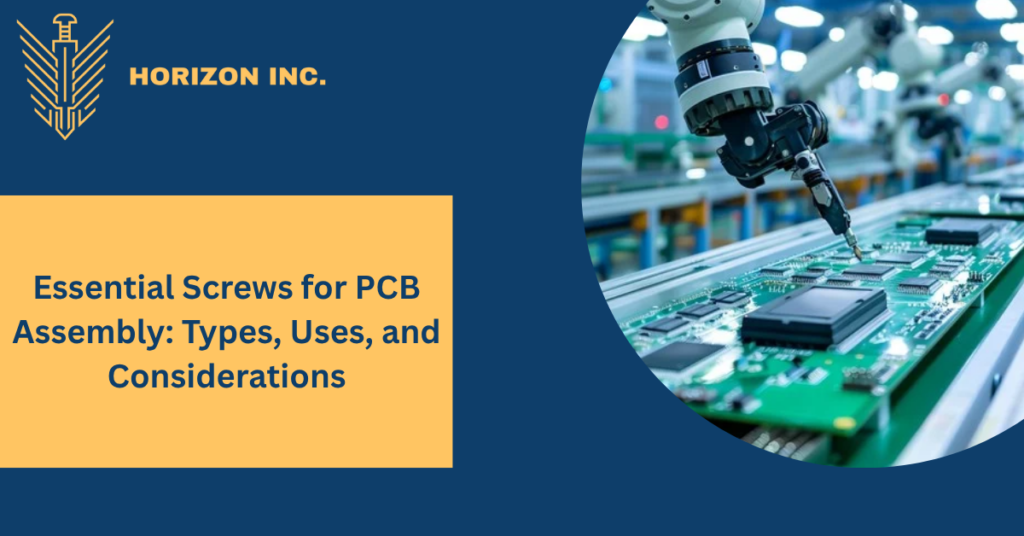
Printed Circuit Board (PCB) assemblies require specialised fasteners to securely mount boards, maintain electrical clearance, withstand vibration and enable serviceability. The most commonly used fasteners include machine screws, threaded standoffs, spacers, self-clinching fasteners, captive screws and rivet nuts.
In most electronics assemblies, M2, M2.5 and M3 machine screws are used to secure PCBs to enclosures, brackets or chassis. Standoffs create the required spacing between the PCB and the mounting surface, preventing short circuits and improving airflow. For sheet metal enclosures, self-clinching nuts and studs provide durable threads that withstand repeated assembly cycles.
The correct fastener selection depends on board size, enclosure material, vibration requirements, service access and electrical insulation requirements. Poor fastener selection can lead to loose boards, damaged PCBs, stripped threads and field failures.
Key Takeaways
- M2, M2.5 and M3 machine screws are commonly used for PCB mounting.
- Standoffs maintain clearance between the PCB and the enclosure.
- Stainless steel and nylon are the most common PCB fastener materials.
- Self-clinching fasteners are widely used in sheet metal electronic enclosures.
- Captive screws improve serviceability where frequent maintenance is required.
- Proper mounting hardware reduces vibration-related failures.
- Fastener selection should consider electrical insulation, corrosion resistance and assembly requirements.
Introduction
The reliability of an electronic assembly depends on more than the PCB design and electronic components. Mechanical fastening plays an equally important role.
A PCB that is inadequately secured can experience vibration, flexing, connector stress and eventual failure. This is especially important in industrial electronics, telecom equipment, EV charging systems, data centre hardware, power electronics and control panels.
Engineers often focus on electronic design while overlooking mounting hardware selection. However, the right combination of screws, spacers, standoffs and threaded inserts contributes significantly to long-term product reliability.
At Horizon Inc., we regularly support manufacturers of:
- Electrical control panels
- Telecom equipment
- Data centre infrastructure
- Industrial automation systems
- EV charging equipment
- Power distribution units
- Electronic enclosures
Many of these applications require robust PCB mounting solutions capable of surviving years of operation.
What Fasteners Are Commonly Used in PCB Assembly?
The most frequently used PCB assembly fasteners include:
| Fastener Type | Primary Function | Typical Applications |
|---|---|---|
| Machine Screws | PCB mounting | Electronic enclosures |
| Threaded Standoffs | PCB spacing | Industrial electronics |
| Spacers | Clearance creation | Multi-board assemblies |
| Self-Clinching Nuts | Permanent threads in sheet metal | Electronic chassis |
| Self-Clinching Studs | Component mounting | Control panels |
| Captive Screws | Maintenance access | Server racks and telecom equipment |
| Rivet Nuts | Thread creation in thin materials | Sheet metal assemblies |
Why Are Standoffs Important in PCB Assemblies?
Standoffs serve several critical functions:
- Prevent PCB contact with conductive surfaces
- Improve airflow beneath the board
- Reduce mechanical stress
- Create space for solder joints and components
- Improve serviceability
Without adequate spacing, the underside of a PCB can come into contact with metal surfaces, increasing the risk of electrical failures.
Which Screw Sizes Are Used for PCB Mounting?
The most common PCB mounting screw sizes are:
| Screw Size | Typical Application |
| M2 | Compact electronics, sensors, IoT devices |
| M2.5 | Embedded systems, Raspberry Pi-type boards |
| M3 | Industrial electronics and control systems |
| M4 | Heavy assemblies and power electronics |
M3 is often considered the most common size in industrial electronics due to its balance between strength and compactness.
What Materials Are Used for PCB Fasteners?
Stainless Steel
Advantages:
- Corrosion resistant
- High strength
- Suitable for industrial environments
Common grades:
- A2-70 (304 Stainless Steel)
- A4-70 (316 Stainless Steel)
Nylon
Advantages:
- Electrically insulating
- Lightweight
- Non-corrosive
Applications:
- Sensitive electronic assemblies
- Low-load applications
Brass
Advantages:
- Good electrical conductivity
- Corrosion resistance
- Frequently used in threaded standoffs
How Are Self-Clinching Fasteners Used in Electronic Enclosures?
Many electronics manufacturers use sheet metal enclosures made from CRCA steel, stainless steel or aluminium.
Repeated assembly and maintenance can quickly wear out tapped holes in thin sheet metal. Self-clinching fasteners solve this problem by permanently embedding threads into the sheet metal.
Common options include:
Self-Clinching Nuts
Used when durable female threads are required.
Applications:
- PCB mounting brackets
- Power supply housings
- Telecom cabinets
Self-Clinching Studs
Used when components need to be mounted onto a panel.
Applications:
- PCB support structures
- Grounding hardware
- Internal mounting arrangements
For electronics manufacturers, self-clinching fasteners often provide a more reliable solution than repeatedly tapped sheet metal.
When Should Rivet Nuts Be Used Instead of Self-Clinching Fasteners?
Rivet nuts are preferred when:
- Access is available from only one side
- Existing assemblies require retrofit threads
- Material thickness is insufficient for tapping
They are frequently used in:
- Electronic cabinets
- Telecom racks
- Industrial equipment enclosures
- Outdoor electronic housings
What Are the Common Failure Modes in PCB Fastening?
Over-Tightening
Excessive torque can:
- Crack PCB laminates
- Damage copper traces
- Distort mounting holes
Insufficient Thread Engagement
Can result in:
- Loose boards
- Vibration failures
- Intermittent electrical issues
Incorrect Standoff Height
May cause:
- PCB flexing
- Connector misalignment
- Mechanical stress
Using Low-Quality Hardware
Common issues include:
- Corrosion
- Thread stripping
- Reduced service life
How Do Electronics Manufacturers Select PCB Fasteners?
| Selection Criteria | Recommendation |
| Frequent maintenance | Captive screws |
| Thin sheet metal | Self-clinching nuts |
| One-sided installation | Rivet nuts |
| Electrical insulation | Nylon screws and spacers |
| High vibration | Stainless steel fasteners with locking features |
| Industrial environments | Stainless steel hardware |
Real-World Applications
Industrial Control Panels
PCBs mounted using M3 machine screws and threaded standoffs.
Telecom Infrastructure
Self-clinching studs and captive screws simplify maintenance while ensuring reliable mounting.
Data Centre Equipment
Server hardware commonly uses captive fasteners and precision standoffs to facilitate rapid servicing.
EV Charging Equipment
Stainless steel mounting hardware is preferred due to vibration and environmental exposure.
FAQs
What is the most common screw size used in PCB assembly?
M3 machine screws are among the most commonly used sizes for industrial electronics assemblies.
Why are standoffs used in PCB mounting?
They create clearance between the PCB and mounting surface, preventing shorts and improving airflow.
Are nylon screws suitable for PCB assembly?
Yes. Nylon screws provide electrical insulation and are commonly used in low-load electronics applications.
When should self-clinching fasteners be used?
When durable threads are required in thin sheet metal enclosures.
Can rivet nuts be used in electronics enclosures?
Yes. They are widely used when access is available from only one side of the assembly.
Conclusion
PCB assembly fasteners play a critical role in the mechanical reliability of electronic products. Selecting the correct screws, standoffs, spacers and threaded fastening solutions helps prevent vibration failures, simplifies servicing and improves overall product durability.
For manufacturers of electrical panels, telecom equipment, data centre hardware, industrial automation systems and electronic enclosures, the choice of fastening hardware should be considered as carefully as the electronic design itself.
Horizon Inc. supplies industrial fastening solutions including machine screws, captive screws, self-clinching fasteners, rivet nuts and related hardware used in electronics manufacturing, sheet metal fabrication and enclosure assembly across India.
Looking for fasteners for PCB assemblies, electronic enclosures, telecom equipment or industrial electronics? Contact Horizon Inc. for machine screws, captive screws, self-clinching fasteners, rivet nuts and assembly hardware designed for electronics manufacturing and sheet metal fabrication applications across India.

Yusuf T. Unjhawala is Co-founder of Horizon Inc., a supplier of industrial fasteners serving electrical control panel manufacturers, sheet metal fabricators, telecom equipment manufacturers, solar industry, HVAC, and industrial OEMs across South India.
Public Policy and Research:
Yusuf is an Adjunct Scholar at the Takshashila Institution, Bengaluru, where his work focuses on defence, strategic affairs.