
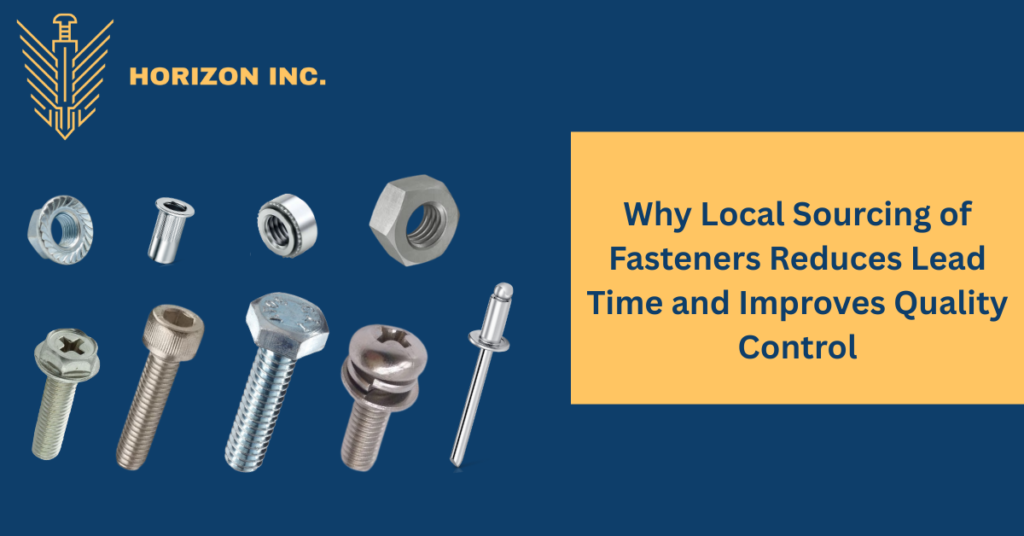
Local sourcing of fasteners helps manufacturers reduce procurement lead times, improve quality control, lower inventory carrying costs, and respond more quickly to production changes. Unlike imported fasteners, locally stocked fasteners can often be delivered within days rather than weeks or months. This reduces the risk of production delays caused by shipping disruptions, customs clearance issues, or international logistics challenges.
Local suppliers also make quality verification easier. Procurement teams can review test certificates, inspect products, discuss technical requirements, and resolve issues much faster. For industries such as electrical panels, sheet metal fabrication, data centres, telecom infrastructure, EV charging equipment, and renewable energy projects, local sourcing improves supply chain reliability while supporting lean inventory practices and better working capital management.
Key Takeaways
- Local sourcing significantly reduces procurement lead times.
- Faster deliveries help prevent production stoppages.
- Quality issues can be identified and resolved more quickly.
- Lower inventory levels reduce working capital requirements.
- Supplier communication becomes faster and more effective.
- Local sourcing improves supply chain resilience during disruptions.
- Smaller and more flexible order quantities are often possible.
Introduction
Fasteners are often among the lowest-cost items in a bill of materials, yet they frequently determine whether production continues smoothly or comes to a halt.
A missing self-drilling screw, blind rivet, rivet nut, weld stud, or self-clinching fastener can delay an entire assembly line, postpone project completion, or impact customer delivery schedules.
In recent years, manufacturers have experienced disruptions caused by container shortages, port congestion, geopolitical tensions, customs delays, and fluctuating freight costs. These challenges have highlighted the importance of evaluating not only the purchase price of a fastener but also its availability, quality consistency, and supply chain reliability.
For many OEMs, fabricators, contractors, and procurement teams, local sourcing has become a strategic advantage rather than merely a convenience.
What Is Local Sourcing of Fasteners?
Local sourcing refers to procuring fasteners from suppliers located within the same country, region, or market where manufacturing operations occur.
This may involve:
- Local stockists
- Regional distributors
- Domestic manufacturers
- Technical fastener suppliers maintaining inventory nearby
Local sourcing does not necessarily mean that every fastener is manufactured domestically. In many cases, suppliers maintain local inventory while sourcing products from approved global manufacturers.
The key advantage is that inventory, technical support, and quality assurance are available locally.
How Does Local Sourcing Reduce Lead Times?
Lead time includes far more than manufacturing time.
It typically consists of:
- Production time
- Quality inspections
- Packaging
- Freight movement
- Customs clearance
- Inland transportation
- Receiving and inspection
Imported fasteners can require several weeks or months before reaching the end user.
Local suppliers eliminate much of this logistical complexity.
| Procurement Stage | Imported Supply | Local Supply |
|---|---|---|
| International Freight | Required | Not Required |
| Customs Clearance | Required | Not Required |
| Port Congestion Risk | High | None |
| Emergency Replenishment | Difficult | Easy |
| Delivery Flexibility | Limited | High |
| Response to Design Changes | Slow | Fast |
For manufacturers operating under tight production schedules, reducing procurement uncertainty is often more valuable than saving a small amount on unit price.
Why Does Local Sourcing Improve Quality Control?
Quality issues become expensive when discovered after installation or field deployment.
Examples include:
- EPDM washers cracking on roofing screws
- Blind rivets failing prematurely
- Incorrect plating thickness
- Inconsistent thread dimensions
- Missing test documentation
Local suppliers provide several quality-control advantages:
Faster Resolution of Non-Conformities
Defective material can be inspected and replaced quickly.
Easier Verification of Documentation
Procurement teams can request:
- Material certificates
- Salt spray test reports
- Mechanical test reports
- Compliance declarations
Better Traceability
Batch-level traceability becomes easier when suppliers maintain local inventory and quality records.
Technical Support
Application-specific recommendations can be obtained before installation rather than after failures occur.
How Does Local Sourcing Reduce Inventory Costs?
Many manufacturers maintain excessive safety stock because imported replenishment is unpredictable.
This ties up capital in inventory.
Local sourcing enables:
- Smaller order quantities
- More frequent deliveries
- Reduced buffer stock
- Better cash flow management
For manufacturers using thousands of fasteners each month, even a modest reduction in inventory can free significant working capital.
What Are the Benefits for Electrical Panel and Sheet Metal Manufacturers?
Electrical enclosure manufacturers often use:
- Self-clinching fasteners
- Rivet nuts
- Blind rivets
- Machine screws
- Weld studs
Production schedules frequently change due to customer revisions or project requirements.
Local suppliers can support:
- Prototype quantities
- Small production runs
- Engineering changes
- Urgent replenishment
From Horizon Inc.’s experience supporting panel builders and sheet metal fabricators, one of the most common causes of production delays is not the availability of sheet metal or fabricated parts, but the shortage of specialised fastening components required for final assembly.
Local Sourcing vs Imported Sourcing: Which Is Better?
| Selection Criteria | Local Sourcing | Imported Sourcing |
| Lead Time | Excellent | Moderate to Poor |
| Emergency Orders | Excellent | Limited |
| Quality Visibility | High | Lower |
| Communication Speed | Fast | Slower |
| Minimum Order Quantity | Usually Lower | Usually Higher |
| Inventory Requirement | Lower | Higher |
| Freight Costs | Lower | Higher |
| Unit Purchase Price | Sometimes Higher | Sometimes Lower |
The best strategy is often a hybrid approach.
Standard, high-volume fasteners may be sourced globally, while critical production items are sourced locally to ensure continuity and responsiveness.
How Should Procurement Teams Select a Local Fastener Supplier?
When evaluating suppliers, consider the following:
| Evaluation Factor | What to Check |
| Inventory Availability | Ready stock levels |
| Technical Support | Product selection assistance |
| Quality Systems | ISO 9001 certification |
| Documentation | Test reports and certificates |
| Delivery Capability | Same-day or next-day options |
| Product Range | Ability to consolidate purchases |
| Traceability | Batch and lot tracking |
Avoid selecting suppliers based solely on unit price.
A delayed shipment often costs significantly more than the apparent savings achieved through low-cost procurement.
Real-World Example
A sheet metal enclosure manufacturer requires:
- Self-clinching studs
- Blind rivets
- Rivet nuts
- Machine screws
An imported shipment is delayed by three weeks due to customs clearance.
Production stalls while waiting for a relatively inexpensive component.
By maintaining a relationship with a local supplier holding inventory, the manufacturer can continue production and fulfil customer commitments.
This scenario occurs far more frequently than many procurement teams expect.
Frequently Asked Questions
Are locally sourced fasteners always manufactured in India?
No. Many local suppliers stock products manufactured globally while maintaining inventory and support locally.
Does local sourcing reduce procurement costs?
While unit prices may sometimes be higher, total procurement costs often decrease through lower freight costs, reduced inventory, and fewer production disruptions.
Is local sourcing suitable for OEMs?
Yes. OEMs benefit from faster replenishment, technical support, and improved quality oversight.
What industries benefit most from local fastener sourcing?
Electrical panels, sheet metal fabrication, data centres, telecom infrastructure, renewable energy, EV charging equipment, machinery manufacturing, and construction projects.
Can local suppliers provide test certificates?
Reputable suppliers can often provide material certificates, salt spray reports, and compliance documentation depending on product type.
Should manufacturers completely stop importing fasteners?
Not necessarily. Many companies use a combination of local and imported sourcing to balance cost, availability, and risk.
Conclusion
Fasteners may represent a small percentage of product cost, but they have a disproportionate impact on production continuity, installation quality, and customer satisfaction.
Local sourcing helps manufacturers reduce lead times, improve quality control, minimise inventory costs, and build more resilient supply chains. In industries where production schedules are increasingly compressed, reliable access to fastening components can provide a meaningful competitive advantage.
For procurement teams evaluating sourcing strategies, the question should not be “What is the cheapest fastener?” but rather “Which sourcing strategy keeps production running reliably?”
Looking for a reliable fastener supply partner in South India?
Horizon Inc. supplies self-drilling screws, blind rivets, rivet nuts, weld studs, self-clinching fasteners, and industrial fasteners from stocking locations in Bangalore and Chennai. Our team supports manufacturers, fabricators, OEMs, contractors, and procurement professionals with ready inventory, technical guidance, and responsive delivery schedules.

Yusuf T. Unjhawala is Co-founder of Horizon Inc., a supplier of industrial fasteners serving electrical control panel manufacturers, sheet metal fabricators, telecom equipment manufacturers, solar industry, HVAC, and industrial OEMs across South India.
Public Policy and Research:
Yusuf is an Adjunct Scholar at the Takshashila Institution, Bengaluru, where his work focuses on defence, strategic affairs.