
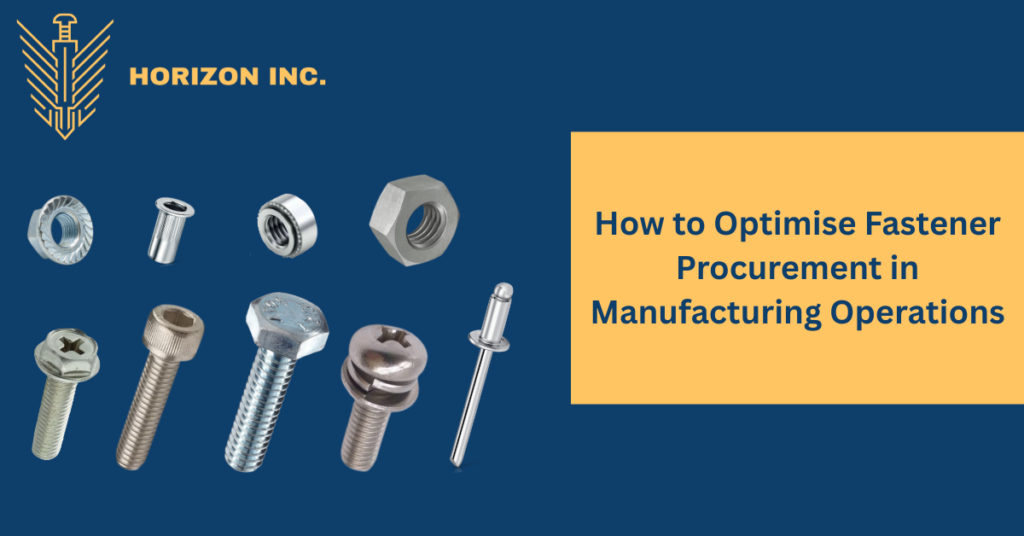
Manufacturers can optimise fastener procurement by standardising fastener specifications, consolidating suppliers, forecasting consumption, maintaining minimum stock levels, and evaluating suppliers based on total cost rather than unit price alone. Although fasteners typically represent a small percentage of the total bill of materials, shortages can stop production lines, delay deliveries, and increase operational costs. Effective procurement combines technical standardisation, inventory management, supplier partnerships, and digital purchasing controls. For industries such as electrical panels, sheet metal fabrication, telecom infrastructure, solar installations, and industrial manufacturing, a structured fastener procurement strategy helps reduce stockouts, minimise excess inventory, improve quality consistency, and lower overall procurement costs. Manufacturers that treat fasteners as strategic components rather than routine consumables often achieve better operational reliability and lower total cost of ownership.
Key Takeaways
- Fasteners may represent low spend but can have a high impact on production continuity.
- Standardising fastener specifications reduces inventory complexity.
- Supplier consolidation simplifies procurement and improves negotiating power.
- Forecasting consumption reduces emergency purchases.
- Vendor Managed Inventory (VMI) can reduce stockouts and procurement workload.
- Total cost of ownership is more important than unit purchase price.
- Inventory visibility is critical for high-volume manufacturing operations.
Introduction
In many manufacturing organisations, procurement teams devote significant attention to major raw materials while fasteners receive comparatively little strategic focus.
This approach is understandable. A self-drilling screw, blind rivet, rivet nut, or machine screw often costs only a fraction of the components it helps assemble.
However, production lines do not stop because a major component is unavailable. Quite often, they stop because a small but critical fastener is missing.
Whether manufacturing electrical control panels, sheet metal enclosures, telecom cabinets, EV charging equipment, solar structures, or industrial machinery, effective fastener procurement directly influences production efficiency, inventory costs, and product quality.
The challenge is balancing availability, quality, and cost without creating excessive inventory.
Why Is Fastener Procurement Important in Manufacturing?
Fasteners influence several aspects of manufacturing performance:
- Production continuity
- Inventory carrying costs
- Supplier management
- Product reliability
- Installation efficiency
- Quality compliance
A shortage of a frequently used M5 machine screw or blind rivet can delay production schedules even when all major components are available.
Similarly, poor-quality fasteners can lead to installation failures, rework, warranty claims, and field service costs.
What Are the Common Challenges in Fastener Procurement?
Manufacturers frequently encounter the following issues:
| Challenge | Impact |
|---|---|
| Excessive fastener variety | Higher inventory costs |
| Multiple suppliers for similar products | Procurement complexity |
| Emergency purchasing | Higher procurement costs |
| Inconsistent quality | Production and field failures |
| Poor inventory visibility | Stockouts and downtime |
| Lack of forecasting | Frequent shortages |
| Supplier lead time variability | Production disruptions |
Many factories discover they have hundreds of low-volume fastener SKUs that could be standardised into a much smaller range.
How Does Standardisation Improve Fastener Procurement?
Standardisation is often the quickest way to improve procurement efficiency.
Engineering and procurement teams should collaborate to reduce unnecessary variation in:
- Thread sizes
- Head styles
- Material grades
- Surface finishes
- Fastener lengths
For example, reducing machine screw sizes from ten variants to four variants can significantly simplify purchasing and inventory management.
Should Procurement Teams Focus Only on Unit Price?
No.
Focusing exclusively on unit price is one of the most common procurement mistakes.
A lower-cost fastener may create higher overall costs through:
- Installation failures
- Increased assembly time
- Corrosion issues
- Product warranty claims
- Supplier delivery delays
Procurement decisions should consider total cost of ownership.
| Evaluation Criteria | Importance |
| Unit price | Medium |
| Product quality | High |
| Delivery reliability | High |
| Technical support | Medium |
| Inventory availability | High |
| Compliance documentation | Medium |
| Supplier responsiveness | High |
In many applications, a slightly higher-priced fastener can reduce operational costs significantly.
How Can Manufacturers Reduce Fastener Inventory Costs?
Inventory optimisation requires balancing availability with working capital requirements.
Recommended practices include:
- Establishing minimum and maximum stock levels
- Categorising fasteners by usage frequency
- Tracking monthly consumption trends
- Eliminating obsolete inventory
- Consolidating duplicate SKUs
ABC analysis can help classify fasteners according to consumption value and usage frequency.
High-movement items should be monitored more closely than rarely used specialised fasteners.
What Is Vendor Managed Inventory (VMI) for Fasteners?
Vendor Managed Inventory (VMI) is a supply arrangement where the supplier monitors stock levels and replenishes inventory based on agreed consumption patterns. VMI programmes are increasingly used for fasteners because they reduce stockouts, lower procurement administration, and improve inventory accuracy. Manufacturers benefit from reduced purchasing workload while maintaining availability of critical Class-C components such as screws, rivets, washers, and nuts. VMI is particularly effective in high-volume manufacturing environments where hundreds of fastener transactions occur each month.
How Can Procurement Teams Improve Forecasting?
Fastener demand forecasting should be linked to:
- Production schedules
- Historical consumption
- Seasonal demand patterns
- Planned maintenance activities
- New product introductions
Useful forecasting metrics include:
| Metric | Purpose |
| Monthly consumption | Demand planning |
| Lead time | Reorder planning |
| Safety stock | Stockout prevention |
| Supplier performance | Risk management |
| Inventory turns | Working capital optimisation |
Forecasting significantly reduces costly emergency purchases.
What Role Does Supplier Consolidation Play?
Many manufacturers purchase similar fasteners from multiple suppliers.
Supplier consolidation offers several benefits:
- Better pricing leverage
- Reduced administrative workload
- Simplified quality management
- Improved inventory planning
- Faster issue resolution
However, critical fasteners should still have approved secondary sources to mitigate supply chain risk.
What Fastener Procurement Practices Does Horizon Inc Commonly Observe?
Based on Horizon Inc.’s experience supplying manufacturers of electrical panels, telecom enclosures, EV charging equipment, solar structures, and sheet metal assemblies, several recurring procurement challenges are common:
- Excessive SKU proliferation
- Last-minute emergency purchasing
- Procurement based solely on lowest price
- Limited visibility of consumption data
- Overlooking installation performance during supplier evaluation
Manufacturers that address these issues typically experience smoother production planning and reduced procurement costs.
Real-World Example
An enclosure manufacturer used over 100 different fastener SKUs across multiple product lines.
After reviewing consumption patterns and standardising common fasteners, the company:
- Reduced active SKUs by nearly 30%
- Improved inventory visibility
- Simplified supplier management
- Reduced emergency procurement orders
The result was improved purchasing efficiency without affecting product performance.
FAQ
How often should fastener inventory be reviewed?
High-consumption fasteners should ideally be reviewed weekly, while slower-moving inventory can be reviewed monthly.
What is the biggest procurement mistake with fasteners?
Selecting suppliers solely based on the lowest unit price without considering quality, lead time, and reliability.
Should manufacturers maintain safety stock for fasteners?
Yes. Safety stock is essential for frequently used and production-critical fasteners.
What is Vendor Managed Inventory?
VMI is a system where the supplier monitors inventory and replenishes stock based on agreed inventory levels and consumption patterns.
How can manufacturers reduce fastener SKUs?
By standardising thread sizes, head styles, materials, and finishes wherever technically feasible.
Are imported fasteners always cheaper?
Not necessarily. Freight costs, lead times, quality risks, and inventory carrying costs must also be considered.
Conclusion
Fastener procurement is often overlooked because individual fasteners are low-cost items. However, their impact on production continuity, inventory costs, and product quality is disproportionately large.
Manufacturers that standardise specifications, improve forecasting, consolidate suppliers, and implement structured inventory controls can achieve significant operational benefits.
In many cases, optimising fastener procurement delivers measurable savings without any major investment in new equipment or production processes.
Looking to streamline fastener procurement, reduce inventory complexity, and improve supply reliability?
Horizon Inc. works with manufacturers across electrical panels, sheet metal fabrication, telecom infrastructure, solar installations, EV charging equipment, and industrial manufacturing to help optimise fastener sourcing and inventory management.
Contact our team to discuss your fastener requirements and procurement challenges.
📌 Contact Us
📞 Call: 080-41179152
📱 WhatsApp: +91 9916777262
✉️ Email: sales@horizonincindia.com
🌐 Visit: www.horizonincindia.com

Yusuf T. Unjhawala is Co-founder of Horizon Inc., a supplier of industrial fasteners serving electrical control panel manufacturers, sheet metal fabricators, telecom equipment manufacturers, solar industry, HVAC, and industrial OEMs across South India.
Public Policy and Research:
Yusuf is an Adjunct Scholar at the Takshashila Institution, Bengaluru, where his work focuses on defence, strategic affairs.