
Are Cheap Fasteners Really Cheaper?
Not always.
The purchase price of a fastener represents only a small part of its total cost. A low-cost screw, rivet, rivet nut or weld stud may appear economical during procurement, but can create significantly higher costs during manufacturing and throughout the product lifecycle. Installation failures, damaged components, increased assembly time, corrosion, warranty claims, emergency purchases and production delays often outweigh the initial savings achieved through buying cheaper fasteners. For manufacturers of electrical panels, telecom cabinets, sheet metal enclosures, solar equipment and industrial machinery, evaluating fasteners based solely on unit price can lead to higher overall operating costs. The more effective approach is to evaluate total cost of ownership, which considers quality, reliability, installation performance, supply consistency and lifecycle costs.
Key Takeaways
- Lowest purchase price does not necessarily mean lowest overall cost.
- Fastener failures can stop production lines.
- Poor-quality fasteners increase rework and labour costs.
- Corrosion failures can lead to expensive warranty claims.
- Installation performance directly affects manufacturing productivity.
- Total cost of ownership is a more useful procurement metric than unit price.
Introduction
Ask most procurement teams how they compare fastener suppliers and the answer is often straightforward:
“Who is offering the lowest price?”
While this approach appears logical, it frequently ignores the much larger costs that occur after the fastener enters production.
Fasteners are usually among the lowest-cost items in a product assembly. However, they are often among the most critical components from a manufacturing perspective.
A production line assembling electrical panels, telecom cabinets or industrial equipment can continue without many things.
It cannot continue without the correct screw.
Why Do Procurement Teams Focus on Unit Price?
The answer is simple.
Unit price is easy to measure.
The hidden costs of poor-quality fasteners are much harder to capture.
Many organisations track:
- Purchase price
- Supplier quotations
- Cost reductions
Far fewer organisations track:
- Assembly delays
- Installation failures
- Rework hours
- Product failures in the field
- Warranty costs
- Emergency procurement costs
As a result, decisions are often made using incomplete information.
What Costs Are Hidden Behind a Cheap Fastener?
| Visible Cost | Hidden Cost |
|---|---|
| Purchase price | Production downtime |
| Freight | Rework |
| GST | Assembly delays |
| Inventory cost | Warranty claims |
| Inspection | Product failures |
| Supplier payment | Emergency purchases |
For many manufacturers, hidden costs can exceed the original fastener purchase value many times over.
How Can Cheap Fasteners Affect Production Efficiency?
Poorly manufactured fasteners can create:
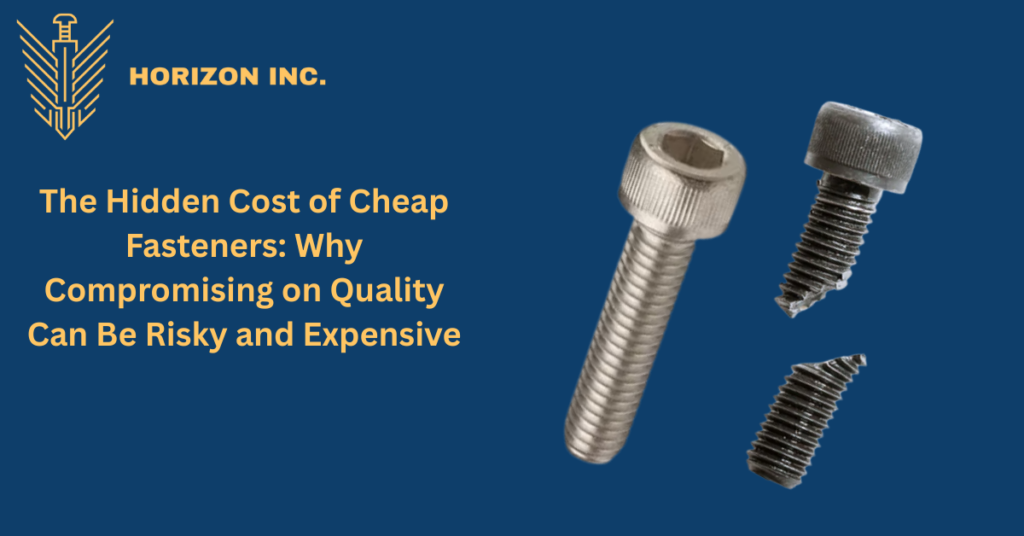
- Stripped threads
- Head breakage
- Driver recess failure
- Drill point failure
- Inconsistent dimensions
Each failure consumes operator time.
If an assembly technician spends an additional 10 seconds installing each fastener and uses 50,000 fasteners annually, the labour impact becomes substantial.
The procurement team may save money.
The factory pays the bill.
Can Cheap Fasteners Cause Production Line Stoppages?
Yes.
One missing or rejected fastener can stop an entire assembly operation.
In Horizon Inc.’s experience supplying manufacturers of electrical panels and sheet metal enclosures, emergency requests often arise because a low-cost supplier failed to deliver on time or supplied inconsistent material.
The cost of a production stoppage is rarely reflected in the purchase order value.
What Happens When Fasteners Fail in the Field?
Field failures are usually the most expensive consequence.
Common issues include:
- Corrosion
- Loose joints
- Water ingress
- Vibration-related failures
- Structural integrity issues
For outdoor telecom cabinets, solar installations and electrical enclosures, a failed fastener can result in service visits, replacement costs and reputational damage.
How Does Corrosion Increase Lifecycle Costs?
Corrosion is one of the most common long-term failure modes.
Many low-cost fasteners use inconsistent coatings or inadequate corrosion protection.
Typical consequences include:
- Rust staining
- Reduced clamping force
- Water leakage
- Joint failure
- Premature replacement
Standards such as ASTM B117 salt spray testing are often used to evaluate corrosion performance of coated fasteners.
Should Procurement Teams Consider Total Cost of Ownership?
Absolutely.
Procurement decisions should consider the complete lifecycle cost.
Total Cost of Ownership Comparison
| Factor | Low-Cost Fastener | Reliable Fastener |
| Purchase Price | Lower | Higher |
| Installation Efficiency | Lower | Higher |
| Rework Risk | Higher | Lower |
| Corrosion Resistance | Variable | Predictable |
| Warranty Risk | Higher | Lower |
| Supply Reliability | Variable | Consistent |
| Total Lifecycle Cost | Often Higher | Often Lower |
The objective should not be to buy the cheapest fastener.
The objective should be to minimise the total cost of the finished product.
What Procurement Questions Should Buyers Ask?
Before selecting a fastener supplier, procurement teams should ask:
- Is the product manufactured to a recognised standard?
- What testing data is available?
- What is the coating specification?
- What is the lead time consistency?
- What is the historical rejection rate?
- What technical support is available?
- What is the supplier’s inventory capability?
Real-World Example
A sheet metal enclosure manufacturer switched to a lower-priced self-drilling screw to reduce procurement costs.
Within months, operators reported:
- Increased drill point failures
- More stripped recesses
- Longer installation times
The apparent saving on fastener cost was outweighed by increased labour costs and production inefficiencies.
The company ultimately returned to the original specification.
FAQ
Why are cheap fasteners risky?
Because the initial purchase price often ignores costs related to installation failures, downtime, corrosion and warranty claims.
What is total cost of ownership in fasteners?
It is the combined cost of purchasing, installing, maintaining and replacing a fastener throughout its lifecycle.
Are expensive fasteners always better?
No. Procurement should focus on performance, consistency and lifecycle cost rather than price alone.
How can poor-quality fasteners affect manufacturing?
They can increase assembly time, rework, downtime and field failures.
What industries are most affected by fastener quality?
Electrical panels, telecom infrastructure, solar installations, industrial equipment, transportation and sheet metal fabrication.
Conclusion
The cheapest fastener on a quotation sheet is not necessarily the cheapest fastener for the business.
Manufacturers that evaluate fasteners solely on unit price often overlook much larger costs associated with production efficiency, reliability and product performance.
The most successful procurement teams focus not on the lowest purchase price, but on the lowest total cost of ownership.
That distinction often determines whether a fastener saves money or silently increases costs throughout the manufacturing process.

Yusuf T. Unjhawala is Co-founder of Horizon Inc., a supplier of industrial fasteners serving electrical control panel manufacturers, sheet metal fabricators, telecom equipment manufacturers, solar industry, HVAC, and industrial OEMs across South India.
Public Policy and Research:
Yusuf is an Adjunct Scholar at the Takshashila Institution, Bengaluru, where his work focuses on defence, strategic affairs.