
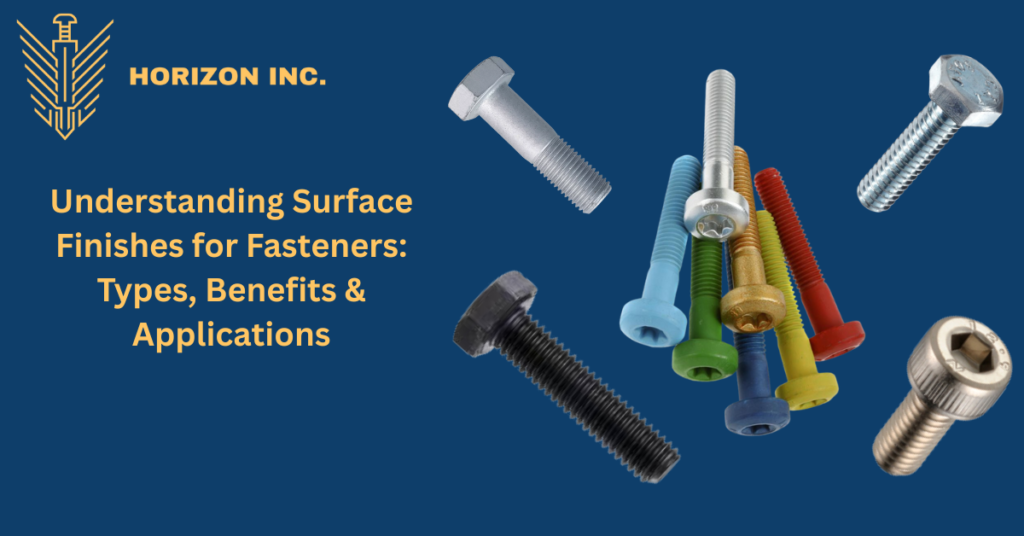
Surface finishes are protective or functional coatings applied to fasteners to improve corrosion resistance, appearance, wear resistance, lubricity, electrical properties or service life. The correct finish depends on the operating environment, required corrosion protection, mechanical requirements and budget.
Common fastener finishes include zinc plating, hot-dip galvanising, zinc flake coatings such as Geomet and Dacromet, black oxide, phosphate coating, nickel plating and stainless steel passivation. Zinc plating is widely used for indoor applications, while hot-dip galvanising is preferred for outdoor structures exposed to weather. Zinc flake coatings are commonly used in automotive, solar and infrastructure applications where high corrosion resistance is required without significantly increasing coating thickness. Selecting the correct finish can significantly extend fastener life and reduce maintenance costs.
Key Takeaways
- Surface finish selection is often as important as selecting the fastener material.
- Zinc plating is economical and suitable for indoor or mildly corrosive environments.
- Hot-dip galvanising provides significantly thicker corrosion protection for outdoor applications.
- Geomet and zinc flake coatings offer high corrosion resistance without hydrogen embrittlement.
- Black oxide is primarily used for appearance and light corrosion protection.
- Stainless steel fasteners often require passivation rather than additional coatings.
- Incorrect finish selection is a common cause of premature fastener failure.
Introduction
Fasteners are often expected to perform reliably for years while being exposed to moisture, chemicals, pollution, UV radiation and temperature variations. While material selection is important, the surface finish frequently determines how long a fastener survives in service.
A low-cost carbon steel fastener with an appropriate protective coating may outperform an unprotected fastener many times its cost. Conversely, an incorrectly selected coating can lead to rust, seizure, galvanic corrosion or premature failure.
For procurement teams, design engineers and manufacturers, understanding fastener finishes helps improve durability, reduce warranty claims and lower lifecycle costs.
Why Are Surface Finishes Applied to Fasteners?
Fastener coatings serve several purposes:
- Corrosion protection
- Improved appearance
- Reduced friction during installation
- Better torque consistency
- Increased wear resistance
- Electrical conductivity or insulation
- Identification and colour coding
Different industries prioritise different benefits depending on the application.
What Are the Most Common Surface Finishes for Fasteners?
Zinc Plating
Zinc plating, also known as electroplating or electro-galvanising, deposits a thin zinc layer on steel fasteners. The zinc acts as a sacrificial coating and corrodes before the underlying steel.
Common passivation colours:
- Clear / Blue Zinc
- Yellow Zinc
- Black Zinc
Typical applications:
- Electrical panels
- Sheet metal assemblies
- Furniture
- Appliances
- General industrial equipment
Advantages:
- Economical
- Attractive appearance
- Suitable for high-volume production
Limitations:
- Limited outdoor life
- Not ideal for marine environments
Hot-Dip Galvanising (HDG)
Hot-dip galvanising involves immersing fasteners in molten zinc, creating a thick metallurgically bonded coating. Typical coating thickness is substantially higher than electroplated zinc.
Typical applications:
- Solar structures
- Telecom towers
- Transmission lines
- Infrastructure projects
- Structural steelwork
Advantages:
- Excellent outdoor durability
- Sacrificial corrosion protection
- Long service life
Limitations:
- Increased coating thickness affects thread tolerances
- Higher cost than zinc plating
Geomet and Zinc Flake Coatings
Geomet is a modern zinc-aluminium flake coating designed to provide high corrosion resistance with relatively thin coating thickness.
Typical applications:
- Automotive fasteners
- Solar mounting systems
- Heavy equipment
- Infrastructure components
Advantages:
- High salt spray resistance
- Consistent torque characteristics
- No hydrogen embrittlement concerns
- Thin coating suitable for threaded parts
Dacromet Coating
Dacromet was among the first zinc flake coating systems and became widely used in automotive and industrial applications. It provides excellent corrosion resistance and avoids hydrogen embrittlement issues.
However, many industries have moved towards newer zinc flake systems such as Geomet due to environmental considerations.
Black Oxide
Black oxide is a conversion coating that produces a black appearance on steel fasteners.
Typical applications:
- Electrical enclosures
- Machine tools
- Consumer products
- Indoor equipment
Advantages:
- Attractive finish
- Minimal dimensional change
- Cost-effective
Limitations:
- Limited corrosion protection
- Usually requires oil or wax treatment
Phosphate Coating
Phosphate coatings create a crystalline surface that improves paint adhesion and lubrication.
Typical applications:
- Automotive assemblies
- Machinery
- Drywall screws
- Industrial equipment
Advantages:
- Improved paint adhesion
- Better torque control
Limitations:
- Limited standalone corrosion resistance
Nickel Plating
Nickel plating offers moderate corrosion protection with a bright decorative appearance.
Typical applications:
- Hardware
- Decorative fittings
- Consumer products
- Furniture accessories
Stainless Steel Passivation
Stainless steel fasteners often require passivation rather than plating. Passivation removes contaminants and strengthens the natural chromium oxide layer.
Typical applications:
- Food processing
- Pharmaceutical equipment
- Marine applications
- Outdoor equipment
Advantages:
- Excellent corrosion resistance
- No coating to chip or peel
How Do Different Fastener Finishes Compare?
| Finish | Corrosion Resistance | Coating Thickness | Typical Use |
|---|---|---|---|
| Zinc Plating | Moderate | Low | Indoor industrial applications |
| Black Zinc | Moderate | Low | Electrical panels and equipment |
| Black Oxide | Low | Very Low | Indoor applications |
| Phosphate | Low | Very Low | Automotive and machinery |
| Nickel Plating | Moderate | Low | Decorative hardware |
| Geomet | Very High | Low | Automotive, solar, infrastructure |
| Dacromet | Very High | Low | Industrial and automotive |
| Hot-Dip Galvanised | Very High | High | Outdoor structural applications |
| Stainless Steel Passivated | Very High | N/A | Marine and food industries |
How Should Engineers Select the Right Fastener Finish?
| Application Environment | Recommended Finish |
| Indoor dry conditions | Zinc Plating |
| Electrical Panels & Enclosures | Zinc Plating or Black Zinc |
| Industrial Machinery | Zinc Plating or Phosphate |
| Outdoor Equipment | Geomet or HDG |
| Telecom Infrastructure | HDG or Zinc Flake Coating |
| Solar Structures | HDG or Geomet |
| Coastal Environment | Stainless Steel or Geomet |
| Food Processing Equipment | Stainless Steel Passivated |
What Are Common Failures Caused by Incorrect Surface Finish Selection?
Based on Horizon Inc.’s experience supplying fasteners to panel builders, telecom contractors and infrastructure manufacturers, common issues include:
Premature Rusting
Using zinc-plated fasteners outdoors where HDG or zinc flake coatings are required.
Washer Failure
Low-quality roofing screws often use poor-quality bonded washers that crack during installation, allowing water ingress.
Galvanic Corrosion
Using dissimilar materials in humid environments without considering electrochemical compatibility.
Thread Fit Problems
Incorrect specification of hot-dip galvanised bolts and nuts can create assembly issues because of coating thickness.
Where Are Different Fastener Finishes Commonly Used?
| Industry | Common Finishes |
| Electrical Panels | Zinc Plated, Black Zinc |
| Telecom Infrastructure | HDG, Geomet |
| Data Centres | Zinc Plated, Stainless Steel |
| Solar Installations | HDG, Geomet |
| Automotive | Zinc Flake Coatings |
| Furniture | Zinc Plated, Nickel Plated |
| Food Processing | Stainless Steel Passivated |
| Infrastructure | HDG |
Frequently Asked Questions
Which fastener finish provides the best corrosion resistance?
Hot-dip galvanising, Geomet coatings and stainless steel passivation generally provide the highest corrosion resistance depending on the environment.
Is zinc plating suitable for outdoor use?
Only in mildly corrosive environments. For long-term outdoor exposure, HDG or zinc flake coatings are usually preferred.
What is the difference between Geomet and Dacromet?
Both are zinc flake coatings, but Geomet is a newer generation coating developed to meet modern environmental requirements.
Does black oxide prevent rust?
Black oxide provides only limited corrosion protection and is generally used indoors.
Why are stainless steel fasteners often not plated?
Stainless steel derives corrosion resistance from its chromium content and protective oxide layer.
Can coating thickness affect thread fit?
Yes. Hot-dip galvanised coatings are significantly thicker and require special thread tolerances.
Conclusion
Selecting the correct surface finish is critical to fastener performance, durability and lifecycle cost. Zinc plating remains the most common choice for indoor industrial applications, while hot-dip galvanising and zinc flake coatings such as Geomet dominate demanding outdoor environments. Stainless steel passivation continues to be the preferred solution for highly corrosive and hygienic applications.
For engineers and procurement teams, evaluating the operating environment, corrosion requirements and installation conditions before selecting a finish can prevent premature failures and significantly extend service life.
Need fasteners with zinc plating, hot-dip galvanising, Geomet, black oxide or other specialised finishes?
Horizon Inc. supplies industrial fasteners for electrical panels, telecom infrastructure, data centres, solar installations, OEM manufacturing and sheet metal fabrication. Contact our team to identify the most suitable fastener finish for your application and service environment.

Yusuf T. Unjhawala is Co-founder of Horizon Inc., a supplier of industrial fasteners serving electrical control panel manufacturers, sheet metal fabricators, telecom equipment manufacturers, solar industry, HVAC, and industrial OEMs across South India.
Public Policy and Research:
Yusuf is an Adjunct Scholar at the Takshashila Institution, Bengaluru, where his work focuses on defence, strategic affairs.