
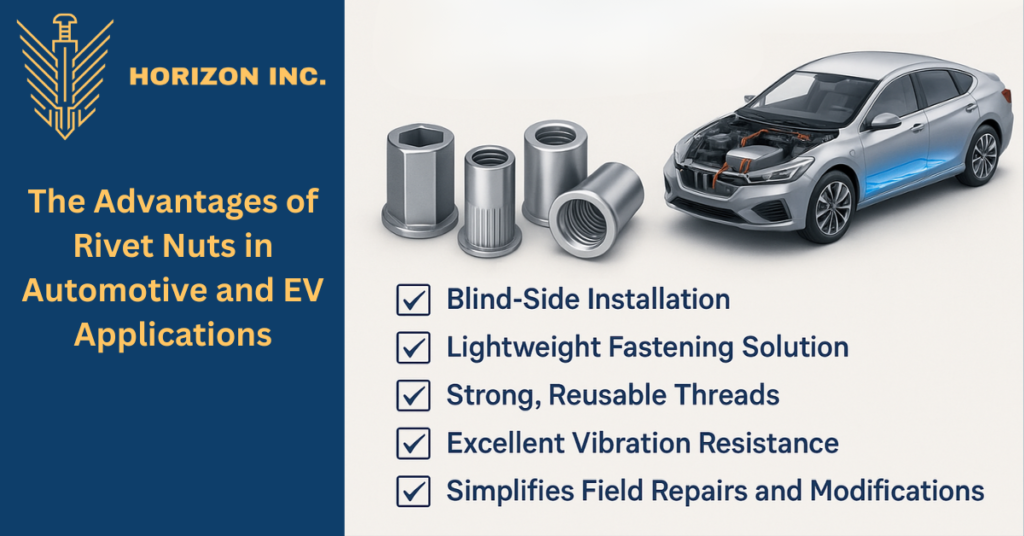
Nut inserts are widely used in automotive and electric vehicle (EV) manufacturing because they create strong, reusable internal threads in thin sheet metal, aluminium sections, tubular structures, and composite materials where conventional tapping is not practical. They can be installed from one side of the workpiece, making them ideal for closed sections and inaccessible assemblies commonly found in modern vehicles.
Compared with weld nuts, self-tapping screws, or tapped holes, nut inserts reduce assembly time, eliminate welding distortion, support lightweight vehicle designs, and simplify maintenance. They are commonly used in battery enclosures, body panels, chassis components, dashboard assemblies, charging equipment, seating systems, and mounting brackets. Their ability to provide durable threads while maintaining structural integrity makes them a preferred fastening solution in both conventional vehicles and electric mobility applications.
Key Takeaways
- Nut inserts provide strong internal threads in thin materials.
- Installation requires access from only one side.
- Suitable for steel, aluminium, stainless steel, and composites.
- Reduce the need for welding and secondary machining.
- Improve serviceability and maintenance.
- Available in round body, hex body, semi-hex, and closed-end designs.
- Widely used in EV battery packs, chargers, and lightweight vehicle structures.
Introduction
Vehicle manufacturers continually seek ways to reduce weight, improve assembly efficiency, and simplify maintenance. At the same time, fastening systems must withstand vibration, temperature fluctuations, and repeated service operations throughout the vehicle’s life.
Nut inserts have emerged as a practical solution because they create permanent internal threads in materials that are too thin for conventional tapping. Their versatility has made them increasingly common in passenger vehicles, commercial vehicles, electric two-wheelers, EV charging infrastructure, battery enclosures, and automotive electronics.
Why Are Nut Inserts Used in Automotive and EV Manufacturing?
Modern vehicles contain numerous thin-walled structures where conventional threaded holes are impractical.
Nut inserts help manufacturers by:
- Creating reusable threads in thin sheet metal
- Eliminating the need for access to both sides
- Reducing welding operations
- Supporting lightweight designs
- Simplifying assembly automation
- Improving serviceability during maintenance
This combination of advantages makes them suitable for high-volume production environments.
How Do Nut Inserts Compare with Other Threaded Fastening Methods?
| Fastening Method | Access Required | Reusable Threads | Suitable for Thin Material | Heat Required |
|---|---|---|---|---|
| Nut Inserts | One Side | Yes | Yes | No |
| Weld Nuts | Both Sides | Yes | Limited | Yes |
| Tapped Holes | Both Sides | Yes | Often No | No |
| Self-Tapping Screws | One Side | Limited | Yes | No |
For many automotive assemblies, nut inserts provide the best balance between installation speed, thread strength, and manufacturing efficiency.
Where Are Nut Inserts Used in Electric Vehicles?
Electric vehicles contain several assemblies that benefit from blind-thread installation.
Common applications include:
Battery Enclosures
Battery packs often use aluminium and thin-gauge steel structures. Nut inserts provide secure threaded attachment points without introducing heat from welding.
Charging Equipment
EV charging systems require secure mounting of electrical components, covers, and access panels.
Vehicle Body Structures
Used for attaching:
- Covers
- Panels
- Brackets
- Reinforcement components
Interior Assemblies
Suitable for:
- Dashboard supports
- Instrument panels
- Seating systems
- Interior trim components
Thermal Management Systems
Cooling assemblies and battery thermal management systems frequently require serviceable threaded connections.
Which Types of Nut Inserts Are Used in Automotive Applications?
| Type | Characteristics | Typical Applications |
| Round Body Nut Insert | General-purpose design | Body panels, brackets |
| Hex Body Nut Insert | High torque resistance | Structural assemblies |
| Semi-Hex Nut Insert | Improved anti-rotation | Irregular hole applications |
| Closed-End Nut Insert | Sealed thread design | Battery enclosures |
| Jack Nut | Expands behind material | Plastics and composites |
| Split Nut Insert | Low load applications | Interior trim assemblies |
Why Are Nut Inserts Important for EV Battery Enclosures?
Battery enclosures require:
- High reliability
- Corrosion resistance
- Serviceability
- Lightweight construction
Closed-end nut inserts are frequently selected because they help prevent moisture ingress while providing secure threaded attachment points.
In many EV designs, they eliminate the need for weld nuts, reducing heat input near sensitive battery components.
What Materials Are Used for Automotive Nut Inserts?
Material selection depends on corrosion exposure, strength requirements, and compatibility with surrounding materials.
| Material | Advantages | Typical Applications |
| Steel | High strength and cost-effective | General automotive assemblies |
| Stainless Steel | Corrosion resistance | Outdoor and exposed areas |
| Aluminium | Lightweight | EV battery systems and lightweight structures |
Careful material selection is important to minimise galvanic corrosion when joining dissimilar metals.
What Are Common Failure Modes of Nut Inserts in Vehicles?
Failures are usually related to installation rather than the insert itself.
Common issues include:
Incorrect Hole Size
Oversized holes can reduce pull-out strength and increase rotation risk.
Under-Compression
Insufficient setting force can lead to loosening during vibration.
Over-Compression
Excessive installation force may damage the insert or surrounding material.
Wrong Material Selection
Using carbon steel inserts in corrosive environments may lead to premature corrosion.
Inadequate Grip Range Selection
Choosing an insert outside its designed grip range can compromise performance.
How Should Engineers Select Nut Inserts for Automotive Projects?
Consider the following factors:
| Selection Factor | Consideration |
| Base Material | Steel, aluminium, composite, plastic |
| Thickness | Material thickness and grip range |
| Load Requirements | Tensile and torque requirements |
| Environmental Conditions | Corrosion, moisture, chemicals |
| Serviceability | Frequency of removal and reinstallation |
| Installation Access | Blind-side accessibility |
| Sealing Requirements | Open-end or closed-end design |
Real-World Applications
Automotive and EV manufacturers commonly use nut inserts in:
- Battery pack housings
- EV charger cabinets
- Electric scooter frames
- Bus body structures
- Dashboard mounting systems
- Seat mounting brackets
- HVAC assemblies
- Electrical control modules
- Vehicle access panels
Based on Horizon Inc.’s experience supplying fastening solutions to automotive and EV manufacturers, closed-end and hex-body nut inserts are increasingly specified where vibration resistance and serviceability are critical requirements.
FAQs
What is the main advantage of a nut insert in automotive manufacturing?
It creates strong reusable threads in thin materials where conventional tapping is not practical.
Are nut inserts suitable for electric vehicle battery enclosures?
Yes. Closed-end nut inserts are commonly used in battery packs and enclosures because they provide strong threaded connections and can help improve sealing.
Can nut inserts replace weld nuts?
In many applications, yes. They eliminate welding operations and can be installed from one side.
Which nut insert provides the highest resistance to rotation?
Hex body nut inserts generally provide better anti-rotation performance than round body designs.
Are stainless steel nut inserts necessary for EV applications?
Not always. Material selection depends on corrosion exposure, mechanical requirements, and compatibility with surrounding materials.
Can nut inserts be installed in aluminium?
Yes. They are widely used in aluminium battery enclosures, body structures, and lightweight vehicle assemblies.
Conclusion
As automotive and electric vehicle manufacturers continue to pursue lighter, more efficient, and serviceable designs, nut inserts have become an increasingly important fastening solution. Their ability to provide strong reusable threads in thin materials, eliminate welding operations, and simplify assembly makes them suitable for a wide range of vehicle applications.
Whether used in battery enclosures, charging infrastructure, body panels, or interior assemblies, selecting the correct nut insert design, material, and grip range is essential for achieving long-term reliability and performance.
Looking for reliable nut inserts for automotive, EV, charging infrastructure, or sheet metal assemblies? Horizon Inc. supplies steel, stainless steel, aluminium, hex body, round body, closed-end, and specialty nut inserts designed for demanding industrial applications. Contact our team to discuss your design requirements and fastening challenges.
📞 Call: 080-41179152
📱 WhatsApp: +91 9916777262
✉️ Email: sales@horizonincindia.com
🌐 Visit: www.horizonincindia.com

Yusuf T. Unjhawala is Co-founder of Horizon Inc., a supplier of industrial fasteners serving electrical control panel manufacturers, sheet metal fabricators, telecom equipment manufacturers, solar industry, HVAC, and industrial OEMs across South India.
Public Policy and Research:
Yusuf is an Adjunct Scholar at the Takshashila Institution, Bengaluru, where his work focuses on defence, strategic affairs.