
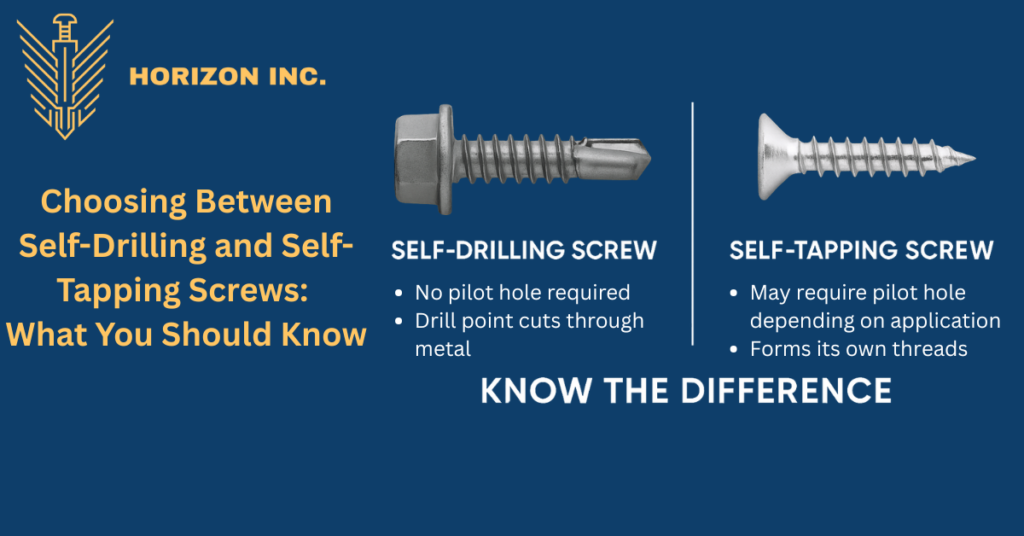
The main difference between self drilling screws and self tapping screws is that self-drilling screws create their own hole and threads in a single operation, while self-tapping screws create threads but usually require a pre-drilled pilot hole. Self-drilling screws feature a drill-point tip that functions like a miniature drill bit, eliminating the need for a separate drilling step. Self-tapping screws have specialised thread designs that cut or form threads in an existing hole. In sheet metal fabrication, roofing, telecom infrastructure, electrical enclosures, and industrial equipment manufacturing, self-drilling screws are typically chosen for faster assembly and reduced labour costs, while self-tapping screws are preferred when hole sizes must be controlled precisely or when working with thinner materials. All self-drilling screws are self-tapping, but not all self-tapping screws are self-drilling.
Key Takeaways
- Self-drilling screws drill and fasten in one operation.
- Self-tapping screws usually require a pilot hole.
- Self-drilling screws improve installation speed.
- Self-tapping screws provide greater flexibility in pre-drilled assemblies.
- Roofing, PEB structures, and steel fabrication commonly use self-drilling screws.
- Electrical panels and enclosures often use self-tapping screws in prepared holes.
- Selecting the wrong screw can increase installation time and reduce joint reliability.
Introduction
In sheet metal fabrication and industrial manufacturing, the terms “self-drilling screw” and “self-tapping screw” are often used interchangeably. However, these fasteners serve different functions and selecting the wrong type can lead to installation difficulties, increased labour costs, and weaker joints.
At Horizon Inc., we regularly assist OEMs, electrical panel manufacturers, telecom cabinet fabricators, solar EPC contractors, and PEB installers in selecting the appropriate fastening solution for their applications.
This guide explains the differences, advantages, limitations, and practical selection criteria for both screw types.
What Is a Self-Tapping Screw?
A self-tapping screw is designed to create mating threads as it is driven into a material.
Unlike conventional machine screws, self-tapping screws do not require a pre-threaded hole. However, most self-tapping screws require a pilot hole before installation.
Common Characteristics
- Creates threads during installation
- Usually requires a pilot hole
- Available in thread-forming and thread-cutting designs
- Suitable for metal, plastic, wood, and composite materials
Typical Applications
- Electrical control panels
- Sheet metal enclosures
- HVAC ducting
- Appliance manufacturing
- Light-duty metal assemblies
What Is a Self-Drilling Screw?
A self-drilling screw combines drilling, thread forming, and fastening into a single operation.
The screw tip resembles a miniature drill bit that creates the hole before the threads engage and secure the material. This eliminates separate drilling operations and significantly reduces assembly time.
Common Characteristics
- Drill point eliminates pilot-hole drilling
- Creates threads automatically
- Faster installation
- Suitable for metal-to-metal fastening
- Available in multiple drill point capacities
Typical Applications
- PEB roofing systems
- Steel structures
- Solar mounting systems
- Telecom towers
- Outdoor cabinets
- HVAC support structures
How Do Self-Drilling and Self-Tapping Screws Compare?
| Feature | Self-Tapping Screw | Self-Drilling Screw |
|---|---|---|
| Pilot Hole Required | Usually Yes | No |
| Drilling Capability | No | Yes |
| Thread Formation | Yes | Yes |
| Installation Speed | Moderate | High |
| Labour Requirement | Higher | Lower |
| Typical Use | Pre-drilled assemblies | Direct fastening |
| Suitable for Thick Steel | Limited | Excellent |
| Common Standards | DIN 7971, ISO 1481 | DIN 7504, ISO 15480 |
When Should You Use Self-Tapping Screws?
Self-tapping screws are ideal when:
- Hole location accuracy is critical
- Components are pre-punched or laser-cut
- Thin sheet metal is used
- Assembly processes already include drilling operations
- Replacement or serviceability is important
In electrical panel manufacturing, self-tapping screws are frequently used for mounting accessories, hinges, brackets, and internal components where holes are already prepared.
When Should You Use Self-Drilling Screws?
Self-drilling screws are generally preferred when:
- Installation speed is important
- Labour costs need to be reduced
- High-volume assembly is involved
- Steel sections must be joined directly
- Outdoor installations require weatherproof fastening
Examples include:
- Roofing sheets
- PEB structures
- Solar panel supports
- Telecom shelters
- Data centre infrastructure
Which Industries Commonly Use Self-Drilling Screws?
| Industry | Common Application |
| Pre-Engineered Buildings | Roof and wall cladding |
| Solar EPC | Mounting structures |
| Telecom Infrastructure | Outdoor cabinets |
| Data Centres | Cable tray supports |
| HVAC | Duct supports |
| Steel Fabrication | Structural assembly |
What Are the Common Failure Modes?
Using Self-Tapping Screws Without Proper Pilot Holes
Common issues include:
- Material cracking
- Thread stripping
- Reduced pull-out strength
- Fastener breakage
Using Incorrect Self-Drilling Screw Point
Common issues include:
- Drill point burnout
- Excessive installation time
- Incomplete penetration
- Joint failure
At Horizon Inc., one common field issue we observe is installers using low-quality self-drilling screws on thicker steel sections. The drill point often wears out before penetrating the substrate, resulting in excessive installation time and damaged fasteners.
How Do You Select the Correct Screw?
| Selection Factor | Recommendation |
| Thin sheet metal | Self-tapping screw |
| Pre-drilled holes | Self-tapping screw |
| Fast installation | Self-drilling screw |
| Thick steel sections | Self-drilling screw |
| Roofing applications | Self-drilling screw with EPDM washer |
| Enclosures and panels | Self-tapping screw |
| Outdoor structures | Stainless steel or coated self-drilling screw |
Why Is Fastener Quality Important?
While self-drilling screws appear simple, performance varies significantly between manufacturers.
Factors affecting performance include:
- Drill point geometry
- Heat treatment
- Surface coating
- Thread accuracy
- Washer quality
For roofing and outdoor applications, poor-quality bonded washers can crack or separate, leading to water ingress and premature failure. This is one of the most common complaints encountered when low-cost imported screws are used.
Frequently Asked Questions
Are self-drilling screws also self-tapping?
Yes. Self-drilling screws create their own hole and also form threads during installation. Therefore, all self-drilling screws are self-tapping screws.
Do self-tapping screws always require a pilot hole?
In most metal applications, yes. A pilot hole helps ensure proper thread formation and reduces installation torque.
Can self-drilling screws be used in stainless steel?
Special grades designed for stainless steel applications are available, but standard self-drilling screws may struggle with harder stainless materials.
Which screw is faster to install?
Self-drilling screws are faster because drilling and fastening occur in a single operation.
What is the most common self-drilling screw standard?
DIN 7504 is one of the most widely used standards for self-drilling screws.
Are self-drilling screws suitable for roofing?
Yes. Hex head self-drilling screws with bonded EPDM washers are widely used in roofing and cladding applications.
Conclusion
Both self-drilling screws and self-tapping screws have important roles in modern manufacturing and construction. The correct choice depends on material thickness, production volume, assembly process, and environmental conditions.
For pre-drilled assemblies and precision sheet metal applications, self-tapping screws often provide the most practical solution. For roofing, structural steel, telecom infrastructure, and high-volume fabrication, self-drilling screws typically deliver faster installation and lower labour costs.
Understanding the difference between these fasteners helps engineers, procurement teams, and fabricators improve productivity, reduce failures, and achieve more reliable assemblies.
Need help selecting the right fastener for sheet metal fabrication, electrical enclosures, telecom infrastructure, solar installations, or industrial manufacturing?
Contact Horizon Inc. for application-specific recommendations on self-drilling screws, self-tapping screws, blind rivets, nut inserts, weld studs, and self-clinching fasteners. Our team can help you reduce installation time, improve assembly reliability, and select the right fastener for your specific application.
📞 Call: 080-41179152
📱 WhatsApp: +91 9916777262
✉️ Email: sales@horizonincindia.com
🌐 Visit: www.horizonincindia.com

Yusuf T. Unjhawala is Co-founder of Horizon Inc., a supplier of industrial fasteners serving electrical control panel manufacturers, sheet metal fabricators, telecom equipment manufacturers, solar industry, HVAC, and industrial OEMs across South India.
Public Policy and Research:
Yusuf is an Adjunct Scholar at the Takshashila Institution, Bengaluru, where his work focuses on defence, strategic affairs.