
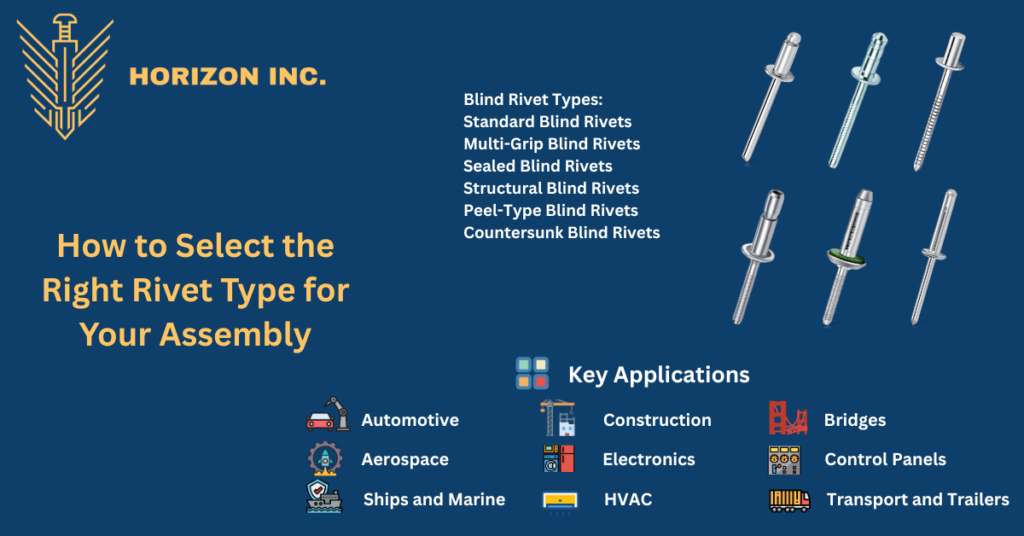
Selecting the right blind rivet depends on five primary factors: material being joined, joint strength requirements, environmental conditions, access limitations, and sealing requirements. Standard open-end blind rivets are suitable for general sheet metal assembly, while structural rivets such as monobolt and interlock rivets are preferred for high-load and vibration-prone applications. Closed-end blind rivets are used when moisture or dust ingress must be prevented. Multigrip rivets are ideal when material thickness varies, reducing inventory requirements. For soft materials such as plastics and composites, peel rivets distribute load over a larger area and help prevent material damage. Choosing the correct rivet improves joint reliability, reduces assembly failures, and ensures long-term performance in applications such as electrical enclosures, telecom cabinets, solar structures, HVAC equipment, and industrial machinery.
Key Takeaways
- Blind rivets are ideal when access is available from only one side of the assembly.
- Rivet selection should consider load, vibration, corrosion exposure, and material compatibility.
- Structural rivets provide significantly higher strength than standard blind rivets.
- Closed-end rivets help create water-resistant and dust-resistant joints.
- Multigrip rivets simplify inventory management where sheet thickness varies.
- Matching rivet material with the parent material helps minimise galvanic corrosion.
Introduction
Blind rivets are among the most widely used permanent fastening solutions in sheet metal fabrication and industrial assembly. They provide a quick, reliable method of joining materials where access is available from only one side of the workpiece. Because different blind rivet designs serve different purposes, selecting the wrong type can result in loose joints, water leakage, vibration failures, or premature corrosion.
For engineers, procurement teams, and fabricators, understanding the differences between blind rivet types is essential for achieving reliable assembly performance.
What Factors Should Be Considered When Selecting a Blind Rivet?
The following factors should be evaluated before choosing a rivet:
Joint Strength Requirements
Determine whether the joint is:
- Cosmetic or light-duty
- Structural and load-bearing
- Subjected to dynamic loads
- Exposed to vibration
Higher loads typically require structural rivets rather than standard blind rivets.
Material Compatibility
Common rivet materials include:
- Aluminium
- Steel
- Stainless steel
Where possible, rivet material should be compatible with the joined materials to minimise galvanic corrosion.
Environmental Conditions
Consider:
- Outdoor exposure
- Humidity
- Coastal environments
- Chemical exposure
- UV exposure
Stainless steel rivets generally provide superior corrosion resistance.
Accessibility
Blind rivets are specifically designed for assemblies where only one side of the joint can be accessed during installation.
Sealing Requirements
Applications such as telecom cabinets, outdoor enclosures, and solar equipment may require sealed joints to prevent ingress of water, dust, or contaminants.
Which Blind Rivet Type Is Best for General Sheet Metal Fabrication?
Open-End Blind Rivets
Open-end blind rivets are the most commonly used rivets in industrial manufacturing.
Typical applications include:
- Electrical control panels
- Sheet metal enclosures
- HVAC equipment
- Cabinets
- General fabrication
Advantages:
- Economical
- Easy installation
- Available in multiple materials
- Suitable for most standard assemblies
Limitations:
- Not watertight
- Limited strength compared to structural rivets
When Should Structural Blind Rivets Be Used?
Monobolt and Interlock Rivets
Structural blind rivets are designed for demanding applications requiring high tensile and shear strength.
Typical applications include:
- Solar mounting structures
- Telecom infrastructure
- Transportation equipment
- PEB structures
- Heavy industrial equipment
Advantages:
- High load capacity
- Excellent vibration resistance
- Mandrel retention systems improve joint integrity
- Reduced risk of loosening under dynamic loads
In Horizon Inc.’s experience supplying fastening solutions to telecom, solar, and enclosure manufacturers, structural rivets are often preferred where maintenance access is difficult and long-term reliability is critical.
When Are Closed-End Blind Rivets Required?
Closed-End Blind Rivets
Closed-end rivets feature a sealed body that prevents fluid and contaminant passage through the rivet.
Recommended applications include:
- Outdoor electrical enclosures
- Telecom cabinets
- Solar combiner boxes
- Control panels exposed to weather
Advantages:
- Improved water resistance
- Reduced dust ingress
- Better corrosion protection
Why Use Multigrip Blind Rivets?
Multigrip Rivets
Multigrip rivets accommodate a wider grip range than conventional rivets.
Benefits include:
- Reduced inventory
- Simplified procurement
- Faster assembly
- Suitable for varying sheet thicknesses
These rivets are particularly useful when fabricators work with multiple material combinations and inconsistent stack thicknesses.
What Rivet Type Works Best for Soft Materials?
Peel Rivets
Peel rivets expand into multiple legs on the blind side, spreading the load over a larger area.
Common applications:
- Plastics
- Fibreglass
- Composite panels
- Thin decorative materials
Advantages:
- Reduced material cracking
- Improved pull-out resistance
- Better load distribution
Blind Rivet Type Comparison Table
| Blind Rivet Type | Strength Level | Sealing Capability | Vibration Resistance | Typical Applications |
|---|---|---|---|---|
| Open-End Rivet | Medium | No | Moderate | Panels, cabinets, enclosures |
| Closed-End Rivet | Medium | Yes | Moderate | Outdoor enclosures, telecom cabinets |
| Multigrip Rivet | Medium | Limited | Moderate | Variable thickness assemblies |
| Peel Rivet | Low-Medium | No | Moderate | Plastics and composites |
| Monobolt Rivet | High | Yes | High | Structural assemblies |
| Interlock Rivet | High | Yes | High | Solar, transport, telecom |
Blind Rivet Selection Guide
| Application Requirement | Recommended Rivet Type |
| General sheet metal assembly | Open-End Rivet |
| Outdoor enclosure | Closed-End Rivet |
| Variable material thickness | Multigrip Rivet |
| Plastic or composite materials | Peel Rivet |
| High vibration environment | Monobolt Rivet |
| Structural load-bearing joint | Interlock or Monobolt Rivet |
| Telecom cabinet assembly | Closed-End or Structural Rivet |
| Solar mounting systems | Structural Rivet |
Real-World Application Examples
Electrical Control Panels
Most internal panel assemblies use open-end blind rivets due to their ease of installation and cost-effectiveness.
Telecom Outdoor Cabinets
Closed-end rivets help minimise moisture ingress and improve enclosure reliability.
Solar Mounting Structures
Structural rivets are commonly used where vibration resistance and long-term durability are required.
HVAC Equipment
Multigrip rivets reduce inventory requirements when joining materials of varying thicknesses.
Frequently Asked Questions
What is the strongest type of blind rivet?
Structural rivets such as Monobolt and Interlock rivets typically provide the highest tensile and shear strength.
Can blind rivets be used outdoors?
Yes. Stainless steel and closed-end blind rivets are commonly used in outdoor applications.
What is the difference between a standard and structural blind rivet?
Structural rivets provide higher strength, improved vibration resistance, and often retain the mandrel after installation.
How do I choose the correct rivet material?
Match the rivet material to the parent material whenever possible and consider corrosion exposure.
Are multigrip rivets stronger than standard rivets?
Not necessarily. Their primary advantage is accommodating a wider range of material thicknesses.
Can blind rivets create a watertight joint?
Closed-end blind rivets can significantly improve sealing performance when correctly installed.
Conclusion
Selecting the correct blind rivet involves more than simply matching the hole diameter. Engineers and fabricators must consider load requirements, vibration exposure, material compatibility, environmental conditions, and sealing requirements. While standard blind rivets are suitable for many sheet metal applications, structural, multigrip, peel, and closed-end rivets each solve specific assembly challenges.
By selecting the appropriate rivet type at the design stage, manufacturers can improve assembly reliability, reduce maintenance costs, and achieve longer service life from their products.
Need help selecting the right blind rivet for your application? Horizon Inc supplies open-end, closed-end, multigrip, monobolt, interlock, peel, and other industrial blind rivets for sheet metal fabrication, electrical enclosures, telecom infrastructure, solar installations, and OEM manufacturing. Contact our team for technical guidance, sizing recommendations, and fast delivery across India.
📞 Call: 080-41179152
📱 WhatsApp: +91 9916777262
✉️ Email: sales@horizonincindia.com
🌐 Visit: www.horizonincindia.com

Yusuf T. Unjhawala is Co-founder of Horizon Inc., a supplier of industrial fasteners serving electrical control panel manufacturers, sheet metal fabricators, telecom equipment manufacturers, solar industry, HVAC, and industrial OEMs across South India.
Public Policy and Research:
Yusuf is an Adjunct Scholar at the Takshashila Institution, Bengaluru, where his work focuses on defence, strategic affairs.