
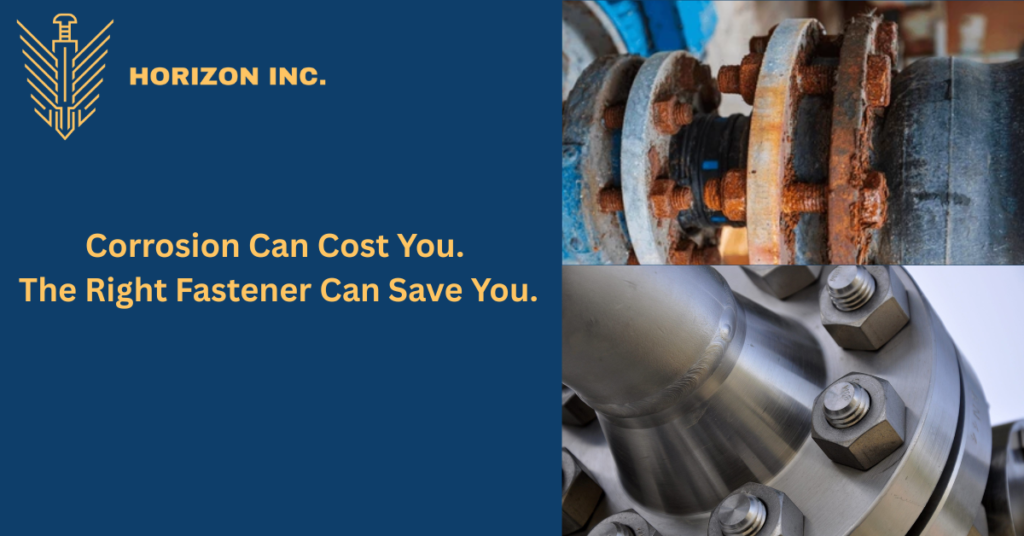
Fastener corrosion occurs when fasteners react with moisture, oxygen, chemicals, salt, or other environmental contaminants. Over time, corrosion reduces the cross-sectional area of the fastener, weakens joint strength, damages coatings, and can ultimately lead to structural failure. The most common forms of fastener corrosion include uniform corrosion, galvanic corrosion, crevice corrosion, and pitting corrosion. Corrosion can be minimised by selecting the correct fastener material, using suitable protective coatings, avoiding dissimilar metal combinations, and designing joints that do not trap moisture. For outdoor structures, solar installations, telecom towers, electrical enclosures, and industrial equipment, proper fastener selection is often as important as strength requirements. A fastener that meets load requirements but lacks adequate corrosion resistance can fail prematurely despite being mechanically sound.
Key Takeaways
- Corrosion is one of the leading causes of premature fastener failure.
- Galvanic corrosion occurs when dissimilar metals are in contact in the presence of moisture.
- Crevice corrosion commonly develops beneath washers, gaskets, and overlapping joints.
- Pitting corrosion can cause sudden failure with little visible surface damage.
- Stainless steel, hot-dip galvanised, and zinc flake coated fasteners provide improved corrosion resistance.
- Material compatibility is critical when selecting fasteners.
- Environmental conditions should always be considered before choosing a fastener.
Introduction
Fasteners are often the smallest components in an assembly, yet they frequently determine its long-term reliability. Whether used in electrical panels, solar structures, telecom cabinets, rooftop installations, HVAC systems, or industrial machinery, fasteners are continuously exposed to environmental conditions that can trigger corrosion.
Many failures that appear to be mechanical problems are actually corrosion-related. A corroded fastener gradually loses strength, thread engagement, clamping force, and sealing capability until the joint becomes unreliable.
Understanding why fasteners corrode helps engineers, procurement teams, and fabricators select the correct fastening solution for their application.
What Is Fastener Corrosion?
Fastener corrosion is the gradual deterioration of a fastener due to chemical or electrochemical reactions with its surrounding environment.
The process typically involves:
- Moisture
- Oxygen
- Salts
- Industrial pollutants
- Chemical vapours
- Temperature fluctuations
As corrosion progresses, the fastener’s mechanical properties deteriorate, increasing the risk of joint failure.
What Are the Most Common Causes of Fastener Corrosion?
Exposure to Moisture and Humidity
The most common cause of corrosion is prolonged exposure to water and atmospheric moisture.
Applications particularly vulnerable include:
- Outdoor electrical enclosures
- Rooftop equipment
- Solar mounting systems
- Telecom towers
- Coastal installations
- HVAC systems
Even intermittent wet-dry cycles can accelerate corrosion.
Galvanic Corrosion
Galvanic corrosion occurs when two dissimilar metals are electrically connected in the presence of an electrolyte such as water.
A common example is using stainless steel fasteners with carbon steel components or aluminium structures without proper isolation.
The less noble metal corrodes at an accelerated rate while the more noble metal remains protected.
| Fastener Material | Mating Material | Corrosion Risk |
|---|---|---|
| Carbon Steel | Carbon Steel | Low |
| Stainless Steel 304 | Stainless Steel 304 | Low |
| Stainless Steel | Aluminium | Moderate to High |
| Stainless Steel | Galvanised Steel | Moderate |
| Carbon Steel | Aluminium | High |
Crevice Corrosion
Crevice corrosion develops in confined areas where moisture becomes trapped and oxygen availability is limited.
Typical locations include:
- Under washers
- Beneath fastener heads
- Lap joints
- Gasket interfaces
- Threaded connections
Because it occurs in hidden areas, significant damage can occur before detection.
Pitting Corrosion
Pitting corrosion produces small but deep cavities in the metal surface.
This form of corrosion is particularly dangerous because:
- Damage is highly localised
- Failure can occur suddenly
- Surface appearance may remain relatively unaffected
Stainless steel fasteners exposed to chloride-rich environments are especially susceptible if the wrong grade is selected.
Chemical and Industrial Exposure
Industrial environments often expose fasteners to:
- Acids
- Alkalis
- Solvents
- Chemical vapours
- Industrial pollutants
Fasteners used in chemical plants, wastewater facilities, and process industries require specialised corrosion-resistant materials.
Coastal and Marine Environments
Salt-laden air significantly accelerates corrosion.
Common challenges include:
- Chloride attack
- Pitting corrosion
- Crevice corrosion
- Accelerated coating breakdown
For coastal installations, stainless steel 316 often provides superior performance compared to stainless steel 304.
How Does Corrosion Affect Fastener Performance?
Corrosion impacts more than appearance.
Potential consequences include:
- Loss of tensile strength
- Reduced clamping force
- Thread seizure
- Joint loosening
- Water ingress
- Structural failure
- Increased maintenance costs
In electrical enclosures and outdoor cabinets, corrosion can also compromise IP sealing performance.
Which Fastener Materials Offer Better Corrosion Resistance?
| Material | Corrosion Resistance | Typical Applications |
| Carbon Steel | Low | Indoor applications |
| Zinc-Plated Steel | Moderate | General industrial use |
| Hot-Dip Galvanised Steel | High | Structural steelwork |
| Stainless Steel 304 | High | Outdoor equipment |
| Stainless Steel 316 | Very High | Marine and coastal environments |
| Zinc Flake Coated Fasteners | High | Automotive and infrastructure |
| Aluminium Fasteners | Moderate to High | Lightweight assemblies |
How Can Fastener Corrosion Be Prevented?
Select the Correct Material
Material selection should always consider:
- Environment
- Exposure conditions
- Expected service life
- Compatibility with mating materials
Use Protective Coatings
Common corrosion-resistant coatings include:
- Zinc plating
- Mechanical galvanising
- Hot-dip galvanising
- Zinc flake coatings
- Geomet coatings
- Dacromet coatings
Avoid Dissimilar Metal Contact
Where different metals must be joined:
- Use insulating washers
- Use nylon spacers
- Use protective coatings
- Consider galvanic compatibility
Improve Joint Design
Design practices can significantly reduce corrosion risk.
Avoid:
- Water traps
- Poor drainage
- Unsealed crevices
- Moisture-retaining joints
Perform Periodic Inspection
Regular inspection is especially important for:
- Solar installations
- Telecom infrastructure
- Outdoor electrical cabinets
- Industrial structures
Early detection prevents costly failures.
What Corrosion Issues Are Commonly Seen in Sheet Metal Fabrication?
Based on applications supplied by Horizon Inc., common corrosion-related issues include:
- Low-quality roofing screws developing rust around washers
- EPDM washers cracking and allowing water ingress
- Zinc plating failure in outdoor installations
- Galvanic corrosion between stainless steel fasteners and galvanised panels
- Corrosion beneath improperly sealed electrical enclosure fasteners
Many of these failures originate from incorrect material selection rather than product defects.
How Do You Select the Right Corrosion-Resistant Fastener?
| Application | Recommended Fastener Material |
| Indoor Control Panels | Zinc-Plated Steel |
| Electrical Enclosures | Stainless Steel 304 |
| Outdoor Cabinets | Stainless Steel 304 or 316 |
| Solar Structures | Stainless Steel 304/316 or Zinc Flake Coated |
| Coastal Installations | Stainless Steel 316 |
| Telecom Towers | Hot-Dip Galvanised or Stainless Steel |
| Chemical Processing Equipment | Application-Specific Stainless Steel Grades |
Frequently Asked Questions
Is stainless steel completely corrosion-proof?
No. Stainless steel is corrosion-resistant but can still suffer from pitting and crevice corrosion under certain conditions.
What is the most common type of fastener corrosion?
Uniform corrosion and galvanic corrosion are among the most frequently encountered forms.
Why do stainless steel fasteners rust near the sea?
Chloride exposure from salt-laden air can break down the passive protective layer on stainless steel.
Which is better for outdoor use: galvanised or stainless steel fasteners?
The answer depends on the environment. Stainless steel generally offers superior long-term corrosion resistance, while galvanised fasteners may provide a more economical solution for many outdoor applications.
Can corrosion occur underneath washers?
Yes. Crevice corrosion commonly develops beneath washers, gaskets, and fastener heads where moisture becomes trapped.
How can galvanic corrosion be avoided?
Use compatible metals, insulating materials, and appropriate coatings to minimise electrochemical reactions.
Conclusion
Fastener corrosion is often overlooked until failure occurs. However, selecting the correct material, coating, and installation method can significantly extend service life and improve reliability. Understanding the mechanisms behind galvanic, crevice, pitting, and uniform corrosion allows engineers and procurement teams to make informed fastening decisions.
For critical applications such as electrical enclosures, telecom infrastructure, solar installations, industrial equipment, and sheet metal fabrication, corrosion resistance should be considered a primary design requirement rather than an afterthought.
Need help selecting corrosion-resistant fasteners for your application?
Horizon Inc supplies stainless steel fasteners, self-drilling screws, blind rivets, nut inserts, weld studs and speciality fastening solutions for electrical enclosures, sheet metal fabrication, solar projects, telecom infrastructure and industrial manufacturing.
Contact our technical team today for application-specific recommendations and corrosion-resistant fastening solutions.
📞 Call: 080-41179152
📱 WhatsApp: +91 9916777262
✉️ Email: sales@horizonincindia.com
🌐 Visit: www.horizonincindia.com

Yusuf T. Unjhawala is Co-founder of Horizon Inc., a supplier of industrial fasteners serving electrical control panel manufacturers, sheet metal fabricators, telecom equipment manufacturers, solar industry, HVAC, and industrial OEMs across South India.
Public Policy and Research:
Yusuf is an Adjunct Scholar at the Takshashila Institution, Bengaluru, where his work focuses on defence, strategic affairs.