
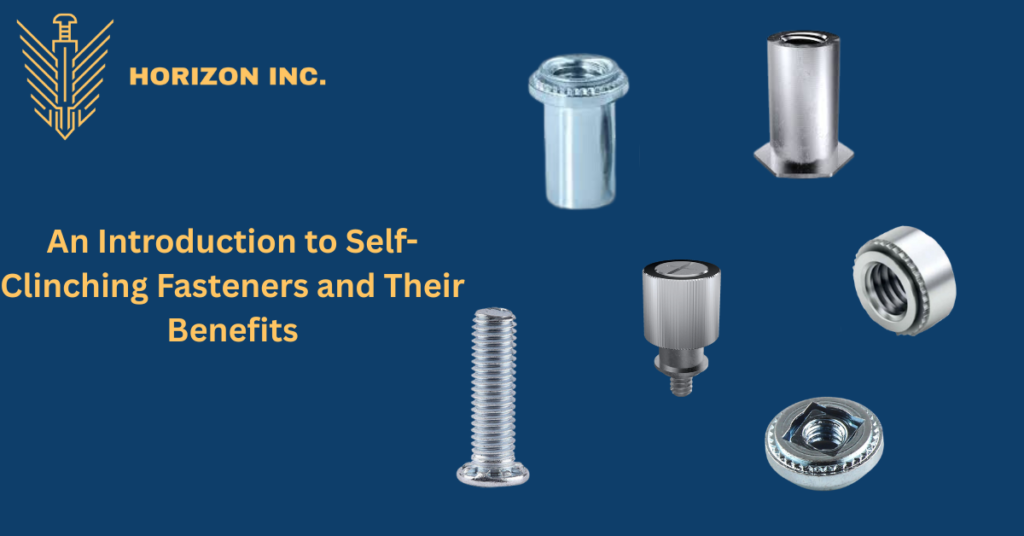
Self-clinching fasteners are permanent mechanical fasteners designed to be installed into ductile sheet metal using a controlled pressing force. During installation, the surrounding sheet metal flows into specially designed undercuts on the fastener, locking it securely into the panel without welding, tapping, or additional hardware. Self-clinching fasteners provide strong threads, studs, standoffs, locating pins, and captive fastening points in thin sheet metal where conventional threading may not be practical. They are widely used in electrical panels, telecom cabinets, server racks, EV charging stations, medical equipment, industrial enclosures, and electronic assemblies because they offer high strength, repeatable installation, and reliable performance in thin-gauge materials.
Key Takeaways
- Create strong threads in thin sheet metal.
- Eliminate welding and secondary tapping operations.
- Provide excellent resistance to push-out and rotation.
- Suitable for steel, stainless steel, and aluminium panels.
- Available as nuts, studs, standoffs, captive screws, and locating pins.
- Widely used in electrical enclosures, telecom cabinets, electronics, and industrial equipment.
- Require proper installation force and correctly sized mounting holes.
Introduction
Design engineers and sheet metal fabricators frequently encounter a common challenge: how to create strong attachment points in thin sheet metal without compromising panel integrity.
Traditional methods such as welding, loose hardware, or direct tapping often introduce additional manufacturing steps, increase assembly time, or reduce reliability.
Self-clinching fasteners solve this problem by permanently embedding threaded or locating features into the sheet itself. Today they are considered a standard fastening solution across industries ranging from electrical panel manufacturing to telecommunications infrastructure and data centre equipment.
What Is the Working Principle of a Self-Clinching Fastener?
A self-clinching fastener is pressed into a pre-prepared hole in ductile sheet metal using a hydraulic or arbor press.
During installation:
- The fastener enters the mounting hole.
- Special knurls, ribs, or serrations displace surrounding sheet metal.
- The sheet material cold-flows into an undercut on the fastener.
- The fastener becomes permanently locked into the panel.
The resulting assembly provides high resistance to both rotation and push-out forces while maintaining a flush or near-flush panel surface.
What Types of Self-Clinching Fasteners Are Available?
Self-Clinching Nuts
These create permanent internal threads in thin sheet metal.
Common applications include:
- Electrical control panels
- Telecom cabinets
- Data centre enclosures
- Industrial machinery covers
Self-Clinching Studs
These provide external threaded mounting points directly from the sheet metal surface.
Typical uses include:
- Mounting brackets
- PCB supports
- Covers and panels
- Internal equipment mounting
Self-Clinching Standoffs
Standoffs create spacing between components while providing threaded attachment points.
Common applications:
- PCB mounting
- Electronic assemblies
- Industrial control systems
- Telecom equipment
Self-Clinching Panel Fasteners
Captive panel screws remain attached to removable access panels.
Typical uses:
- Server racks
- Electrical cabinets
- Outdoor telecom enclosures
- Maintenance access doors
Self-Clinching Locating Pins
These provide alignment and positioning during assembly.
Common applications:
- Cover alignment
- Production fixtures
- Precision assemblies
Self-Clinching Fastener Comparison Table
| Fastener Type | Primary Function | Typical Application |
|---|---|---|
| Self-Clinching Nut | Internal threads | Electrical panels |
| Self-Clinching Stud | External threaded mounting point | Equipment mounting |
| Self-Clinching Standoff | Creates spacing and threading | PCB assemblies |
| Panel Fastener | Captive access fastening | Service panels |
| Locating Pin | Alignment and positioning | Precision assemblies |
Why Are Self-Clinching Fasteners Preferred Over Conventional Methods?
| Feature | Self-Clinching Fasteners | Weld Nuts | Tapped Holes |
| Suitable for Thin Sheet | Yes | Limited | Limited |
| Heat Required | No | Yes | No |
| Additional Hardware | No | Often | No |
| Installation Speed | Fast | Moderate | Slow |
| Distortion Risk | Minimal | Higher | Low |
| Thread Strength | High | High | Limited in thin sheet |
Self-clinching fasteners are particularly advantageous when thin materials make direct threading unreliable. They also eliminate welding-related issues such as distortion, spatter, and additional finishing operations.
How Do You Select the Right Self-Clinching Fastener?
Consider Sheet Material
The host material must be sufficiently ductile to allow cold flow during installation.
Common materials include:
- Mild steel
- Stainless steel
- Aluminium
Consider Sheet Thickness
Every fastener has a minimum sheet thickness requirement.
Selecting a fastener designed for thinner material can lead to pull-out failures.
Consider Load Requirements
Evaluate:
- Tensile loads
- Shear loads
- Torque requirements
- Vibration exposure
Consider Corrosion Requirements
Available materials include:
- Carbon steel
- Zinc-plated steel
- Stainless steel 304
- Stainless steel 316
- Aluminium
What Installation Mistakes Should Be Avoided?
Common field issues include:
Incorrect Hole Size
Oversized holes can reduce torque-out performance.
Insufficient Installation Force
Incomplete seating can result in fastener rotation during assembly.
Installing into Excessively Hard Material
Self-clinching fasteners require ductile sheet material for proper installation.
Burrs Around Mounting Holes
Excessive burrs may prevent full seating and reduce holding strength.
Where Are Self-Clinching Fasteners Commonly Used?
Electrical Panels and Enclosures
Used extensively for mounting components, DIN rails, cable management systems, and removable covers.
Telecom Cabinets
Provide durable fastening points for equipment mounting and access panels.
Data Centres
Used in racks, servers, cooling systems, and network infrastructure equipment.
EV Charging Equipment
Support mounting requirements in compact sheet metal assemblies.
Medical Equipment
Enable reliable fastening in precision sheet metal housings.
Practical Observation from Horizon Inc.
In electrical panel and enclosure manufacturing, we frequently see manufacturers initially attempt direct tapping in thin sheet metal to reduce component costs.
As equipment becomes larger and maintenance cycles increase, stripped threads become a common issue. Self-clinching nuts and standoffs often provide a more reliable long-term solution because they create stronger and more durable threaded attachment points without increasing panel thickness.
For high-volume enclosure production, self-clinching hardware also helps standardise assembly processes and reduce rework.
Frequently Asked Questions
Are self-clinching fasteners permanent?
Yes. Once properly installed, they become a permanent part of the sheet metal assembly.
Can self-clinching fasteners be installed in stainless steel?
Yes, provided the fastener is selected for the material hardness and thickness.
Do self-clinching fasteners require special tools?
Typically they are installed using arbor presses, pneumatic presses, or hydraulic insertion equipment.
Are self-clinching fasteners stronger than tapped holes?
In thin sheet metal, they generally provide significantly stronger and more durable threads than directly tapped holes.
Can self-clinching fasteners replace welding?
In many sheet metal applications, yes. They eliminate welding-related distortion, finishing, and quality concerns.
Conclusion
Self-clinching fasteners have become one of the most effective methods of creating permanent threaded and locating features in thin sheet metal. By eliminating welding, reducing assembly time, and providing reliable fastening performance, they are widely used across electrical panels, telecom infrastructure, electronics, medical equipment, and industrial enclosures.
Selecting the correct fastener type, material, and installation method is essential to achieving long-term performance and reliability.
Need self-clinching nuts, studs, standoffs, captive panel fasteners, or locating pins for your sheet metal assemblies?
Horizon Inc supplies a comprehensive range of self-clinching fasteners for electrical panels, telecom infrastructure, data centre equipment, industrial enclosures, EV charging systems, and OEM manufacturing applications. Contact our technical team to identify the right fastening solution for your design and production requirements.
📞 Call: 080-41179152
📱 WhatsApp: +91 9916777262
✉️ Email: sales@horizonincindia.com
🌐 Visit: www.horizonincindia.com

Yusuf T. Unjhawala is Co-founder of Horizon Inc., a supplier of industrial fasteners serving electrical control panel manufacturers, sheet metal fabricators, telecom equipment manufacturers, solar industry, HVAC, and industrial OEMs across South India.
Public Policy and Research:
Yusuf is an Adjunct Scholar at the Takshashila Institution, Bengaluru, where his work focuses on defence, strategic affairs.