
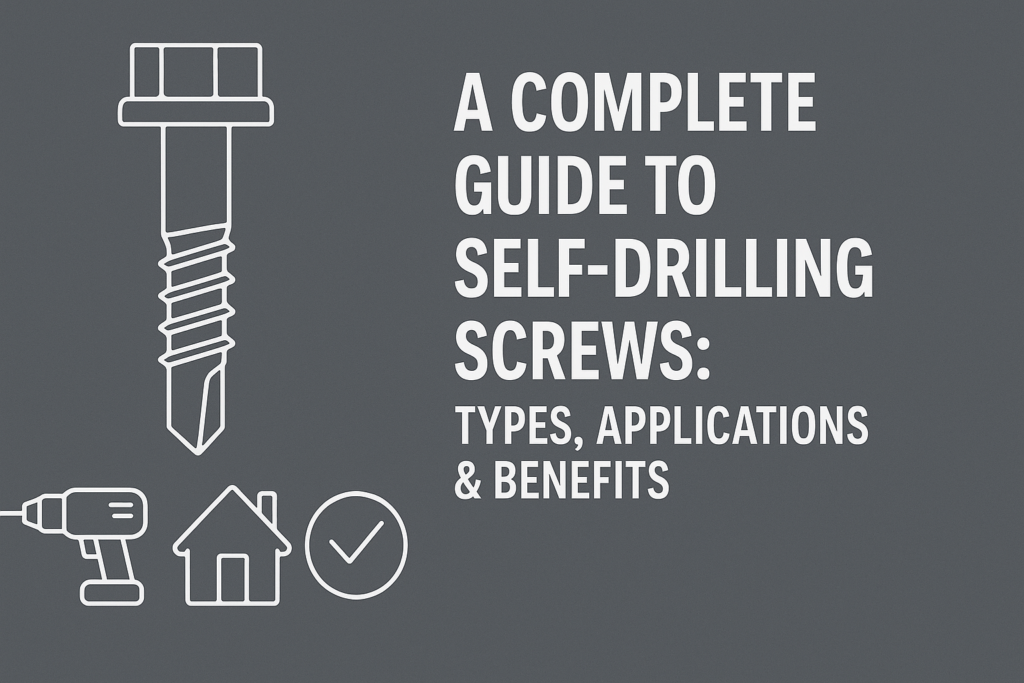
Self-drilling screws are fasteners that combine drilling, thread forming, and fastening into a single operation. Unlike self-tapping screws, they feature a drill-point tip capable of creating its own hole before forming threads. This eliminates the need for pre-drilling in many metal-to-metal and metal-to-substrate applications.
They are widely used in sheet metal fabrication, electrical enclosures, telecom cabinets, solar structures, pre-engineered buildings (PEBs), HVAC systems, and industrial equipment. Self-drilling screws are available in various head styles including hex head, pan head, truss head, and countersunk head, along with different drill point capacities designed for specific material thicknesses. Selecting the correct screw requires consideration of material thickness, environmental conditions, corrosion resistance requirements, and load conditions.
Key Takeaways
- Self-drilling screws eliminate separate drilling operations.
- Suitable for metal-to-metal and metal-to-substrate fastening.
- Available in multiple head styles for different applications.
- Drill point capacity must match material thickness.
- Coating and material selection determine corrosion resistance.
- EPDM washer assemblies help prevent roof leakage.
- Proper installation torque is critical to performance.
- Not all self-drilling screws are suitable for stainless steel or thick structural steel.
Introduction
Fastening technology has evolved significantly over the past few decades, with self-drilling screws becoming one of the most widely used fastening solutions across construction and manufacturing industries.
By combining drilling and fastening into a single operation, these screws improve productivity, reduce labour costs, and simplify installation procedures.
Today they are extensively used in:
- Sheet metal fabrication
- Electrical panels and enclosures
- PEB structures
- Roofing and cladding
- Solar mounting systems
- Telecom infrastructure
- HVAC installations
- Industrial manufacturing
Understanding the different types and specifications is essential for selecting the correct fastener and avoiding installation failures.
What Is a Self-Drilling Screw?
A self-drilling screw incorporates a drill-bit-shaped point that drills through the material before the threads engage and create the fastening connection.
The screw performs three functions:
- Drilling
- Thread forming
- Fastening
This significantly reduces installation time compared to traditional screws that require separate drilling operations.
How Is a Self-Drilling Screw Different from a Self-Tapping Screw?
| Feature | Self-Drilling Screw | Self-Tapping Screw |
|---|---|---|
| Pilot hole required | No | Usually yes |
| Drill-point tip | Yes | No |
| Thread formation | Yes | Yes |
| Metal penetration | Direct | Requires pre-drilled hole |
| Installation speed | Faster | Slower |
| Common applications | Roofing, sheet metal, steel framing | Panels, plastics, light assemblies |
A common mistake is using these terms interchangeably. Self-drilling screws create their own hole, whereas self-tapping screws primarily create threads in an existing hole.
What Are the Main Types of Self-Drilling Screws?
Hex Head Self-Drilling Screws
The most common style used in:
- Roofing systems
- Cladding
- PEB structures
- Steel framing
Advantages:
- High torque transfer
- Fast installation
- Suitable for power tools
- Available with bonded EPDM washers
Pan Head Self-Drilling Screws
Commonly used in:
- Electrical panels
- Control enclosures
- Telecom cabinets
- Sheet metal assemblies
Advantages:
- Neat appearance
- Large bearing surface
- Reduced damage to painted surfaces
Truss Head Self-Drilling Screws
Suitable for:
- Thin sheet metal
- Control panel fabrication
- Signage systems
Advantages:
- Wider head diameter
- Improved pull-through resistance
Countersunk (CSK) Self-Drilling Screws
Used where a flush finish is required.
Applications include:
- Electrical enclosures
- Furniture hardware
- Architectural assemblies
What Are Drill Point Numbers?
Self-drilling screws are available with different drill capacities.
| Drill Point | Typical Material Thickness |
| #1 | Light gauge sheet metal |
| #2 | Thin steel sections |
| #3 | Medium gauge steel |
| #4 | Heavy gauge steel |
| #5 | Thick structural steel |
Selecting an undersized drill point often results in:
- Drill point failure
- Excessive heat generation
- Broken screws
- Poor thread formation
Selecting an oversized drill point may reduce thread engagement.
Which Materials Are Used for Self-Drilling Screws?
Carbon Steel
Most widely used.
Benefits:
- High strength
- Economical
- Suitable for coated applications
Stainless Steel
Common grades:
- A2 (304)
- A4 (316)
Benefits:
- Corrosion resistance
- Outdoor applications
- Coastal environments
Bi-Metal Construction
Combines:
- Hardened carbon steel drill point
- Stainless steel body
Benefits:
- Drills steel efficiently
- Provides corrosion resistance
This is often preferred in roofing and solar applications.
Which Coatings Are Available?
Common coatings include:
- Zinc plated
- Mechanical galvanised
- Ruspert coating
- Ceramic coatings
- Zinc aluminium coatings
The required coating depends on:
- Environmental exposure
- Humidity
- Industrial pollutants
- Coastal conditions
Where Are Self-Drilling Screws Used?
Sheet Metal Fabrication
Applications:
- Control panels
- Electrical enclosures
- Cabinets
- Industrial equipment
Roofing and Cladding
Used for:
- Roof sheets
- Wall cladding
- Purlins
- Structural members
Telecom Infrastructure
Used in:
- Outdoor cabinets
- Equipment racks
- Shelter fabrication
Solar Installations
Applications include:
- Module mounting systems
- Cable management systems
- Junction box assemblies
HVAC Systems
Used for:
- Ducting
- Brackets
- Support systems
How Do You Select the Right Self-Drilling Screw?
| Selection Factor | Consideration |
| Material thickness | Match drill point capacity |
| Environment | Select suitable coating |
| Corrosion resistance | Carbon steel, stainless or bi-metal |
| Appearance | Pan, truss, CSK or hex head |
| Water sealing | EPDM washer required |
| Load requirements | Verify pull-out and shear values |
Common Installation Mistakes
Using the Wrong Drill Point
One of the most frequent causes of installation failure.
Excessive Installation Speed
Can cause:
- Overheating
- Drill point wear
- Thread damage
Over-Tightening
Results in:
- Washer deformation
- Paint damage
- Reduced holding strength
Poor Washer Quality
A common issue seen in roofing applications is washer cracking during installation. Once the EPDM washer fails, water ingress becomes likely.
This is one reason many contractors specify premium self-drilling screws instead of low-cost alternatives.
Why Does Self-Drilling Screw Quality Matter?
While self-drilling screws may appear similar externally, significant differences exist in:
- Drill point geometry
- Heat treatment
- Thread accuracy
- Washer quality
- Coating performance
- Corrosion resistance
Poor-quality screws often result in:
- Broken drill points
- Inconsistent drilling performance
- Water leakage
- Premature corrosion
- Rework costs
From Horizon Inc.’s experience supplying fasteners to panel builders, PEB contractors, telecom infrastructure companies, and industrial manufacturers, screw failures are rarely caused by design alone. More often, they originate from inconsistent manufacturing quality and incorrect screw selection.
Frequently Asked Questions
Can self-drilling screws be used in stainless steel?
Yes, but drill point capacity and material compatibility must be verified. Bi-metal screws are often preferred.
What is the difference between Tek screws and self-drilling screws?
Tek screw is a brand-originated term that has become commonly used to describe self-drilling screws.
Are self-drilling screws waterproof?
The screw itself is not waterproof. Waterproof performance is achieved using bonded EPDM washers.
Can self-drilling screws be reused?
Generally not recommended for critical applications because thread engagement may be reduced.
What causes drill point breakage?
Common causes include:
- Incorrect drill point selection
- Excessive installation speed
- Harder material than specified
- Poor screw quality
Conclusion
Self-drilling screws remain one of the most efficient fastening solutions available for sheet metal, roofing, electrical enclosures, telecom infrastructure, solar installations, and industrial fabrication.
However, successful performance depends on selecting the correct head style, drill point capacity, material grade, and coating system. The lowest-cost screw is often the most expensive choice when failures, leakage, corrosion, and rework costs are considered.
For critical industrial applications, specifying quality-engineered self-drilling screws helps ensure consistent installation performance, long service life, and reduced maintenance.
Need self-drilling screws for sheet metal fabrication, electrical panels, roofing, telecom infrastructure, solar projects, or industrial manufacturing?
Horizon Inc. supplies BIS-compliant, application-specific self-drilling screws from trusted manufacturers, helping fabricators and contractors achieve reliable installation performance, corrosion resistance, and long service life. Contact our team for application support and fastener selection assistance.
📞 Call: 080-41179152
📱 WhatsApp: +91 9916777262
✉️ Email: sales@horizonincindia.com
🌐 Visit: www.horizonincindia.com

Yusuf T. Unjhawala is Co-founder of Horizon Inc., a supplier of industrial fasteners serving electrical control panel manufacturers, sheet metal fabricators, telecom equipment manufacturers, solar industry, HVAC, and industrial OEMs across South India.
Public Policy and Research:
Yusuf is an Adjunct Scholar at the Takshashila Institution, Bengaluru, where his work focuses on defence, strategic affairs.