
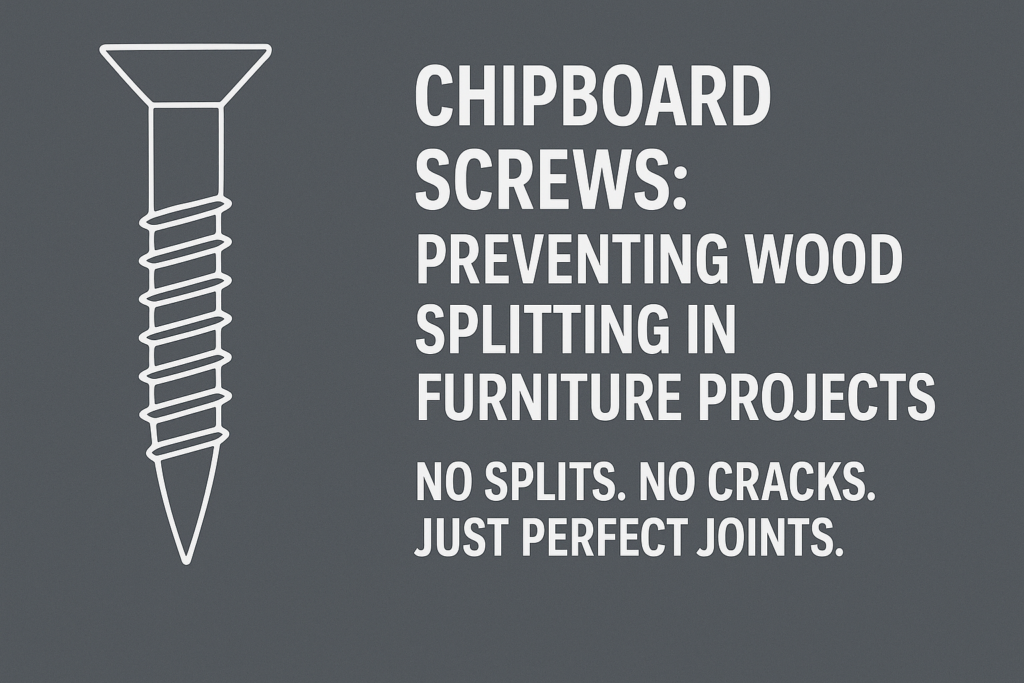
Many furniture manufacturers assume that chipboard screws automatically prevent wood splitting. In reality, standard chipboard screws can still cause splitting in MDF, particle board, plywood and timber, especially near board edges or in dense materials.
The ability of a screw to minimise splitting depends more on its engineering than its classification. Features such as Type-17 points, serrated threads, cutting ribs, reduced shanks and specialised thread geometries help remove material during installation rather than forcing fibres apart. These designs reduce installation torque, minimise internal stresses and improve assembly quality.
For furniture manufacturers, selecting the correct screw design can significantly reduce defects, improve production efficiency and increase the durability of assembled products.
Key Takeaways
- Not all chipboard screws are designed equally.
- Standard chipboard screws can still split wood and engineered boards.
- Type-17 points help reduce splitting by cutting fibres during installation.
- Serrated threads lower driving torque.
- Cutting ribs improve countersunk head seating.
- Different wood materials require different screw designs.
- Screw engineering often matters more than screw size.
- Furniture manufacturers should evaluate screw design before selecting suppliers.
Introduction
Wood splitting remains one of the most common challenges in furniture manufacturing. Whether producing modular furniture, wardrobes, office workstations or kitchen cabinets, splitting can lead to rejected components, rework and customer complaints.
Many manufacturers attempt to solve the problem by switching to chipboard screws. While this is often a step in the right direction, it does not always eliminate splitting.
A common misconception is that all chipboard screws are engineered to prevent board damage. In reality, the performance of a screw depends heavily on its point design, thread geometry and manufacturing quality.
At Horizon Inc., we have frequently encountered situations where manufacturers experienced splitting despite using chipboard screws. In many cases, the issue was resolved not by changing the board material, but by selecting a better engineered screw design.
What Causes Wood Splitting During Screw Installation?
Wood splitting occurs when the material is forced apart faster than it can accommodate the displacement created by the screw.
Common causes include:
- Oversized screw diameter
- Poor screw point design
- Excessive installation torque
- Insufficient edge distance
- Dense board materials
- Inferior screw geometry
- Incorrect pilot hole selection
The problem becomes more pronounced in:
- MDF
- Particle board
- Laminated boards
- Plywood
- Hardwood furniture components
Do Standard Chipboard Screws Prevent Splitting?
Not necessarily.
Traditional chipboard screws were developed primarily for fastening engineered wood products and generally perform better than conventional wood screws.
However, many standard chipboard screws still rely on relatively simple thread and point designs. When driven into dense boards or near panel edges, they can create stresses that lead to cracking and splitting.
This is particularly common in high-volume furniture manufacturing where low-cost commodity screws are often selected primarily on price.
What Screw Features Actually Reduce Splitting?
Type-17 Point
A Type-17 point incorporates a cutting flute at the tip of the screw.
Instead of simply forcing material apart, the flute removes fibres as the screw enters the substrate.
Benefits include:
- Reduced splitting
- Lower insertion torque
- Faster installation
- Improved penetration
Type-17 points are particularly effective in:
- Solid timber
- Plywood
- MDF
- Hardwood furniture applications
Serrated Threads
Some premium furniture screws incorporate serrations or cutting notches along the thread profile.
These serrations:
- Cut fibres more efficiently
- Reduce installation resistance
- Lower torque requirements
- Minimise board stress
Cutting Ribs Under the Head
Countersunk screws often create surface damage when the head seats into the material.
Premium furniture screws may include cutting ribs beneath the head that create a recess during installation.
Benefits include:
- Cleaner seating
- Reduced laminate cracking
- Improved appearance
- Better flush finishing
Reduced Shank Design
Advanced furniture screws sometimes feature a reduced shank diameter between the point and head.
This allows the screw to pull materials together while reducing internal stresses that contribute to splitting.
Which Materials Benefit Most from Engineered Screw Designs?
| Material | Splitting Risk | Benefit from Advanced Screw Design |
|---|---|---|
| Particle Board | Moderate | High |
| MDF | High | Very High |
| Plywood | Moderate | High |
| Hardwood | High | Very High |
| Laminated Board | High | Very High |
| Softwood | Low | Moderate |
Why Do Furniture Manufacturers Experience Different Results Using Similar Screws?
Two screws may appear identical externally while performing very differently during installation.
Performance differences often arise from:
- Point geometry
- Thread design
- Heat treatment
- Manufacturing tolerances
- Material quality
- Surface finish
At Horizon Inc., we have seen furniture manufacturers reduce board damage significantly simply by upgrading from commodity chipboard screws to engineered furniture screws with improved point and thread designs.
How Do Different Screw Designs Compare?
| Screw Type | Splitting Resistance | Driving Torque | Furniture Performance |
| Conventional Wood Screw | Low | High | Moderate |
| Standard Chipboard Screw | Moderate | Moderate | Good |
| Type-17 Chipboard Screw | High | Low | Very Good |
| Serrated Thread Screw | Very High | Low | Excellent |
| Premium Engineered Furniture Screw | Excellent | Very Low | Outstanding |
How Should Furniture Manufacturers Select Screws?
Consider the following factors:
Board Material
Different materials respond differently to screw installation.
Edge Distance
Applications near edges often require more advanced screw designs.
Production Speed
High-speed assembly lines benefit from lower driving torque.
Surface Finish Requirements
Laminated and decorative surfaces require cleaner countersinking performance.
Assembly Strength
Higher pull-out resistance may be required for load-bearing furniture.
Furniture Screw Selection Guide
| Application | Recommended Screw Design |
| MDF Cabinets | Type-17 Point |
| Modular Furniture | Type-17 with Serrated Threads |
| Kitchen Cabinets | Engineered Furniture Screw |
| Wardrobes | Type-17 Point |
| Hardwood Furniture | Advanced Cutting Point Design |
| Laminated Panels | Cutting Rib Countersunk Design |
Common Mistakes Furniture Manufacturers Make
- Selecting screws based only on price.
- Assuming all chipboard screws perform equally.
- Ignoring point design.
- Using excessive installation torque.
- Driving screws too close to edges.
- Not testing screws in actual board materials.
FAQ
Are all chipboard screws designed to prevent splitting?
No. Many standard chipboard screws can still cause splitting depending on the board material and installation conditions.
What is a Type-17 point?
A Type-17 point incorporates a cutting flute that removes material during installation, reducing splitting and lowering driving torque.
Are Type-17 screws better for MDF?
In many applications, yes. They often reduce splitting and improve installation performance compared to standard point designs.
Why do screws split particle board?
Splitting occurs when the screw displaces more material than the board can accommodate, creating internal stresses.
Are expensive screws worth the additional cost?
In many furniture manufacturing applications, improved assembly quality, reduced rejects and faster installation often outweigh the additional fastener cost.
Can poor-quality screws cause furniture defects?
Yes. Inconsistent heat treatment, poor thread formation and inferior point geometry can contribute to installation failures and board damage.
Conclusion
Chipboard screws remain one of the most widely used fasteners in furniture manufacturing, but they are not all created equal. While standard chipboard screws may be suitable for many applications, they do not automatically prevent wood splitting.
Modern engineered furniture screws incorporate advanced features such as Type-17 points, serrated threads, cutting ribs and specialised geometries that significantly improve installation performance. For manufacturers seeking to reduce rejects, improve assembly efficiency and enhance product quality, screw design should be evaluated as carefully as the board material itself.
Looking for furniture screws that deliver consistent installation performance in MDF, particle board, plywood and timber applications?
Horizon Inc. supplies engineered chipboard screws and furniture fasteners designed to reduce splitting, improve holding strength and enhance assembly efficiency. Contact our team to discuss the right fastening solution for your application.
📞 Call: 080-41179152
📱 WhatsApp: +91 9916777262
✉️ Email: sales@horizonincindia.com
🌐 Visit: www.horizonincindia.com

Yusuf T. Unjhawala is Co-founder of Horizon Inc., a supplier of industrial fasteners serving electrical control panel manufacturers, sheet metal fabricators, telecom equipment manufacturers, solar industry, HVAC, and industrial OEMs across South India.
Public Policy and Research:
Yusuf is an Adjunct Scholar at the Takshashila Institution, Bengaluru, where his work focuses on defence, strategic affairs.